The Greatest Single Bane of Today’s Society – Corruption

CorrSingapore has been named the 8th least corrupt country in the world and tops the Asian rankings. It received a score of 85 out of 100 in the Corruption Perception Index which is issued by Transparency International which measures perceived levels of public sector corruption worldwide.
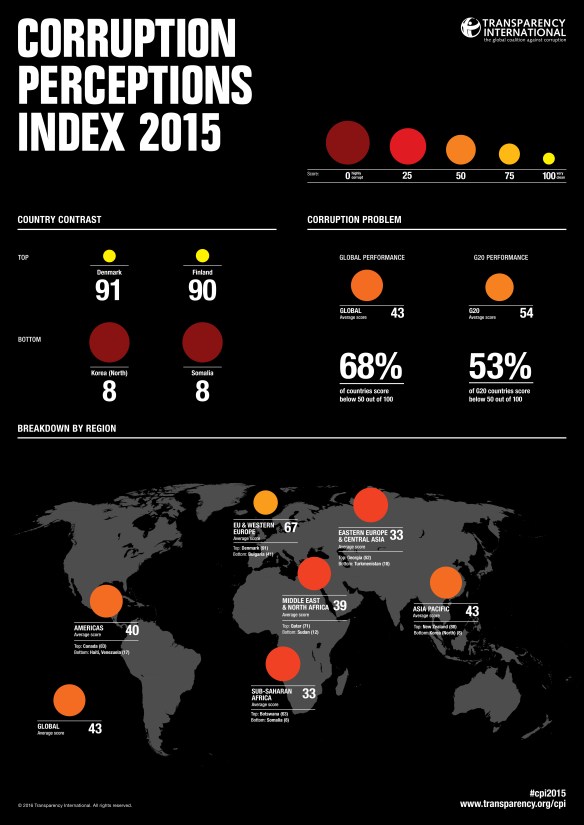
CPI2015_global_ENWorldwide two-thirds of the 168 countries which were tracked actually scored below 50 on a scale from 0 (perceived to be very corrupt) to 100 (perceived to be very clean)
The top spot went to Denmark for the second time in a row with a score of 91. The top ten countries are in the order of rank – Denmark, Finland, Sweden, New Zealand, Netherlands, Norway (joint 5th with Netherlands), Switzerland, Singapore, Canada and Germany

So what made Denmark score so well? According to Transperancy International, top performers share key characteristics: high levels of press freedom; access to budget information so the public knows where money comes from and how it is spent; high levels of integrity among people in power; and judiciaries that don’t differentiate between rich and poor, and that are truly independent from other parts of government.

Somalia and North Korea ended the list at the bottom with a score of only 8. The other countries in the bottom ten were Afghanistan, Sudan, South Sudan, Angola, Libya, Iraq, Venezuela and Guinea-Bissau. Conflict and war, poor governance, weak public institutions like police and the judiciary, and a lack of independence in the media characterise the lowest ranked countries.

CPI_2015_AsiaPacific_ENSo how do countries closer to home stack up? Hong Kong which is seen as a competitor to Singapore in many aspects was at 18 as was Japan. Singapore’s nearest neighbor and the closest ASEAN country is at 54 with the other ASEAN countries much below Malaysia. Thailand is next at 76, followed by Indonesia at 88, Philippines at 95, Vietnam at 112, Laos at 139, Myanmar at 147 and Cambodia bringing up the rear at 150.

India’s score of 38 made it at number 176 along with Bosnia and Herzegovina, Brazil, Bukina Faso, Thailand, Tunisia and Zambia. India’s closest neighbours fare as follows: Sri Lanka and China at 83, Pakistan at 117, Nepal at 130 and Bangladesh at 139.

The results are not that surprising given Singapore’s strong stance on corruption. The country publically names and shames those, especially civil servants and those in high office who are accused of corruption. They also employ legal proceedings against them and sentence them. Hence the high score, which, given how corruption is dealt in the country, could also be higher!

Now, in the other countries in South and Southeast Asia, corruption is a way of life. Corrupt economies do not function as well as non-corrupt ones as the very fact of corruption prevents the natural law of economy from functioning well and freely.
Many people just automatically add the cost of corruption to whatever they need to pay for, especially when dealing with government officials. It is due to this that most people do not have any faith in their public servants, elected or otherwise. Implementation of public services suffers as those need to be paid for, even if they are the basic essentials which every citizen is entitled to. Another casualty is justice as more often than not, justice is either delayed or denied as some of the judiciary may be in the pay of the offenders and let them go scot-free.

Corruption also leads to a loss of growth in that country’s economy as many investors would be reluctant, rightly so, to invest in the country, leading to unemployment or underemployment, lack of infrastructure and development of regions which need them the most. This in turn leads to regression of female empowerment, gender imbalance and female infanticide.

Reading the last two paragraphs make me realise all these are hallmarks of countries which have low Gross Domestic Product (GDP) which is the most commonly referenced figure which covers the national economy of any country and which is used to determined to estimate how wealthy or poor a country and it’s people. Click here and here to understand GDP and GDP with Purchasing Power Parity (PPP) which explains the concepts so much better than I can hope to…

CPI2015_map and country results

CPI2015_map
So where does your country stack up?

An Unforgettable Trip

While in India, one of our smaller trips was to Bangalore to meet my maternal grandmother who is nearing close to 90 and also to meet an uncle who is suffering from a double whammy of Alzheimer’s as well as Parkinson’s!

The four of us plus my mum were supposed to be taking IndiGo both ways, with us taking the 12:30 flight from Mumbai, reaching Bangalore around 2:15. The new airport in Bangalore is very, very far away from the city and to get to anywhere in the city is at least a 90 minute drive, this is assuming the horrendous traffic that Bangalore is famous for is clear and non-existent at that point! We’d planned for a two hour drive to my aunt’s place which is in one of the outer suburbs, the other side of the airport and which should take around 70 – 80 minutes at that time of the day and had expected to reach latest by 4 pm. We’d also arranged for a taxi to pick us up at the airport.

In the morning, while getting ready to leave, I got a message from the airline that the flight had been retimed to an hour later than it was supposed to leave. Though it was irritating, we shrug it off and changed our plans accordingly. We left around 10:30 which should get us to the airport around 11:15, which would be well in time for the 1:30 pm flight. On the way to the airport I received two messages from the airlines – one after the other, which now changed the flight’s departure time to 4 pm!

I was thus, quite upset when I reached the check-in counter. The person who checked us in told me that it was a technical problem and he could check us into the next flight to Bangalore which left at 3:45 pm. When asked, he said there was no guarantee that our scheduled 12:30 flight would make it at 4 pm, but the 3:45 flight was assured to leave on time. So we did the change and spoke to my dad. My dad was by that time not interested in us going to the city, he wanted us to cancel the tickets, get a refund and return home. My mum, on the other hand wanted to meet her mum, sisters and brothers-in-law. Around 3 pm, when we were waiting to start the boarding process, I got another message from the airline saying the 3:45 flight had now been postponed to 5:30 pm.

At this point, I completely lost it! The boarding gate area at this point was resembling a small town bus stand with passengers all over the place. The domestic airport didn’t even have decent places to eat and we were hungry, bored and super angry. I then went to the airline counter and spoke to one of the supervisors. What she told me was a completely different story from what the check-in guy told me. Her story was that since all their flights originate in the northern part of India and that part was fogged up, all flights were running 3-4 hours late, there was no technical problem at all!

Then me and another lady who had to get to Bangalore also urgently spoke to her and when I told her what I was told while checking in, she decided to get it reconfirmed. That was a lie I was told initially. Then that sweet lady (I did write down her name, but now I can’t find the paper) told us she will put us back in my original flight (the 12:30 one) which was now going to land shortly and depart for Bangalore at 5:30 pm.
We (the five of us plus the two of them) then were led out of the security area and had to re-checkin for the 5:30 flight. Clear security once again and then start the wait all over again. We finally got in the bus to get to the aircraft around 5:15 pm and when we reached the aircraft, we saw that all the passengers had not disembarked. What we saw made everyone on that bus comment again! We saw groups of people who used the gangway to take photos and selfies! This sheer selfishness of people really threw me away! These people have also been delayed by 3-4 hours and they know this flight has to go to another destination, yet they spend, nay waste precious moments taking pictures that they can do outside the plane.

We finally boarded and the flight left around 6 pm. We reached Bangalore around 7:15 and got to my aunt’s place at 9 pm! What was roughly a 6 hour journey door-to-door became an almost 12 hour one!

The return journey was nothing like what I wrote above! It was a breeze and what IndiGo is renowned for and we made it home by 3 pm (We had taken the same 12:30 flight from Bangalore to Mumbai)!

This is one trip that none of us are going to forget in a hurry I am sure!

Navroze Mubarak

Saal Mubarak! With these words, Parsis across the world would have greeted each other tomorrow as they heralded the arrival of their new year. Another greeting heard across the agiaries (Fire Temples) would have been Navroze Mubarak!

I studied for 12 years in a Parsi school and so this community holds a special place in my heart. This small, minority community comprises of the followers of Zarathustra. The Parsis in India are those who fled Persia (modern day Iran) due to religious persecution and arrived in western India (modern day Gujarat, Kutch in India and Sindh in Pakistan).

There’s a very sweet story that was told to me in school about the Parsis’ arrival in India. When they arrived in Gujarat, the leader of the Parsis, the head priest or Dastoorji, sent a messanger to the local king asking for his permission to stay in his land as refugees. The king sent back a bowl full of milk. The Dastoorji looked at the bowl of milk his messenger brought back, added a spoon of sugar to it and sent it back to the king. The King understood the message and gave them permission. Soon one of the people in the Parsi group asked the Dastoorji what just happened and he replied that the bowl of milk the king sent over indicated that the land was currently occupied and full and he didn’t want to do anything to disrupt the lives of his people. By mixing sugar in the milk, the Priest sent a message that the Parsis will do nothing to disrupt the land and it’s people and instead, like how sugar adds sweetness to the milk, they will assimilate into the land and only add to the sweetness of this land and not take away anything. And this is how the Parsis adapted the Gujarati way of life – in their language or dialect as well as the dress. Parsis speak a dialect of Gujarati, which we call Parsi Gujarati and women also adopted the saree as their main form of dress.

The more recent arrivals of Parsis, those who arrived in late 19th and early 20th centuries, fleeing from the repressions of the Qajar dynasty in Iran are differentiated from the original Parsi settlers and are called Iranis. This Irani community is smaller than the Parsi community, though both profess the same religion, but religious customs may be slightly different.

In the centuries that they have lived in India, the Parsis, have integrated themselves into the Indian society, while at the same time, maintaining their ethnic individuality.

This community has been faced with dwindling numbers for a while now, the most significant being childlessness or having less than two numbers (which is basically the total fertility rate) or migration. Demographic trends project that by the year 2020 the Parsis will number only 23,000 (less than 0.002% of the 2001 population of India). The Parsis will then cease to be called a community and will be labeled a ‘tribe’.

During the British rule of India, because this community was highly literate and extremely fluent in English, they occupied many important places in the East India Company.

One interesting aspect of the Parsis is that instead of burying or cremating their dead, they place their dead in a Tower of Death where vultures peck the body and pick it clean. Once the bones are bleached by the sun, they are pushed into the circular opening in the tower. They believe, this way is the most ecological way, where even the dead are used as food by vultures and no part of the polluted human body is pushed back into the earth (by burying it) or into the atmosphere (by cremating it).

The Parsi place pf worship is called an Agiary in the Parsi dialect or a Fire Temple in English. The most holy place for Parsis in India is a place called Udwada in Gujarat. Legend says that one of the groups of refugees brought with them the ash of one of sacred fires from Iran and this ash serves, even today, as the bed for the fire in the Udwada Agiary. I remember friends from school going to the Agiary which used to be opposite our school before important exams. Unfortunately, as a non-Parsi I can’t enter the Agiary.

The Parsis have made considerable contributions to the history and development of India, all the more remarkable considering their small numbers. As the maxim “Parsi, thy name is charity” reveals, their greatest contribution, literally and figuratively, is their philanthropy.

Happy Independence Day India

Tomorrow is India’s 68th Independence Day.

I have really mixed feeling about India – one on hand, it’s the land of my birth and there’s so much to love there, but the way people are literally destroying the country, makes me very sad. There’s so much potential there, but most people, especially the politicians seem to have made a game of “What can destroy India faster”!

An ancient civilization, which has given so much to the world, Indians are, in my opinion, more inward looking than outward looking. We are so much in love with our past that we tend to brush aside our present and give little or no thought to our future. We get so caught up in little and silly things, that we miss the forest for the trees!

The country is so rich and diverse, both geogrphically and culturally starting with the Himalayas in the north to the Indian Ocean to the south, the deserts of the Thar and the Rann of Kutch in the west to the hilly terrain of the exotic north-east. There are 25 states, 7 Union Territories and is the second most populous country in the world, after China with an estimated population of 1.21 billion who speak more than 1365 rationalised mother tongues with 29 languages having more than a million native speakers each!

India’s cultural history spans over 4,500 years and the foundations of India’s main religion, Hinduism was laid down as between 3500 to 2500 years ago, when most of the western world was probably cavemen! Probably this is why India was the rich bird, ripe for plucking through the ages – from the Persians, Greeks, Mongols, Mughals, to finally the English, Portuguese and the French. A lot of India’s historically rich treasures were plundered and taken away by the conquerors (and never returned till date)

According to the International Monetary Fund (IMF), as of April 2015, the Indian economy is nominally worth US$2.306 trillion; it is the 7th-largest economy by market exchange rates, and is, at US$7.996 trillion, the third-largest by purchasing power parity, or PPP.

All this talk about India has now made me super nostalgic. I remember reading how the last of the British soldiers left India from the shores of the Gateway of India in Bombay, an edifice, which ironically was constructed in 1911 to commemorate the visit of King George V and Queen Mary

Ok, going to stop with this nostalgia with a tune that many of us, especially those who grew up in a certain era will recognize…..Mile Sur Tera Mera….the original plus the new version

Raja Ravi Varma: India’s First Modern Artist

I want to preface this post with a disclaimer: I am not an artist or even someone with any knowledge of art. What I have written here is based on my research and knowledge. If there is any error in my post, please reach out to me and I will correct it and at the same time, learn something new.

In the past few weeks of posting, whenever I did a post on Indian culture, somehow, most of the pictures I got from Google (the ones I liked that is) turned out to be from Raja Ravi Varma’s collection. His paintings are super familiar to most Indians – his images of the different Gods and Goddesses are the ones we are used to seeing in our Pooja Rooms (family prayer rooms or altars) and so this inspired me to do find out more about the man whose work, about 2-3 generations of Indians have gazed at every single day and then do a post on him today, which is his 167th birth anniversary.

Raja Ravi Varma is considered among one of the finest painters in the history of Indian art and his paintings among the best examples of the fusion of Indian traditions with the techniques of European academic art. Raja Ravi Varma achieved recognition for his paintings from Indian literature and mythology including the epics of Ramayana and the Mahabharata.

Raja Ravi Varma was born in the erstwhile princely state of Travancore in today’s Kerala state today in the year 1948 in a royal family which was very accomplished in the arts. He was patronized by the Maharajah of Travancore and then began formal training with the learning of the basics of painting in Madurai, Tamil Nadu and then trained in water painting by Rama Swami Naidu and then in oil paintings by the Dutch portraitist Theodor Jenson.

His exposure in the west came when he won the first prize in the Vienna Art Exhibition in 1873. In the World Columbian Exposition in Chicago in 1893, he received three gold medals and then teavelled all over India in search of subjects for his paintings.

He also started a lithographic printing press, initially in Mumbai and then near Lonavala (near Mumbai) and the oleographs printed were very popular and continue to be printed even today.

Among the various honours he received, the Kaiser-i-Hind, bestowed by the then Vicerory, Lord Curzon in 1904 on behalf of the British King was the highest. Considering his vast contribution to Indian art, the Government of Kerala has instituted an award called “Raja Ravi Varma Puraskaram”, which is awarded every year to people who show excellence in the field of art and culture.

Raja Ravi Varma died on 02 October 1906 at the age of 58, but his art still lives and delights peoples even today.

Below are some of the prints we generally see in Indian homes – mostly the Gods and Goddesses of the Indian pantheon….

Goddess Saraswati

Goddess Lakshmi

Some other famous paintings:

Lady with Fruit

Lady in the Moonlight