The other day, while randomly clicking links, I came across an article which spoke about intelligence not as a single entity as we know but splitting it into nine different types. The more I read, the more it made sense to me. We all may not be intelligent in the traditional sense, which when you are in school means scoring more marks, but you could be street smart or even people smart which may actually stand you in better stead than being just book smart!
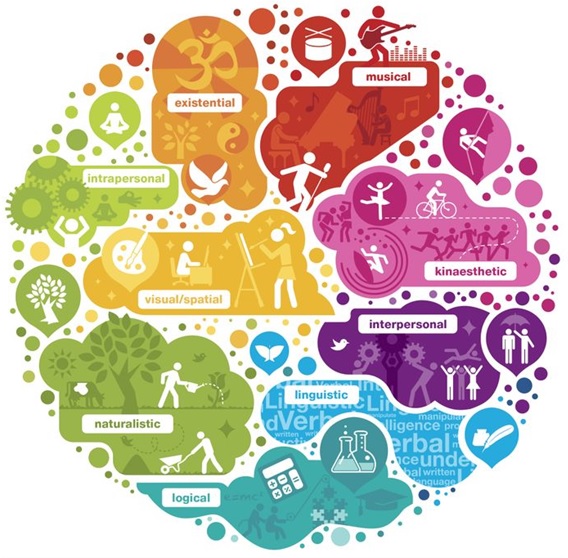
The theory of multiple intelligence was first coined by Howard Gardner who proposed this model in his 1983 book Frames of Mind: The Theory of Multiple Intelligences. According to Gardner, an intelligence must fulfil eight criteria: musical-rhythmic, visual-spatial, verbal-linguistic, logical-mathematical, bodily-kinesthetic, interpersonal, intrapersonal, and naturalistic.
Musical-rhythmic and harmonic or Sound Smart:
This area has to do with sensitivity to sounds, rhythms, tones, and music. People with a high musical intelligence normally have good pitch and may even have absolute pitch, and are able to sing, play musical instruments, and compose music. They have the sensitivity to rhythm, pitch, meter, tone, melody or timbre. Musical intelligence is the capacity to discern pitch, rhythm, timbre, and tone. This intelligence enables us to recognise, create, reproduce, and reflect on music, as demonstrated by composers, conductors, musicians, vocalist, and sensitive listeners. Interestingly, there is often an affective connection between music and the emotions; and mathematical and musical intelligence may share common thinking processes.
Visual-spatial or Picture Smart:
This area deals with spatial judgment and the ability to visualize with the mind’s eye. Spatial ability is one of the three factors beneath g in the hierarchical model of intelligence. Spatial intelligence is the ability to think in three dimensions. Core capacities include mental imagery, spatial reasoning, image manipulation, graphic and artistic skills, and an active imagination. Sailors, pilots, sculptors, painters, and architects all exhibit spatial intelligence.
Verbal-linguistic or Word Smart:
People with high verbal-linguistic intelligence display a facility with words and languages. They are typically good at reading, writing, telling stories and memorizing words along with dates. Linguistic intelligence is the ability to think in words and to use language to express and appreciate complex meanings. Linguistic intelligence allows us to understand the order and meaning of words and to apply meta-linguistic skills to reflect on our use of language. Linguistic intelligence is the most widely shared human competence and is evident in poets, novelists, journalists, and effective public speakers.
Logical-mathematical or Numbers or Reasoning Smart:
This area has to do with logic, abstractions, reasoning, numbers and critical thinking. This also has to do with having the capacity to understand the underlying principles of some kind of causal system. Logical reasoning is closely linked to fluid intelligence and to general intelligence. Logical-mathematical intelligence is the ability to calculate, quantify, consider propositions and hypotheses, and carry out complete mathematical operations. It enables us to perceive relationships and connections and to use abstract, symbolic thought; sequential reasoning skills; and inductive and deductive thinking patterns. Logical intelligence is usually well developed in mathematicians, scientists, and detectives.
Bodily-kinesthetic or Body Smart:
The core elements of the bodily-kinesthetic intelligence are control of one’s bodily motions and the capacity to handle objects skilfully.Gardner elaborates to say that this also includes a sense of timing, a clear sense of the goal of a physical action, along with the ability to train responses. People who have high bodily-kinesthetic intelligence should be generally good at physical activities such as sports, dance, acting, and making things. Bodily kinesthetic intelligence is the capacity to manipulate objects and use a variety of physical skills. This intelligence also involves a sense of timing and the perfection of skills through mind–body union. Athletes, dancers, surgeons, and crafts people exhibit well-developed bodily kinesthetic intelligence.
Interpersonal or Self Smart:
In theory, individuals who have high interpersonal intelligence are characterized by their sensitivity to others’ moods, feelings, temperaments, motivations, and their ability to cooperate in order to work as part of a group. Those with high interpersonal intelligence communicate effectively and empathize easily with others, and may be either leaders or followers. They often enjoy discussion and debate. Interpersonal intelligence is the ability to understand and interact effectively with others. It involves effective verbal and nonverbal communication, the ability to note distinctions among others, sensitivity to the moods and temperaments of others, and the ability to entertain multiple perspectives. Teachers, social workers, actors, and politicians all exhibit interpersonal intelligence.
Intrapersonal or People Smart:
This area has to do with introspective and self-reflective capacities. This refers to having a deep understanding of the self; what one’s strengths or weaknesses are, what makes one unique, being able to predict one’s own reactions or emotions. Intra-personal intelligence is the capacity to understand oneself and one’s thoughts and feelings, and to use such knowledge in planning and directioning one’s life. Intra-personal intelligence involves not only an appreciation of the self, but also of the human condition. It is evident in psychologist, spiritual leaders, and philosophers.
Naturalistic or Nature Smart:
Not part of Gardner’s original seven, naturalistic intelligence was proposed by him in 1995. This area has to do with nurturing and relating information to one’s natural surroundings.This sort of ecological receptiveness is deeply rooted in a “sensitive, ethical, and holistic understanding” of the world and its complexities – including the role of humanity within the greater ecosphere. Naturalist intelligence designates the human ability to discriminate among living things (plants, animals) as well as sensitivity to other features of the natural world (clouds, rock configurations). This ability was clearly of value in our evolutionary past as hunters, gatherers, and farmers; it continues to be central in such roles as botanist or chef. It is also speculated that much of our consumer society exploits the naturalist intelligences, which can be mobilized in the discrimination among cars, sneakers, kinds of makeup, and the like.
Existential or Life Smart:
Gardner did not want to commit to a spiritual intelligence, but suggested that an “existential” intelligence may be a useful construct, also proposed after the original 7 in his 1999 book. Sensitivity and capacity to tackle deep questions about human existence, such as the meaning of life, why we die, and how did we get here.
Gardner also opposed the idea of labeling learners to a specific intelligence and maintained that his theory of multiple intelligences should “empower learners”, not restrict them to one modality of learning. According to Gardner, an intelligence is “a biopsychological potential to process information that can be activated in a cultural setting to solve problems or create products that are of value in a culture.
Even after so many years of this theory being proposed, there is still controversy about it. I am not a psychologist, but this theory does make sense to me. I know that not everyone can be defined as ‘traditionally intelligent’ and this theory does put to rest why some people are widely successful in varied fields. Take music for example. Every years, hundreds of thousands of aspiring musicians audition for jobs and reality shows, but there are just a handful who are successful. That’s probably because they are blessed with musical intelligence, which a whole bunch of the others do not possess. This does make you think, right?
There are a couple of sites which allow you to take a test to determine which intelligence is your dominant one. I did one and no surprises there, at least for me – I got linguistic ability overwhelmingly which is right in my mind.
This is what the result said about me “Your dominant intelligence type is linguistic/verbal or in other words… you are word smart! You have an eloquent and sophisticated way of expressing yourself verbally as well as in writing.
You are passionate about literature, history and current events. You also have a knack for pursuing and learning new languages. You have a charismatic personality and because of you are talented in many areas of communicating, you also have strong interpersonal and intrapersonal skills. You are social, people smart and extremely self-aware.
If you want to do the same test, here’s the test link
Do you agree with Gardner’s theory of multiple intelligence? I’d love to hear what you got? Please do comment below….


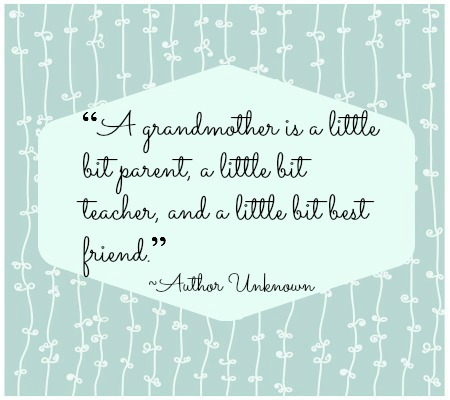 When I woke up this morning, the first thing I thought of today was my paternal grandmother. Somehow I kept thinking about her and thought I should dedicate this post to her.
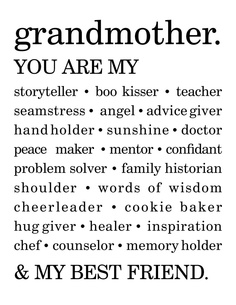 Actually, there’s a story to why I called her ammama. Growing up, it seemed normal to me to call both my grandmothers by this name. I realised that it was different when I heard others call their grandmothers pati which in Tamil means grandmother. But I never really gave it a thought. Following my example, my sister and later other cousins from my maternal side also started calling our maternal grandmother as ammama and used to call their paternal grandma as pati. Years later, probably after I became a mother myself and my mother became a pati, I asked her why I used to call my grandmothers ammama? Her answer actually made me pause because apparently, it was my paternal grandmother who wished that I used this name to call her. I never had the chance to ask her this question, but I guess she must have been quite young when I was born and a streak of vanity in her didn’t want her to officially become a grandmother so young! So by making us call her ammama, she didn’t become a pati, yet we had a unique name to call her.
 Memories and Such