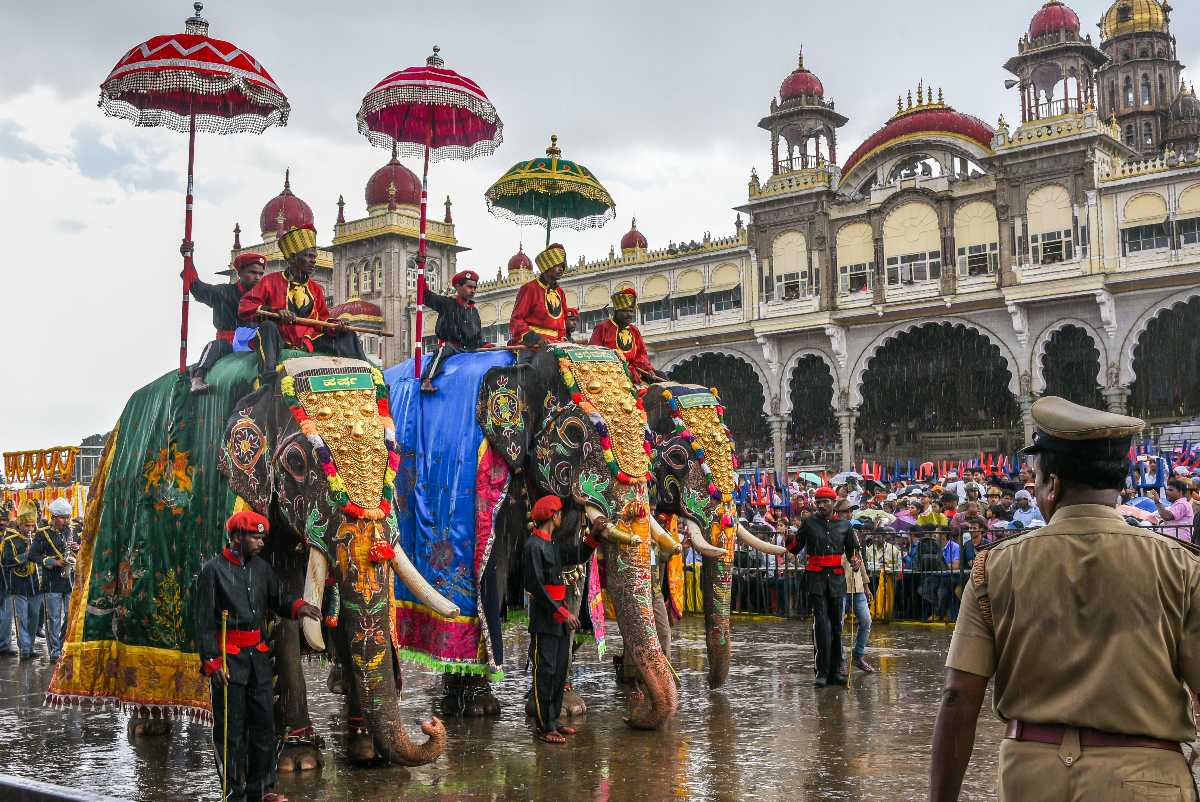
Festivals of India: Mysuru Dasara

Karnataka’s state festival or Nadahabba, the Dasara festival in Mysore is a 10-day festival, starting with the nine nights of Navaratri and the last day being Vijayadashami or Dasara. The festival is observed on the tenth day in the Hindu calendar month of Ashvina, which typically falls in the Gregorian months of September and October. The 10-day extravaganza marks the triumph of good over evil and pays homage to the goddess Chamundeshwari, the presiding deity of Mysuru.

Dasara, Navratri and Vijayadashami was the day in Hindu mythology when Goddess Chamundeshwari or Goddess Durga killed the demon Mahishasura, whose slaying by the Goddess gave the city its name of Mysuru. The Mysuru tradition celebrates the warriors and the state fighting for the good during this festival, ritually worshipping and displaying the state sword, weapons, elephants, and horses along with the Hindu Devi goddess in her warrior form, predominantly as well as the Vishnu avatar of Lord Rama. The origins of the Dasara festival can be traced back to ancient Hindu mythology, specifically the great epic, Ramayana. It is believed that Lord Rama, the seventh avatar of Lord Vishnu, worshipped the goddess Durga before embarking on his journey to rescue his wife, Sita, from the demon king Ravana. In commemoration of the divine blessings bestowed upon him, Lord Rama emerged victorious on the day of Vijayadashami, the tenth day of the festival. The ceremonies and a major procession are traditionally presided by the king of Mysuru.

The Dasara festivities began with the Vijayanagar kings as early as the 14th or 15th century and played a historical role in the 14th-century Vijayanagara Empire, where it was called Mahanavami and the festivities are shown in the relief artwork of the outer wall of the Hazara Rama temple of Hampi. The Italian traveller Niccolò de’ Conti described the festival’s intensity and importance as a grandeur religious and martial event with royal support. The event revered Durga as the warrior goddess or Chamundeshwari and hosted athletic competitions, singing and dancing, fireworks, a pageantry military parade and charitable giving to the public.

After the fall of the Vijayanagar to the Deccan Sultanates, these Hindu celebrations came to an end under Muslim rulers. The Wodeyars of Mysore formed a kingdom in Southern parts of the Vijayanagara Empire and continued the Mahanavami or Dasara festival celebration, a tradition started initially by Raja Wodeyar I in mid-September 1610 at Srirangapatna. The city of Mysuru has a long tradition of celebrating the Dasara festival with grandeur and pomp. The Dasara festival in Mysuru completed its 409th anniversary in 2019. Over the centuries, the Dasara festival evolved and assimilated various regional customs and traditions, ultimately becoming an essential part of Mysuru’s cultural identity. The festival showcases the city’s rich heritage and its reverence for its ruling family, the Wadiyars, who have played a pivotal role in preserving and promoting the festival’s grandeur.
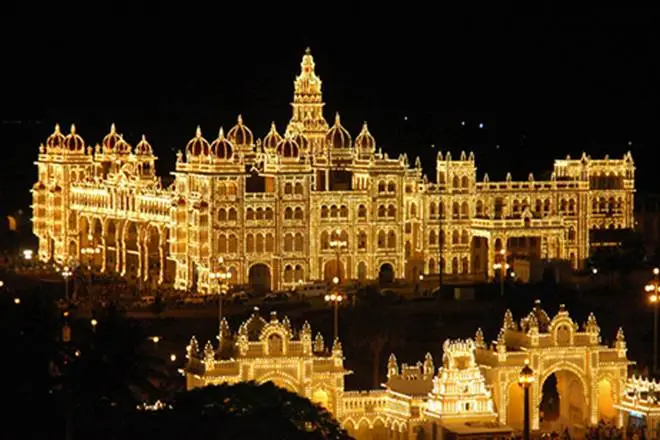
The festival is the jewel in the city’s crown and the entire city springs into action. Adorned with colourful lights and decorations, the iconic Mysuru Palace, a masterpiece of Indo-Saracenic architecture, takes centre stage as it is beautifully illuminated with nearly 100,000 light bulbs from 7 to 10 pm on all days of the festival, presenting a breathtaking sight. The Nadahabba is inaugurated with great fanfare at the Mysuru Palace by the current scion of the royal family. Dressed in traditional regal attire, the Wadiyars carry the golden idol of the goddess Chamundeshwari in a magnificent procession, accompanied by traditional music, dance, and the beats of ceremonial drums. The spirit of the festival is infectious as locals and visitors alike gather to witness this majestic spectacle. The intricate floral rangoli, known as Rangoli Patha, adorn the palace grounds, and the aromatic fragrance of flowers fills the air, adding to the festive ambience. Various cultural and religious programs highlighting the dance, music and culture of the State of Karnataka are performed in front of the illuminated Palace.

The heart of Dasara lies in the nine nights of Navaratri, a time to celebrate the various forms of the divine goddess. Mysuru becomes a cultural haven during this period, with vibrant performances of classical music, dance, and folk arts taking place at various venues across the city.
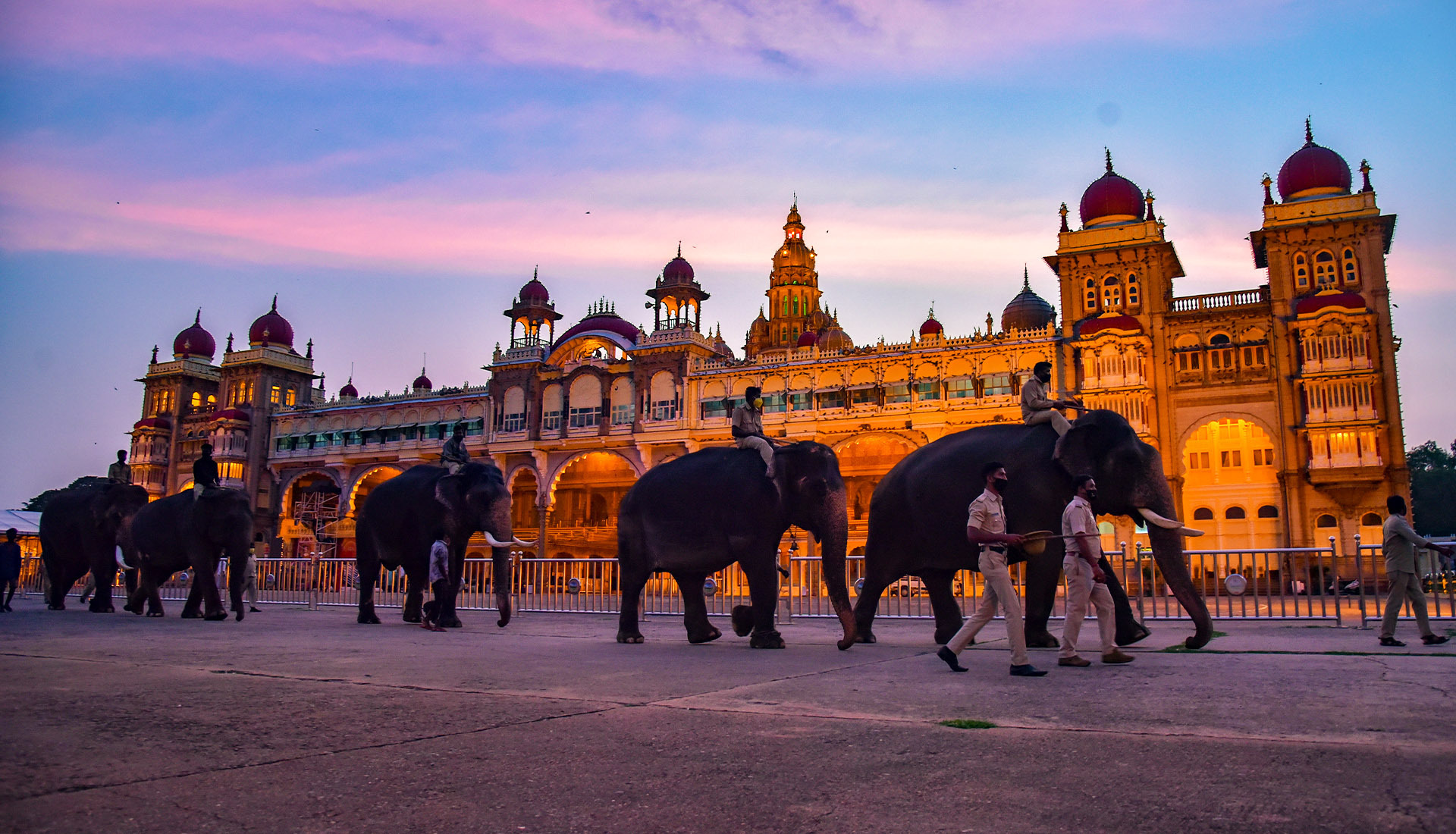
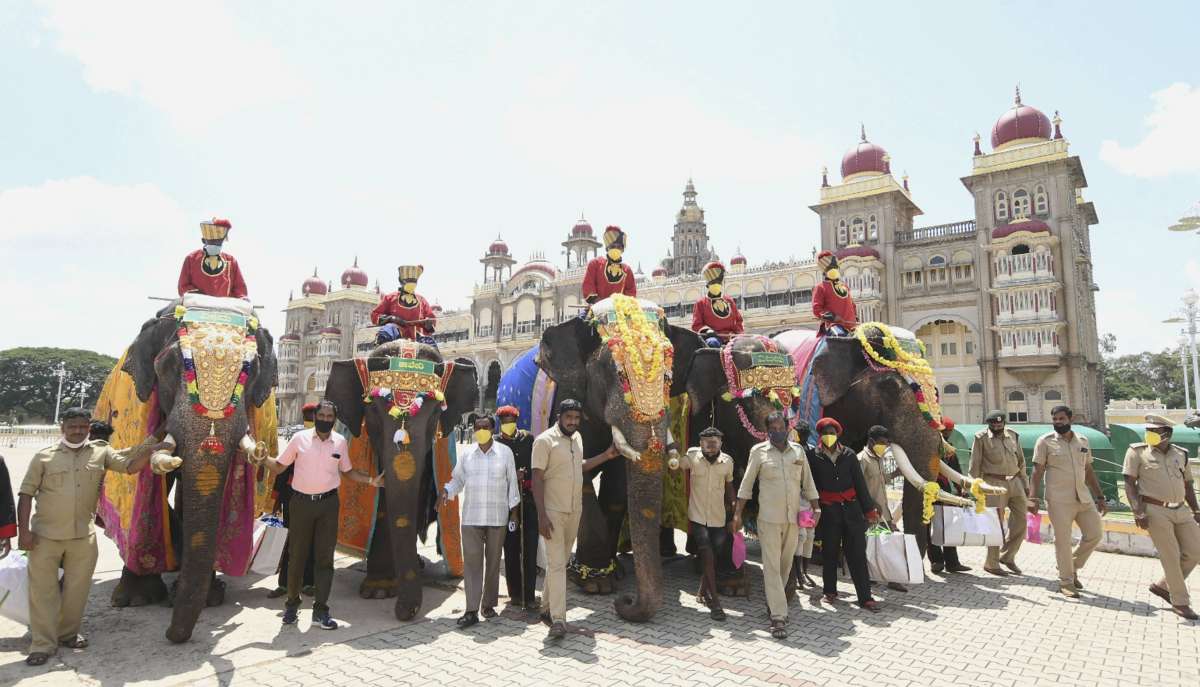
The grand finale of the Dasara festival is the Vijayadashami procession, a regal pageantry that captivates all. The streets of Mysuru come alive with an unending sea of spectators, eagerly awaiting the arrival of the adorned elephant carrying the idol of goddess Chamundeshwari. The traditional Dasara procession, locally known as Jumboo Savari is held on the streets of Mysuru. The main attraction of this procession is the idol of the Goddess Chamundeshwari which is placed on a golden mantapa, made out of 750 kg of gold on the top of a decorated elephant. This idol is worshipped by the royal couple and other invitees before it is taken around in the procession. Colourful tableaux, dance groups, music bands, decorated elephants, horses and camels form a part of the procession which starts from the Mysore Palace and culminates at a place called Bannimantap where the Banni tree or Prosopis spicigera is worshipped.

According to a legend from the Mahabharata, the banni tree was used by the Pandavas to hide their weapons during their one-year period of Agnatavasa where they had to live incognito. Before undertaking any warfare, the kings traditionally worshipped this tree to help them emerge victorious in war. The Dasara festivities would culminate on the night of Vijayadashami with an event held on the grounds at Bannimantap called Panjina Kavayatthu or the torch-light parade.

The procession features beautifully decorated tableaux showcasing the city’s rich history and mythological stories. Folk dancers, performers, and cultural troupes from across the state add a vibrant touch to the procession, reiterating Karnataka’s diverse cultural heritage. The procession culminates with a breathtaking display of traditional music and fireworks, illuminating the night sky and leaving spectators in awe. After the Jamboo Savari, a torchlight parade takes place in the evening at the Bannimantap Parade Grounds.

The famous Mysuru Dasara Exhibition, held in the exhibition grounds opposite the Mysore Palace is a major highlight, where a carnival-like atmosphere enthrals visitors with thrilling rides, games, and mouthwatering street food. Local artisans and craftsmen showcase their talents in the exhibition, adding a touch of traditional artistry to the festivities. The exhibition was started by the Maharaja of Mysore, Chamaraja Wodeyar X in 1880 with the sole aim of introducing timely developments to the people of Mysore. The task of holding the exhibition is now entrusted to the Karnataka Exhibition Authority or KEA. This exhibition starts during Dasara and goes on till December. A play area containing attractions like a Ferris wheel is also present to provide entertainment and various Governmental agencies set up stalls to signify the achievements and projects that they have undertaken.
The Dasara Sports Meet, reminiscent of the days of the Maharajas, draws enthusiastic participants and spectators alike. The traditional sport of Kusti or wrestling and other indigenous games and races bring back the nostalgic charm of a bygone era and attract wrestlers from all around India. On all the 10 days of Dasara, various music and dance concerts are held in auditoriums around Mysore city. Musicians and dance groups from all over India are invited to perform on this occasion.

The Dasara procession has faced increasing pressure from activists and campaigners to end its controversial use of elephants. Procession elephants, as well as their handlers known as mahouts, have died from several shocking incidents over the years. In 2018, leaked footage from the elephants’ training ground showed an elephant swaying in distress. International press labelled the video heartbreaking and reported on how the elephants must undergo two months of rigorous training to perform in the procession.

Dasara in Mysuru is not just a festival; it is a testament to the city’s deep-rooted heritage and the enduring spirit of its people. It is festivals like this, that help us to cherish and preserve our cultural legacies for generations to come.

2023 Week 41 Update

Renowned American author, motivational speaker, and sales trainer Zig Ziglar, best known for his charismatic speaking style and his motivational books and seminars, is the source of today’s quote. This quote conveys the idea that achieving greatness or success doesn’t require innate greatness or exceptional abilities from the beginning. Instead, it emphasises the importance of taking the initial step, starting somewhere, and consistently working towards your goals. The quote underscores the significance of beginning the journey towards goals, ambitions, or personal growth. It suggests that everyone has to start somewhere, regardless of their current skills or abilities. The act of starting is the first step, and from there, it’s about consistent effort and improvement over time. It encourages individuals not to be discouraged by their initial limitations or self-doubt. The belief is that greatness can be attained through dedication, learning, and hard work. The quote implies that waiting for perfection or greatness to arrive before starting is counterproductive. Instead, it suggests that progress and greatness are the results of action and persistence. Zig Ziglar’s quote motivates individuals to take that first step toward their aspirations, reminding them that even small beginnings can lead to great achievements over time. It emphasises the transformative power of action and the importance of perseverance on the path to greatness.

In the last month, I have not been walking as much as I used to, partly because of work and also since R has gone back to India, I need to do housework which eats into my walking time. So I have decided not to obsess too much about this and walk only as much as I can until R is back. Hopefully, she will be back soon and I can start walking again.

BB will enlist very soon and as much as he hates it, I am hugging him as much as I can. My hope and prayers for him are that he enjoys his time there and becomes a better version of himself in the next two years.

That’s all from me this week. Stay positive and enjoy life!

In My Hands Today…

Firestarters: How Innovators, Instigators, and Initiators Can Inspire You to Ignite Your Own Life – Raoul Davis Jr., Paul Eder and Kathy Palokoff

What is the difference between those bold enough to pursue their dreams and others who never get comfortable enough to ignite their lives? The doers are “Firestarters” and, because of them, the world is a much different, and often, better place.

This motivational how-to book provides insights into the crucial difference between people who make things happen and those who only think about making an impact. Based on research from many disciplines and interviews with professionals at the top of their fields, Firestarters creates a complete roadmap to achieve personal success and make an impact in the world.

The heart of the book features stories about successful entrepreneurs, CEOs, organizational leaders, and forward-looking thinkers from a variety of professions. They describe the factors and conditions that ignited their lives and helped them become achievers. Some are known to the public; others will be completely new. But all the stories demonstrate how they became–and you can become–a Firestarter.

The authors provide pragmatic advice on how individual readers can ignite the qualities that will lead them toward pursuing and realizing their dreams. Self-assessment exercises, checklists, and other tools will help readers apply Firestarter insights to their own lives. Also included are group exercises and discussion guides so the book can be used in business and nonprofit settings to develop the skills that help companies grow.

Whether you’re an individual seeking ways to realize personal ambitions or a leader trying to motivate your team, you’ll benefit from the Firestarter methods featured in this inspirational book.

Friday the 13th: A day shrouded in Enigma and Mystery

Today is Friday the 13th – a date shrouded in mystery and fear, often associated with bad luck, curses, and eerie happenings. For centuries, this particular day has sparked a multitude of myths and superstitions, captivating the minds of people across various cultures.

In Norse mythology, the day was named after Frigg, the goddess of love and fertility, which led to it being called Frigg’s Day eventually evolving into Friday. Frigg’s counterpart in Roman mythology was Venus, the goddess of love, beauty, and fertility, further cementing the association of Friday with a divine feminine presence. In medieval Christian Europe, it gained an unfortunate reputation due to its connection to events considered ill-fated. For instance, some Christians believed that Eve tempted Adam with the forbidden fruit on a Friday, and it was also considered the day on which Cain murdered his brother Abel.

The superstition surrounding the number 13 is known as triskaidekaphobia and the fear of Friday the 13th is known as friggatriskaidekaphobia or paraskevidekatriaphobia. Friggatriskaidekaphobia comes from Frigg, the Norse goddess of wisdom after whom Friday is named, and the Greek words triskaideka, meaning 13, and phobia, meaning fear. Paraskevidekatriaphobia is also derived from Greek, where paraskeví translates as Friday, and dekatria is another way of saying 13. Experts say that friggatriskaidekaphobia affects millions of people and estimate that businesses, especially airlines, suffer from severe losses on Friday the 13th. Triskaidekaphobia, or the fear of the number 13, is even more widespread. So much so that many high-rise buildings, hotels, and hospitals skip the 13th floor, and many airports do not have gates numbered 13. In many parts of the world, having 13 people at the dinner table is considered bad luck.

Its roots can be traced back to various historical and cultural sources. One widely held belief links it to the Last Supper, where there were 13 individuals present, including Jesus and his twelve disciples. Judas Iscariot, the apostle who later betrayed Jesus, is often associated with the number 13, adding to the ominous reputation of this numeral.

Western culture perceives the number 12 as a symbol of completeness and harmony with 12 months in a year, 12 zodiac signs, 12 days of Christmas, 12 labours of Hercules, and 12 tribes of Israel, among others. In contrast, the number 13 was considered irregular and unbalanced, evoking feelings of discomfort and unease and a long history as a sign of bad luck.

The fusion of Friday and the number 13 to create Friday the 13th is a relatively recent phenomenon, believed to have gained prominence in the 19th century. Despite its rather recent concoction, the fear and superstitions surrounding this date have become deeply ingrained in popular culture worldwide. Over time, numerous myths and legends have emerged, further fueling the aura of Friday the 13th.

One of the most enduring legends associated with Friday the 13th is the curse of the Knights Templar. The Knights Templar, a medieval Christian military order, faced persecution and were eventually disbanded by King Philip IV of France on Friday, October 13, 1307. According to the legend, the Grand Master of the Templars, Jacques de Molay, placed a curse upon those responsible for their destruction, vowing that they would face misfortune. This curse is said to be the reason behind the superstitions surrounding Friday the 13th. Another popular belief related to Friday the 13th is its association with the full moon. While both Friday and the number 13 have their respective superstitions, the combination of the two is believed to intensify the perceived malevolence of this day, leading to heightened supernatural occurrences and erratic behaviour.

In the late-19th century, a New Yorker named Captain William Fowler (1827-1897) sought to remove the enduring stigma surrounding the number 13 — and particularly the unwritten rule about not having 13 guests at a dinner table — by founding an exclusive society called the Thirteen Club. The group dined regularly on the 13th day of the month in room 13 of the Knickerbocker Cottage, a popular watering hole Fowler owned from 1863 to 1883. Before sitting down for a 13-course dinner, members would pass beneath a ladder and a banner reading “Morituri te Salutamus,” Latin for “Those of us who are about to die salute you.”

In more recent times, several traumatic events have occurred on Friday the 13th, including the German bombing of Buckingham Palace in September 1940; the murder of Kitty Genovese in Queens, New York in March 1964; a cyclone that killed more than 300,000 people in Bangladesh in November 1970; the disappearance of a Chilean Air Force plane in the Andes in October 1972; the death of rapper Tupac Shakur in September 1996 and the crash of the Costa Concordia cruise ship off the coast of Italy, which killed 30 people in January 2012.

In some cultures, Friday the 13th is considered an inauspicious day for travel. It is believed that embarking on a journey on this date may lead to unfortunate incidents or accidents during the trip. Many individuals tend to avoid making important decisions or initiating new endeavours on Friday the 13th. The fear of potential bad luck or negative outcomes often prompts people to postpone crucial life choices until the day has passed.

So why are people scared of Friday the 13th? The fear of Friday the 13th, known as paraskevidekatriaphobia, is surprisingly widespread, impacting millions of people worldwide. But why does this particular date invoke such dread and trepidation? Several factors contribute to this phenomenon.

Cultural conditioning plays a significant role in shaping our beliefs and perceptions. From an early age, many of us are exposed to stories, movies, and media that depict Friday the 13th as a day of ill fortune. As these beliefs become deeply ingrained, they can manifest as genuine fear in adulthood. Confirmation bias refers to our tendency to interpret events in a way that confirms our preexisting beliefs. On Friday the 13th, people might be more vigilant and pay extra attention to any negative or unfortunate incidents, reinforcing the belief that the day is indeed cursed. The collective belief in the unluckiness of Friday the 13th can create a self-fulfilling prophecy. When so many people are apprehensive about a specific date, their shared energy and anxiety can influence their experiences and interactions, potentially leading to a heightened sense of negativity on that day. Superstitions can evoke genuine fear and anxiety in individuals. When people genuinely believe that something is unlucky or cursed, it can trigger physiological responses, such as increased heart rate, sweating, and feelings of unease. These reactions can reinforce the perception that the day is genuinely dangerous.

Friday the 13th remains an enigma that has captivated the human imagination for centuries. Its origins in the amalgamation of a day associated with the divine feminine and a number steeped in superstition have given rise to a host of myths and legends. As people continue to fear this date, it’s essential to recognise the power of collective beliefs and the impact of cultural conditioning on our perception of luck.

Source

So, take a moment today to reflect on the fascinating history and myths surrounding it. Perhaps this day is not as foreboding as it seems, and the fear can be put to rest, allowing us to embrace the beauty of the unknown without the weight of superstition.

In My Hands Today…

Without Ever Reaching the Summit: A Journey – Paolo Cognetti, translated by Stash Luczkiw

Why climb a mountain without ever reaching the summit?

In 2017, Paolo Cognetti returned to Nepal, not to conquer the mountains but to journey through the high valleys of the Dolpo with a copy of Peter Matthiessen’s The Snow Leopard in hand. Drawing on memories of his childhood in theAlps, Cognetti explored the roots of life in the mountains, truly getting to know the communities and the nature that forged this resilient, almost mythical region.

Accompanying him was Remigio, a childhood friend who had never left the mountains of Italy, and Nicola, a painter he had recently met. Joined by a stalwart team of local sherpas, the trio started out in the remote Dolpo region of Nepal. From there, a journey of self-discovery shaped by illness, human connection, and empathy was born.

Without Ever Reaching the Summit features line illustrations drawn by the author.