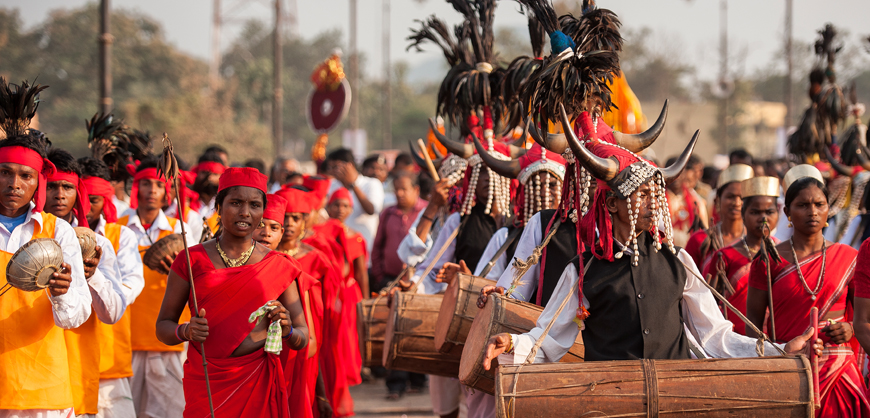
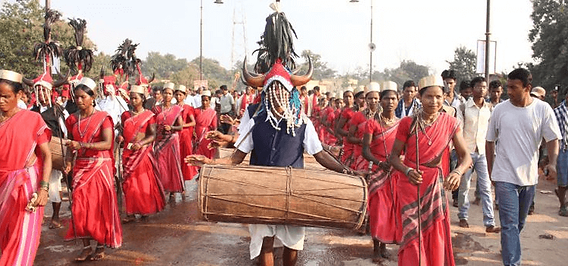
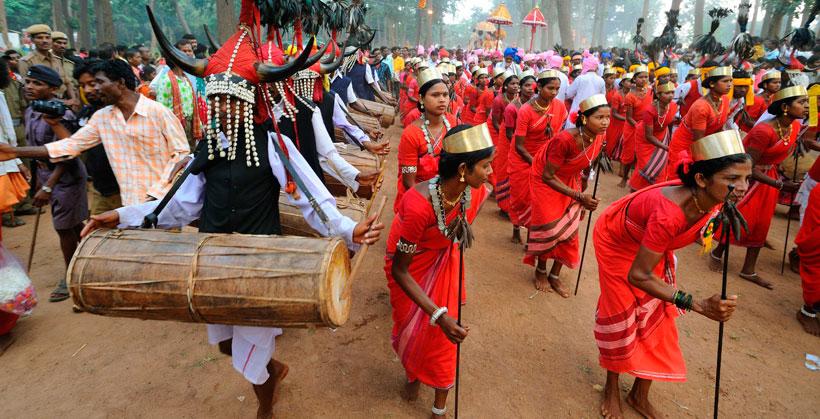
Bastar Dussehra is not just a festival; it is a grand cultural phenomenon that transcends the conventional understanding of Dussehra. Celebrated in the tribal heartland of Chhattisgarh, this festival is a vibrant tapestry of ancient traditions, spiritual fervour, and community unity. Unlike the rest of India, where Dussehra marks the victory of Lord Rama over Ravana, Bastar Dussehra is a unique celebration dedicated to Goddess Danteshwari, the revered deity of the region. Spanning an astonishing 75 days, it is one of the longest festivals in the world, deeply rooted in the history and culture of the Bastar region.
The origins of Bastar Dussehra trace back to the 15th century, during the reign of Maharaja Purushaottam Deo of the Kakatiya dynasty. Legend has it that Maharaja Purushaottam Deo, a devout follower of Lord Jagannath of Puri, undertook a year-long pilgrimage to the Jagannath Temple. Pleased by his devotion, Lord Jagannath gifted him a massive wooden chariot with 16 wheels for his return journey. However, due to the chariot’s unwieldy size, it was divided into two parts: one with 12 wheels and the other with 4 wheels. These chariots became integral to the Dussehra celebrations in Bastar, symbolising the divine connection between the king and the deity.
Another narrative suggests that the festival was initiated to unite the diverse tribal communities of Bastar under a common cultural umbrella. The festival, which began in Bade Dongar, the capital of the Kakatiya rulers, was later shifted to Jagdalpur during the reign of Maharaja Dalpat Deo in the 17th century. This move was aimed at integrating the local tribes and preserving their unique traditions, which continue to thrive to this day.
Bastar Dussehra is a multi-faceted celebration that involves a series of rituals, ceremonies, and community events. The festival begins on the new moon day of the Hindu month of Shravan in July-August and culminates on the 13th day of Ashwin in September-October.
The festival commences with the Pat Jatra ritual, where the first log of wood is brought from the forest to construct the grand chariot for Goddess Danteshwari. This ritual is a symbolic act of worshiping the forest and its resources, reflecting the deep connection between the tribal communities and nature. The wood is meticulously selected and transported using traditional methods, with the participation of various tribal groups.
Following the Pat Jatra, the construction of the chariot begins in a ceremony known as Deri Gadhai. Carpenters from different villages come together to build a two-storied chariot, which will later carry the idol of Goddess Danteshwari during the Rath Yatra. This process is a testament to the collective effort and unity of the tribal communities, each contributing their skills to the grand endeavour.
The highlight of Bastar Dussehra is the Rath Yatra, where the idol of Goddess Danteshwari is placed on the chariot and paraded through the streets of Jagdalpur. This procession is accompanied by traditional music, dance, and the fervent participation of the local populace. The Rath Yatra symbolises the journey of the goddess from her temple to the city, blessing the people and the land.
The festival concludes with the Muria Darbar, a unique democratic assembly where the Maharaja of Bastar listens to the grievances and requests of the people. This ritual underscores the egalitarian ethos of the tribal communities, where every voice is heard and respected. The Muria Darbar is a fitting end to the festival, reinforcing the bonds of community and governance.
Bastar Dussehra is steeped in legends and stories that add to its mystique and cultural significance. One of the most prominent legends revolves around the spiritual powers of a young girl who plays a crucial role in the transfer of power during the festival. Before the Diwan or the chief minister assumes control of the state, a girl believed to be possessed by divine energy is consulted for her approval. She stands with a wooden sword in a warrior-like posture, symbolising the protective power of the goddess.
Another fascinating aspect of Bastar Dussehra is the absence of the burning of Ravana’s effigy, a common practice in other parts of India. Instead, the festival focuses on the worship of Goddess Danteshwari and the coming together of various tribal deities. This unique feature highlights the festival’s emphasis on spiritual harmony and preserving indigenous traditions.
Bastar Dussehra is more than just a religious festival; it celebrates the rich cultural heritage of the Bastar region. The festival brings together the diverse tribal communities of Bastar, each contributing their unique customs, music, and dance to the grand celebration. This cultural amalgamation reminds us of the region’s historical unity and the resilience of its traditions in the face of modernisation.
The festival also plays a crucial role in promoting tourism in Bastar, attracting visitors from across the country and the world. The vibrant rituals, traditional crafts, and tribal performances offer a glimpse into the region’s unique cultural landscape, making Bastar Dussehra a must-see event for cultural enthusiasts.
Bastar Dussehra is a testament to the enduring spirit of the tribal communities of Chhattisgarh. The festival transcends religious boundaries, celebrating the region’s unity, diversity, and cultural richness. With its ancient origins, unique rituals, and profound cultural significance, Bastar Dussehra stands as a beacon of tradition in an ever-changing world. As the festival continues to evolve, it remains a vibrant reminder of the power of faith, community, and cultural preservation.
Crossings: How Road Ecology Is Shaping the Future of Our Planet – Ben Goldfarb
An eye-opening account of the global ecological transformations wrought by roads, from the award-winning author of Eager.
Some 40 million miles of roadways encircle the earth, yet we tend to regard them only as infrastructure for human convenience. While roads are so ubiquitous they’re practically invisible to us, wild animals experience them as entirely alien forces of death and disruption.
In Crossings, environmental journalist Ben Goldfarb travels throughout the United States and around the world to investigate how roads have transformed our planet. A million animals are killed by cars each day in the U.S. alone, but as the new science of road ecology shows, the harms of highways extend far beyond roadkill.
Creatures from antelope to salmon are losing their ability to migrate in search of food and mates; invasive plants hitch rides in tire treads; road salt contaminates lakes and rivers; and the very noise of traffic chases songbirds from vast swaths of habitat. Yet road ecologists are also seeking to blunt the destruction through innovative solutions.
Goldfarb meets with conservationists building bridges for California’s mountain lions and tunnels for English toads, engineers deconstructing the labyrinth of logging roads that web national forests, animal rehabbers caring for Tasmania’s car-orphaned wallabies, and community organizers working to undo the havoc highways have wreaked upon American cities. Today, as our planet’s road network continues to grow exponentially, the science of road ecology has become increasingly vital. Written with passion and curiosity, Crossings is a sweeping, spirited, and timely investigation into how humans have altered the natural world―and how we can create a better future for all living beings.
The train screeched to a halt at Lonavala station, and Arjun practically bounced out of his seat. “Finally! Fresh air!” he declared dramatically, throwing his arms wide as if he could already breathe in the hill station’s crisp atmosphere through the train’s grimy windows.
“Calm down, Mountain Man,” laughed Priya, adjusting her oversized sunglasses. “We haven’t even gotten off yet.”
Their group of six had been planning this weekend trip for months. There was Arjun, the eternal optimist and self-appointed trip organiser; Priya, sharp-tongued but fiercely loyal; Rohit, quiet and thoughtful, who’d been harboring feelings for Priya since their first year; Kavya, bubbly and Instagram-obsessed; Vikram, the skeptic who complained about everything but never missed a hangout; and Neha, practical and level-headed, often the voice of reason.
“I still think we should have booked a proper hotel,” Vikram grumbled, hefting his designer backpack. “This Airbnb thing sounds sketchy.“
“It’s not sketchy, it’s authentic,” Arjun countered. “The listing said it’s a colonial-era bungalow with ‘old-world charm.’ How cool is that?”
“Old-world charm usually means no Wi-Fi and questionable plumbing,” Vikram muttered.
Kavya, who had been frantically taking selfies since they’d entered the Western Ghats, looked up from her phone. “Guys, I’m getting no signal. Like, zero bars. How am I supposed to post our trip?”
“That’s the point!” Arjun said. “Digital detox! Quality time! Bonding!”
“I’m already feeling detoxed,” Neha said dryly. “Mainly of my will to live.”
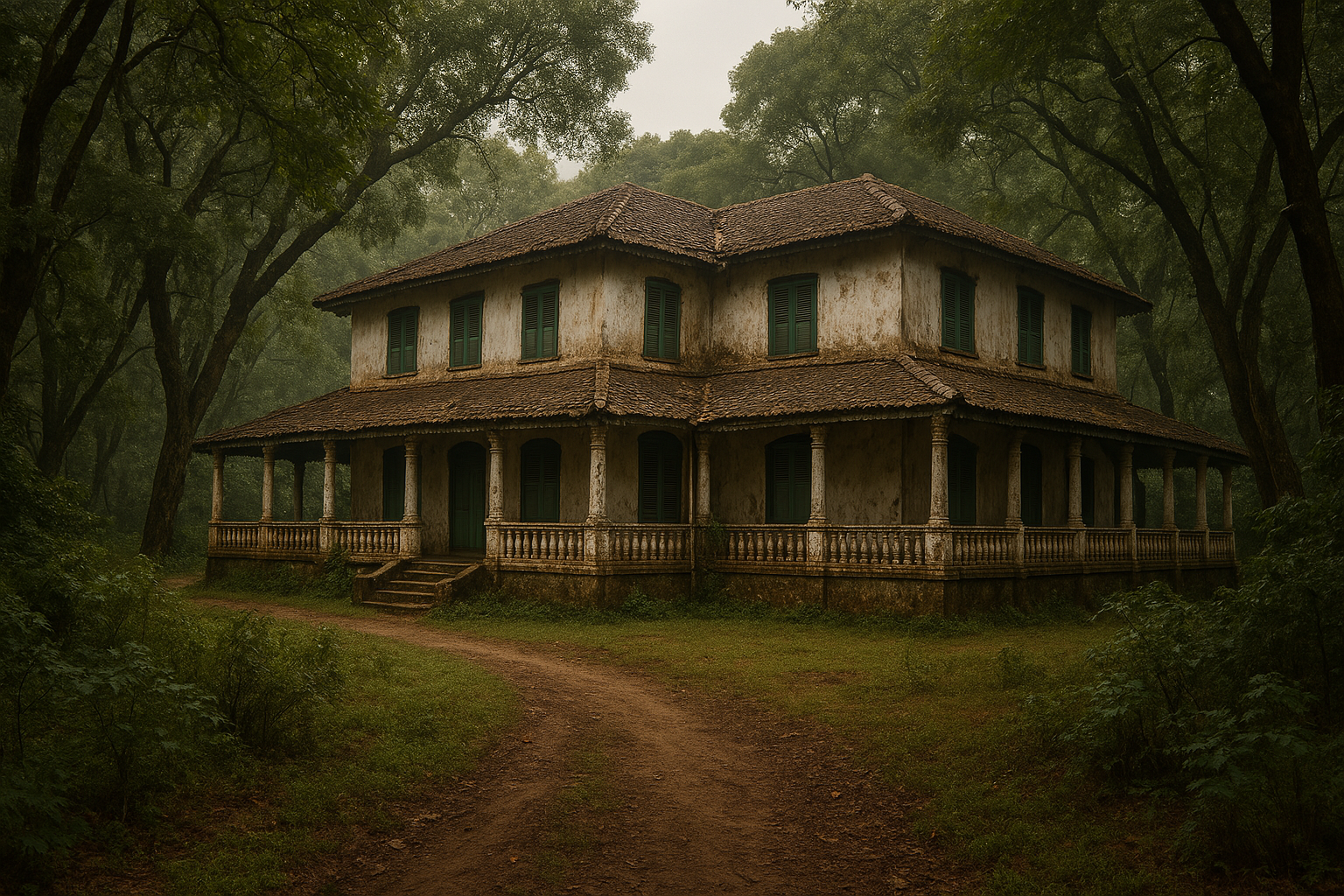
After a bumpy auto-rickshaw ride through winding roads flanked by misty hills and cascading waterfalls, they arrived at their destination. The bungalow stood at the end of a narrow dirt path, surrounded by dense trees that seemed to lean in conspiratorially. It was exactly as advertised: a sprawling colonial structure with weathered white walls, green shutters, and a wraparound veranda that had seen better decades.
“It looks like something out of a horror movie,” Rohit observed quietly.
“Or a romantic period drama,” Priya added, and Rohit’s heart did a little skip.
“Why not both?” Kavya said cheerfully, finally finding one tiny bar of signal and immediately snapping photos.
The caretaker, an elderly man named Raman uncle, greeted them with a mixture of warmth and what seemed like concern. He was lean and weathered, with kind eyes that seemed to hold secrets.
“Welcome, welcome,” he said, jangling a large set of keys. “You are the college group, yes? From Mumbai?”
“That’s us!” Arjun beamed. “Ready for the best weekend ever!”
Raman uncle’s smile faltered slightly. “Ah, yes. Well, let me show you the house. There are just a few… guidelines.”
As he led them through the musty interior, pointing out the kitchen, bathrooms, and bedrooms, his tone grew more serious. “Please, do not go to the third floor. It is not safe, old floorboards, you understand. And after sunset, it is better to stay inside. The forest can be… confusing at night.”
“Confusing how?” Neha asked, her practical mind immediately catching the euphemism.
“Animals,” Raman uncle said quickly. “Leopards, sometimes. And the paths, they all look the same in the dark.”
Vikram shot Arjun a pointed look. “Leopards. Great choice, organiser.”
“Leopards are scared of humans,” Arjun said dismissively. “And look at this place! It’s perfect!“
After Raman uncle left, promising to return the next evening, the group settled in. They distributed themselves across the four bedrooms on the second floor, with Arjun and Vikram sharing one, Priya and Kavya sharing another, and Rohit and Neha taking the remaining two rooms.
The first evening passed pleasantly enough. They cooked a chaotic dinner together, with Priya demonstrating her surprising culinary skills. At the same time, Kavya documented every dish for her Instagram story (which she couldn’t post due to the poor signal, leading to much dramatic sighing). Rohit found excuses to help Priya in the kitchen, and she didn’t seem to mind, which gave him hope.
“This is nice,” Vikram admitted grudgingly as they sat on the veranda after dinner, sharing bottles of beer they’d brought from Mumbai. “Peaceful.“
“See? I told you…” Arjun began, but was interrupted by a strange sound from above.
Thump. Drag. Thump. Drag.
Everyone looked up at the ceiling.
“What was that?” Kavya whispered.
“Probably just the wind,” Neha said, but her voice lacked conviction.
“Wind doesn’t make dragging sounds,” Rohit pointed out.
Thump. Drag. Thump. Drag.
The sound came again, clearly footsteps, but dragging, as if someone was pulling something heavy across the floor above them.
“That’s the third floor,” Priya said quietly. “The one we’re not supposed to go to.”
“Maybe it’s just settling,” Arjun suggested, though his usual confidence seemed shaken. “Old houses make weird noises.”
Vikram stood up abruptly. “I’m going to check.”
“Are you insane?” Kavya hissed. “Raman uncle specifically said not to go up there!”
“Raman uncle also said there were leopards, and I haven’t seen any paw prints. I bet he just doesn’t want us messing with his storage or something.”
Before anyone could stop him, Vikram had stalked inside and up the creaking staircase. The others followed reluctantly, clustering at the bottom of the stairs leading to the third floor.
“Vikram?” Arjun called. “Find anything?”
There was a long pause, then Vikram’s voice, strangely strained: “Guys? You need to see this.”
They climbed the narrow staircase to find Vikram standing in a doorway, his face pale. Beyond him was a room that looked like it belonged in a different century, or a different world entirely.
The room was filled with old photographs, hundreds of them, covering every wall. But these weren’t ordinary family photos. They showed the same group of six young people, over and over again, in different poses, different clothes, but always the same faces. Their faces.
“What the hell?” Priya breathed.
Kavya grabbed Neha’s arm. “Those are us. Those are literally us.”
In photo after photo, they could see themselves, laughing on the veranda downstairs, cooking in the kitchen, sitting around the very same table where they’d just eaten dinner. The photos looked old, yellowed at the edges, as if they’d been taken decades ago.
“This is impossible,” Rohit said, stepping closer to examine one of the images. “These photos… they look vintage, but that’s definitely me.”
“And me,” Arjun whispered, pointing to a photo showing him with his arm around a laughing Priya. “But I’ve never seen this picture before in my life.”
Neha, ever practical, was examining the room more carefully. “Look at this,” she said, pointing to a corner where dozens of diaries were stacked. She opened one at random and began reading aloud:
“Day 1: Arrived at the bungalow with the group. Arjun is as enthusiastic as ever, Vikram is complaining, and Kavya can’t stop taking photos. Rohit keeps looking at Priya when he thinks no one is watching. Some things never change.”
“What does that mean, ‘some things never change’?” Kavya asked, her voice small.
Neha flipped to another entry: “‘Day 15: We tried to leave today, but the path just led us back to the house. Raman uncle won’t explain what’s happening. He just smiles sadly and tells us to be patient.”
“Day 15?” Arjun repeated. “We’ve only been here one day.”
“Keep reading,” Priya urged, though her voice was shaking.
“Day 43: Rohit finally told Priya how he feels. She said she’d known all along and had been waiting for him to find the courage. Even trapped here, there’s still room for happiness.”
Rohit and Priya looked at each other, and despite the surreal horror of the situation, something passed between them.
“Day 78: We think we understand now. We’ve been here before. Many times. The photos prove it. But each time, we forget when we arrive. We only start remembering as the cycle nears its end.”
“Cycle?” Vikram’s voice cracked. “What cycle?”
Neha flipped ahead frantically. “Day 127: This is my last entry. Tomorrow we’ll try to leave again, and we’ll wake up in Mumbai with no memory of this place, planning another trip to Lonavala. But maybe this time, if we’re lucky, someone will read these diaries before it’s too late. If you’re reading this, you are us, and we are you. Find Raman uncle. Ask him about the curse. Ask him about the English sahib who died here in 1923. Ask him how to break free.”
The room fell silent except for the sound of their collective breathing.
“This is insane,” Vikram said finally. “Someone’s playing an elaborate prank. Those photos are doctored, the diaries are fake…“
He was interrupted by the sound of footsteps on the stairs. They all turned to see Raman uncle ascending slowly, his face grave.
“You found the room,” he said simply.
“What is this?” Arjun demanded, his voice higher than usual. “What’s happening to us?”
Raman uncle sighed deeply. “It is a long story. There was an Englishman, James Worthington, who built this house in 1922. He fell in love with a local woman, Kamala, but her family forbade the match. In his anger and heartbreak, he… he did something terrible. He turned to dark practices, tried to bind her spirit to this place so she could never leave him.”
“And?” Priya prompted when he paused.
“The ritual went wrong. Instead of binding just her, he created a trap for love itself. Young couples, groups of friends with love between them, they come here, and the house feeds on their connections, their emotions. It keeps them in a loop, living the same experiences over and over.”
“That’s impossible,” Neha said, but her voice lacked conviction.
“How many times?” Rohit asked quietly. “How many times have we been here?“
Raman uncle’s eyes were sad. “This is your forty-seventh visit.”
The number hit them like a physical blow.
“Forty-seven times,” Kavya whispered. “We’ve lived through this forty-seven times?”
“But we don’t remember,” Priya said, as if trying to make sense of it. “We go back to Mumbai and plan the trip again, with no memory of what happened here.”
“The house lets you leave when the cycle completes,” Raman uncle explained. “But it also makes you forget, ensuring you’ll return. Only in the final days do the memories begin to surface.”
“So, how do we break it?” Arjun asked. “There has to be a way.”
Raman uncle looked at them for a long moment. “The curse was born from love turned selfish, possessive. It can only be broken by love freely given, without expectation of return.“
“What does that mean?” Vikram demanded.
But before Raman uncle could answer, something extraordinary happened. Despite the supernatural horror of their situation, despite being trapped in a cosmic loop for who knows how long, Rohit stepped forward and took Priya’s hand.
“I need to tell you something,” he said, his voice steady despite everything. “I’ve been in love with you since the first year. Maybe that’s why we keep coming back here, I don’t know. But if we’re trapped, if this is all we have, I want you to know.”
Priya looked at him, tears in her eyes. “I know,” she said softly. “I’ve always known. And I’ve been waiting for you to be brave enough to say it.”
They kissed then, simple and sweet, and something in the house seemed to shudder.
“Well, this is awkward,” Kavya said, but she was smiling through her tears. “Here I thought the scariest part would be the supernatural imprisonment.”
“Actually,” Neha said thoughtfully, “I think they might be onto something. Raman uncle, when you said love freely given…”
“The curse feeds on selfish love, possessive love,” Raman uncle confirmed. “But love that expects nothing in return, love that wishes only happiness for the other person…”
Arjun suddenly laughed, and they all turned to stare at him. “You know what’s funny? In forty-seven loops, we’ve probably become the best of friends anyone could ask for. We’ve shared everything, been through everything together, even if we don’t remember it.”
“We have,” Vikram agreed, and for once, he wasn’t complaining. “And honestly? Even if we’re trapped, even if this is all insane, I can’t think of five people I’d rather be trapped with.”
One by one, they moved closer together, forming a circle on the dusty floor of the photograph room.
“I love you all,” Kavya said simply. “Not romantically, well, except you two are adorable, but I love our friendship. I love that Arjun always believes the best in everything, that Vikram pretends to be cynical but cares more than anyone, that Neha always keeps us grounded, that Priya makes us all braver, and that Rohit sees beauty in everything.”
“I love that we found each other,” Neha added. “In all the chaos of college, in Mumbai, in life, we found each other.”
“And I love that even here, even in this impossible situation, we’re still us,” Priya said. “We’re still taking care of each other.”
The house began to tremble. The photographs on the walls started to fade, their edges curling as if being consumed by invisible flames.
“It’s working,” Raman uncle said, his voice filled with wonder. “In forty-seven cycles, you never… You were always trying to escape, to get away. You never chose to stay together.”
“Because we never remembered how much we meant to each other,” Rohit realised.
The trembling intensified, and a warm light began to fill the room. One by one, the photographs crumbled to dust, decades of trapped moments finally released.
“What happens now?” Arjun asked.
“Now you choose,” Raman uncle said. “You can leave, return to Mumbai, and continue your lives with the full memory of what happened here. The curse is broken, you’ll never be drawn back.”
“Or?” Priya prompted.
Raman uncle smiled. “Or you acknowledge what you’ve learned in forty-seven lifetimes of friendship. That some bonds are stronger than any magic.”
They looked at each other, these six friends who had been through more together than any group should ever have to endure, even if they couldn’t remember most of it.
“We’re graduating next year anyway,” Kavya pointed out. “We were all worried about staying in touch, starting careers, growing apart.”
“Can’t really grow apart from people you’ve been cosmically bonded to,” Vikram said with a grin.
“I can’t think of anything I’d want more,” Arjun said honestly.
The light grew brighter, and they felt themselves being lifted, not by any supernatural force, but by the simple power of choosing love, friendship, romance, and loyalty over fear.
When the light faded, they were standing on the veranda of the bungalow, but it looked different now. Cleaner, brighter, as if decades of sadness had been washed away. The sun was rising over the Western Ghats, painting the sky in shades of gold and pink.
“So,” Kavya said, pulling out her phone and finding, miraculously, full signal bars. “Anyone want to extend this trip a few more days? I have a feeling we’ve got some catching up to do.”
They laughed, and the sound echoed across the hills, free and clear and full of promise.
Later, much later, as they sat around the kitchen table sharing stories and filling in gaps that memory couldn’t quite bridge, Raman uncle appeared in the doorway. But he looked different now, younger, lighter, as if a great weight had been lifted from his shoulders.
“Thank you,” he said simply. “I have been the caretaker here for sixty years, watching groups come and go, trapped in their cycles. You are the first to choose love over escape.”
“What will you do now?” Neha asked.
He smiled. “Return to my own life, I think. I have grandchildren I have not seen in many years.”
As he prepared to leave, Arjun called out to him. “Raman uncle, one more question. In forty-seven cycles, did we ever… did Rohit and Priya ever…?”
“Every time,” the old man said with a twinkle in his eye. “Love always finds a way, beta. Even in the worst circumstances.”
And as their laughter filled the morning air, echoing across the hills of Lonavala, six friends discovered that some stories don’t end, they just begin again, deeper and truer than before.
The house stood peaceful in the morning light, no longer a prison but a place where love had learned to set itself free.
Best known as the COO of Facebook and the author of the best-selling book “Lean In”, which encourages women to pursue leadership roles and challenge workplace gender barriers, Sheryl Sandberg is widely recognised for her advocacy on women’s empowerment, resilience, and compassionate leadership, making her an influential voice in both business and personal growth.
Sandberg’s quote sheds light on the true nature of empathy. She reminds us that empathy isn’t about offering quick reassurances or trying to “fix” someone’s pain. Often, the most compassionate response is simply to acknowledge the reality of someone’s suffering without minimising it. Telling someone “it will be okay” may unintentionally dismiss their feelings, while recognising that things are not okay validates their experience and makes them feel truly seen and supported. Real empathy is about presence, understanding, and acceptance, walking with someone in their pain rather than rushing them out of it.
It’s been more than three weeks since BB went to Australia, and we are really missing him. He will be back sometime next week, and then it’s the countdown to the end of his national service. GG has been very busy last week and on into this coming week with back-to-back tests, so I barely see her when she is home.
This week’s motivation is about opportunities. When things don’t work out as you expected and your desired opportunity doesn’t come to fruition, it’s easy to fall into a downward spiral of questioning your choices. Don’t be too hard on yourself. Remember, there’s always another opportunity. The more you dwell on what could have been, the more oblivious you become to the wonderful opportunities that are unfolding right in front of you. If that particular opportunity didn’t work out, it could mean that something about it wasn’t right for you. The right opportunity will come, and it will be way better than you imagined. It will be worth the wait. This one really resonated with me, as this is exactly what I tend to do.
My long walk is finally coming to an end, and I am so excited! I am just about 50 km from home, which means that sometime next week I should finish it. Currently, I am on the outskirts of Johor Bahru, the capital of the state of Johor, just off the causeway separating Singapore and Malaysia. When I complete the walk, I will share more about it, including the whys and wheres.
And that’s all from me this week. Stay positive, keep smiling, and remember, don’t be hard on yourself; there’s a new opportunity just waiting for you to notice it!
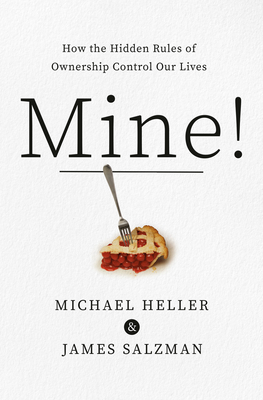
Mine!: How the Hidden Rules of Ownership Control Our Lives – Michael A. Heller, James Salzman
A hidden set of rules governs who owns what–explaining everything from whether you can recline your airplane seat to why HBO lets you borrow a password illegally–and in this lively and entertaining guide, two acclaimed law professors reveal how things become mine.
Mine is one of the first words babies learn. By the time we grow up, the idea of ownership seems natural, whether buying a cup of coffee or a house. But who controls the space behind your airplane seat: you reclining or the squished laptop user behind? Why is plagiarism wrong, but it’s okay to knock-off a recipe or a dress design? And after a snowstorm, why does a chair in the street hold your parking space in Chicago, but in New York you lose the space and the chair?
Mine! explains these puzzles and many more. Surprisingly, there are just six simple stories that everyone uses to claim everything. Owners choose the story that steers us to do what they want. But we can always pick a different story. This is true not just for airplane seats, but also for battles over digital privacy, climate change, and wealth inequality. As Michael Heller and James Salzman show–in the spirited style of Freakonomics, Nudge, and Predictably Irrational–ownership is always up for grabs.
With stories that are eye-opening, mind-bending, and sometimes infuriating, Mine! reveals the rules of ownership that secretly control our lives.






 Memories and Such