School Stories: Sports Day

A couple of weeks back, in our class WhatsApp chat, we started talking about our school days and the conversation veered towards our sports day. I enjoyed that conversation so much that I decided to take a trip down memory lane to reminisce about those days.

Our school sports day was the highlight of the second term, which happened after the Diwali holidays in the second term. The main sports day would happen sometime in December/early January before the class X students had their prelims.

Our school was divided into four houses and this was only for the secondary section. Unlike other schools, we didn’t have house named for flowers, national leaders or even landmarks. Since my school is a Parsi school, our houses were named for ancient Persian princesses. Selection of students to the different houses was completely random and we’ve tried to think of the various ways they may have done the choosing, but other than randomness, we have never been able to figure it out. In one family, you would have sisters in different houses, as it was in my house and also in my neighbour’s place where all the sisters were in different houses. I was in the green house while my sister was in the yellow house. As part of our school uniform, along with our school badge which was pinned on the top left of our uniform, above our hearts, we had to pin our house badge to the left of the school badge.

For a few months before the actual day, we would have what was known as indoor games as well as sports for which the school did not have the facilities to play and which needed to be played at a nearby gymkhana. These included sports like carrom, chess, badminton and table tennis. We also had some games like square ball and volley ball, which we played in our school grounds, competing with each other. The sports day was held in a small stadium not very close to the school, but in a centrally located area. A month or so before the actual sports day, we all trooped to the stadium for our heats. This was usually a half day and those of us who were not so inclined, used that half day to just chill and gossip with friends and cheer those who are competing. For children in the primary and kindergarten sections, they had their heats in a small garden behind the school.

In the days leading to the sports day, while the other events were held, we would anxiously keep track of the wins of each house and at the same time start the practice for the march past. Usually the class five students will be super eager to take part in the march past and would audition for the same. By the time we reached class eight, it was the other way around – we had to be forced to go down and take part. The march past contingent was made up of one girl who would carry the placard with the name of the house followed by the house captain who carried the house flag who would be followed by the march past contingent made up of 30 girls in 10 rows of three girls each. Every one on the field will be in white shorts and the school shirt which was our PE uniform and anyone representing a house will have a length of silk ribbon in the colour of the house stitched down both sides of their shorts.
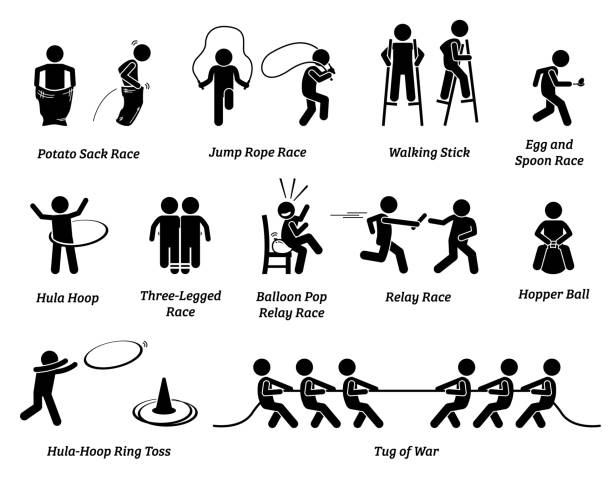
The primary, kindergarten sections and any guests and parents sit together, but the secondary girls sit in their houses. This means that we would get very noisy, especially when we are cheering for our team and booing the opposition. The day’s finale was the march past and the house which scored the highest number of points aka the winner for the year had the honour of leading the march past. During my school years, it had always been the green house which led the march past with usually the red house coming second, the blue house at third position and the yellow house bringing up the rear. And usually, it would be the yellow house which would win the march past trophy. I only remember one year when I was probably in class 6, when there was a three-way tie for first position. Green, red and blue houses all tied and there was a toss to determine who would lead the march past and who would walk in second. I remember red house winning the toss and the captain of the house, who later became famous, was screaming and jumping with joy, because under her captaincy, the red house led the march past.

Our sports day would always be on a Sunday afternoon and would usually start around 2 pm and end around 6ish in the evening. We would go home tired but happy that day, especially since the next day used to be school holiday to help us (and more likely the teachers) recuperate from a hectic day.

This blog post was a blast to write as memories all kept flooding in and I wrote this post with a huge smile on my face. For most of us, our school days are the golden days which we remember fondly, with all the bad parts edited out. Maybe it’s our way of keeping our innocent and young years in our heart?
2021 Week 05 Update

This week was a version of Hell week for GG because she has two projects due on the same day and one of them which was a coding project had some issues which her group just could not resolve. Just when it seemed that they had to redo the whole thing within one day, they managed to reach out to their teacher who helped them, albeit with some reduction in their final marks and they managed to submit it in time. The second project has issues because of some people in the group, one of whom was out the whole day on submission day which pissed off the rest of the group. GG is so mad at this person that she has decided that moving forward, she will not be in the same group as this person if she can help it.

BB on the other hand had a usual week, though I can see him studying more this semester compared to the previous one. He is confident of scoring much better this semester, but I don’t want to push my hopes too high, but I did have a dream one day of a certain semester GPA, so I am optimistic cautious of perhaps a chance this dream does come true. I did dream of their O level scores and BB’s score was bang on, but I was off by one point for GG though.

This week I saw a news report which brought a smile on my face. The world has hit a milestone this week in the sense that more people have been vaccinated than have been infected world over. A total of 119 million vaccine doses have been administered till date while the number of infections has reached about 106 million now. Of the active cases more than 99% have mild conditions and less than 0.5% of patiebts are in a critical condition. The USA has more than 27 million cases till date and India has 10 million cases till date. But if you look at total cases per 1 million of population, India drops to the 119th position at 7791 cases per 1 million of population while the US is at number is at number 7 with 82,511 cases per 1 million of population.

The Chinese diaspora will be celebrating the Chinese Lunar New Year next week and to all those who celebrate this festival, Xin Nian Quai Le and a Happy Lunar New Year to you and your family. I remember the last year when the cases hit Singapore just after CNY and we are here one year later with the end still looking quite far away!

Here’s today’s positive thought. It’s one I should also practice myself because at heart, I seem to attract negative thoughts so I am going to aim this week to only think positive thoughts.

In My Hands Today…

Entitled: How Male Privilege Hurts Women – Kate Manne

In this bold and stylish critique, Cornell philosopher Kate Manne offers a radical new framework for understanding misogyny. Ranging widely across the culture, from Harvey Weinstein and the Brett Kavanaugh hearings to “Cat Person” and the political misfortunes of Elizabeth Warren, Manne’s book shows how privileged men’s sense of entitlement – to sex, yes, but more insidiously to admiration, care, bodily autonomy, knowledge, and power – is a pervasive social problem with often devastating consequences.

In clear, lucid prose, Manne argues that male entitlement can explain a wide array of phenomena, from mansplaining and the under-treatment of women’s pain to mass shootings by incels and the seemingly intractable notion that women are “unelectable.” Moreover, Manne implicates each of us in toxic masculinity: It’s not just a product of a few bad actors; it’s something we all perpetuate, conditioned as we are by the social and cultural mores of our time. The only way to combat it, she says, is to expose the flaws in our default modes of thought while enabling women to take up space, say their piece, and muster resistance to the entitled attitudes of the men around them.

With wit and intellectual fierceness, Manne sheds new light on gender and power and offers a vision of a world in which women are just as entitled as men to our collective care and concern.

Introverts, Extroverts and Ambiverts

For as long as I remember, I have been an introvert, preferring books and my own company to other people. But as I grew older and started appreciating people, I realised that I actually like engaging with people some of the time, especially when we are having an interesting conversation. This made me realise while I will never be an extrovert who likes being the centre of attraction, I was not the introvert I was growing up. That’s when I learnt that I may be an ambivert instead.

So, what are all the definitions of such people?

Extroverts are those who tend to enjoy human interactions and to be enthusiastic, talkative, assertive, and gregarious. Extroverts are energised and thrive off being around other people, taking pleasure in activities that involve large social gatherings, including activities like parties, community activities, public demonstrations and business or political groups. They also tend to work well in groups and is more likely to enjoy time spent with people and find less reward in time spent alone as they tend to be energized when around other people, and they are more prone to boredom when they are by themselves.

Extroverts are wired for enthusiasm. Research has found that extroverts are more likely to associate pleasurable feelings with their current environment, according to one analysis of neurological differences between introverts and extroverts. They are more likely to be a leader with research findings showing that most leaders self-identify as extroverts. They are great in groups, large rooms and often have no problem building rapport with anyone. Extroverts are anti-boring and great at pulling out the best from people, be it conversation, energy and confidence as well as more likely to have lots of interesting adventures, fun activities and socialising in their calendars which gives them lots to talk about. Extroverts also tend to be happier with research that found that extroverts tend to be more optimistic, cheerful and better at mood regulation, which means that in a given situation someone can control their moods or emotional responses more easily and allowing them to be social fixers.

Famous extroverts include politicians like Winston Churchill, Margaret Thatcher, Bill Clinton and sports personalities like Muhammed Ali.

Introverts are typically perceived as being more reserved or reflective and some popular psychologists have characterised introverts as people whose energy tends to expand through reflection and dwindle during interaction. Introverts often take pleasure in solitary activities like reading, writing, or meditating and is likely to enjoy time spent alone and find less reward in time spent with large groups of people. Introverts are easily overwhelmed by too much stimulation from social gatherings and engagement, with introversion defined by some in terms of a preference for a quiet, more minimally stimulating external environment. They prefer to concentrate on a single activity at a time and like to observe situations before they participate and are more analytical before speaking. Mistaking introversion for shyness is a common error as introversion is a preference, while shyness stems from distress. While introverts prefer solitary to social activities, they do not necessarily fear social encounters like shy people do.

Studies have found that introverts are humbler than extroverts, an incredibly important and hard to learn trait which makes them more perceptive, more open and less bogged down by ego making them wonderful leaders, managers and friends. Why, because they are wonderful observers who can pick up on social nuances, hidden emotions and team dynamics better than anyone. When they speak, people listen and take their words seriously because they tend to think carefully before speaking and use words carefully. Introverts also make some of the best employees because they are incredible listeners, great at asking the right questions and think before they speak and are very observant so often give the best input.

Some of the most talented people in history have been introverts from Apple co-founder Steve Wozniak to the greatest genius of the 20th century, Albert Einstein. Other super successful introverts include J.K Rowling, Bill Gates and Mahatma Gandhi

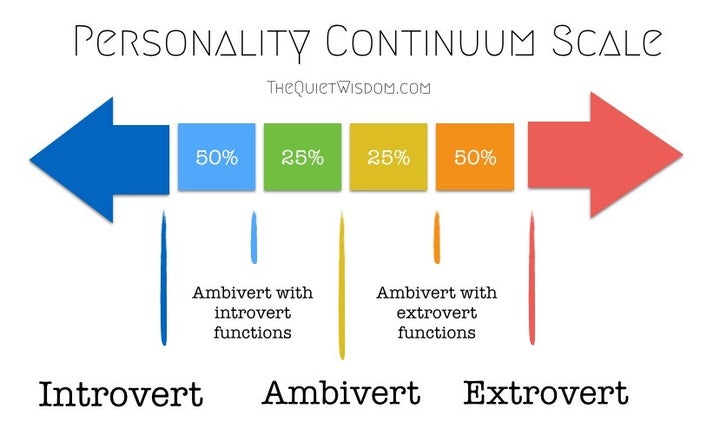
While most people view being introverted or extraverted as mutually exclusive, it is actually part of a single, continuous dimension of personality, with some scoring near one end, and others near the halfway mark. Ambiverts falls more or less directly in the middle. Ambivert are moderately comfortable with groups and social interaction, but also relish time alone, away from a crowd. In simpler words, an ambivert is a person whose behaviour changes according to the situation they are in. In the face of authority or in the presence of strangers, the person may be introverted. However, in the presence of family or close friends, the person may be highly energetic or extroverted.

It is commonly accepted that extroverts excel in jobs that require interaction with people, the best in sales, in leading people and being successful at work, but this fallacy was turned in its head during an analysis by Adam Grant, an associate professor at the Wharton School of the University of Pennsylvania, who analysed 35 separate studies and found the statistical relationship between extroversion and income was basically zero. He conducted a personality survey and collected three-month sales records for more than 300 salespeople, both male and female. The people who ranked right in the middle for extroversion and introversion–ambiverts–turned out to be the best salespeople. Grant theorised that ambiverts seem to strike a balance between the two more extreme personality traits theorising that the ambivert advantage stems from the tendency to be assertive and enthusiastic enough to persuade and close, but at the same time, listening carefully to customers and avoiding the appearance of being overly confident or excited.

There is nothing wrong in being an introvert, extrovert or an ambivert. Each type has its strengths and weaknesses and knowing what personality type you are (and most people know this by the time they get to their teens or latest by their early twenties) will help you amplify your strengths and help you overcome weaknesses.

If you want to know where on the spectrum you lie, here’s a short, ten question quiz from TED to help you find out.

And here are some TED videos about these personality traits. Watch and learn more…

In My Hands Today…

The Tears of My Soul – Kim Hyun Hee

When Korean Air Lines flight 858 exploded in 1987, killing 115 passengers, international law-enforcement officials immediately started searching for the hardened North Korean terrorists who could have committed such a crime. What they found was Kim Hyun Hee, an idealistic young woman who had been transformed by her country into an obedient killing machine.

The Tears of My Soul is her poignant, shocking, and utterly compelling story. Kim Hyun Hee grew up in a country obsessed by the loss of South Korea, an Orwellian world where right and wrong, good and evil, slavery and freedom meant nothing but what the North Korean Communist Party said they did.

At sixteen, she was singled out by the Party for her intelligence and beauty and given special training in languages. At nineteen she was honored to be chosen for the North Korean Army’s secret and elite espionage school. There she was trained to kill with everything from her hands and feet to grenades and assault rifles, enduring years of grueling physical and psychological conditioning designed to make her an effective and utterly obedient tool of the Party’s spy masters. And in 1987, at age twenty-five, she was sent on the mission that would, she was told, reunify her divided country forever.

Kim and her control agent, a man she considered her spiritual father, were captured only hours after the explosion. They were provided with suicide capsules, but hers failed and, for the first time in her life, Kim was outside the control of her masters. After more than a year of soul-wrenching questioning and deprogramming by the South Korean police, Kim realized the full enormity of her crimes, made a full confession, and waited for execution. But in a remarkable decision that sparked national outrage, the South Korean president gave her a full pardon, declaring that she was as much a victim of North Korea as the passengers. Kim Hyun Hee has devoted the rest of her life to atoning for the 115 lives lost on flight 858.