In My Hands Today…

Awe: The New Science of Everyday Wonder and How It Can Transform Your Life – Dacher Keltner

Awe is mysterious. How do we begin to quantify the goose bumps we feel when we see the Grand Canyon, or the utter amazement when we watch a child walk for the first time? How do you put into words the collective effervescence of standing in a crowd and singing in unison, or the wonder you feel while gazing at centuries-old works of art?

Up until fifteen years ago, there was no science of awe, the feeling we experience when we encounter vast mysteries that transcend our understanding of the world. Scientists were studying emotions like fear and disgust, emotions that seemed essential to human survival. Revolutionary thinking, though, has brought into focus how, through the span of evolution, we’ve met our most basic needs socially. We’ve survived thanks to our capacities to cooperate, form communities, and create culture that strengthens our sense of shared identity—actions that are sparked and spurred by awe.

In Awe, Dacher Keltner presents a radical investigation and deeply personal inquiry into this elusive emotion. Revealing new research into how awe transforms our brains and bodies, alongside an examination of awe across history, culture, and within his own life during a period of grief, Keltner shows us how cultivating awe in our everyday life leads us to appreciate what is most humane in our human nature. And during a moment in which our world feels more divided than ever before, and more imperiled by crises of different kinds, we are greatly in need of awe. If we open our minds, it is awe that sharpens our reasoning and orients us toward big ideas and new insights, that cools our immune system’s inflammation response and strengthens our bodies. It is awe that activates our inclination to share and create strong networks, to take actions that are good for the natural and social world around us. It is awe that transforms who we are, that inspires the creation of art, music, and religion. At turns radical and profound, brimming with enlightening and practical insights, Awe is our field guide, from not only one of the leading voices on the subject but a fellow seeker of awe in his own right, for how to place awe as a vital force within our lives.

Festivals of India: Nag Panchami

Today is Naga Panchami. One of India’s unique festivals, Nag Panchami is a day of traditional worship of the snake or Nag or Naja or Naga, which are associated with the mythical Naga beings observed by Hindus, Jains, and Buddhists throughout India and Nepal. The worship is offered on the fifth day of the bright half of the lunar month of Shravan which is around mid-July to mid-August. Some Indian states, like Karnataka, Rajasthan and Gujarat, celebrate Naga Panchami in the dark half or Krishna Paksha of the same month. As part of the festivities, a Naga or serpent deity made of silver, stone, wood, or a painting is given a reverential bath with milk and their blessings are sought for the welfare of the family. Live snakes, especially cobras, are also worshipped on this day, especially with offerings of milk and generally with the assistance of a snake charmer.

Naga Panchami is also a day when Akharas or traditional Indian wrestling gyms, hold special celebrations to honour the mystical symbolism of the snake as a symbol of virility and kundalini energy. There are many legends in Hinduism and folklore narrated to the importance of worship of snakes. According to Hindu Puranas and the Mahabharata, Kashyapa, grandson of Lord Brahma, married two daughters of Prajapati Daksha, Kadru and Vinata. Kadru then gave birth to the race of Naga, while Vinata gave birth to Aruna, who became the charioteer of the sun god, Surya, and also gave birth to the great eagle Garuda, who became the vehicle of Lord Vishnu.

In the Mahabharata epic, the sage Astika stops King Janamejaya from sacrificing and eventually decimating the serpent race or the Sarpa Satra. This sacrifice was performed by Janamejaya to avenge the death of his father Parikshita, who was killed by Takshaka, the king of the snakes. A sacrificial fireplace had been specially erected and the fire sacrifice to kill all snakes in the world was started by a galaxy of learned Brahmin sages. The sacrifice performed in the presence of Janamejaya was so powerful that it was causing all snakes to fall into the Yagna kunda or the sacrificial fire pit. When the priests found that only Takshaka who had bitten and killed Parisksihita had escaped to the nether world of Indra seeking his protection, the sages increased the tempo of reciting the mantras to drag Takshaka and also Lord Indra to the sacrificial fire. Takshaka had coiled himself around Indra’s cot but the force of the sacrificial yagna was so powerful that even Indra along with Takshaka was dragged towards the fire. This scared the Gods who then appealed to Manasadevi to intervene and resolve the crisis. She then requested her son Astika to go to the site of the yagna and appeal to Janamejaya to stop the Sarpa Satra yagna. Astika impressed Janamejaya with his knowledge of all the Sastras or scriptures who then granted him to seek a boon. It was then that Astika requested Janamejeya to stop the Sarpa Satra. Since the king was never known to refuse a boon given to a Brahmin, he relented, despite protests by the sages performing the yagna. The yagna was then stopped and thus the life of Indra and Takshaka and the rest of the serpent race was spared. This day, according to the Hindu Calendar, happened to be Nadivardhini Panchami or the fifth day of the bright fortnight of the lunar month of Shravana during the monsoon season and since then the day is a festival day of the Naga as their life was spared on this day. Lord Indra also went to Manasadevi and worshipped her. During this sacrifice, the Mahabharata as a whole was first narrated by the sage, Vaisampayana. According to the Garuda Purana, offering prayers to snakes on this day is auspicious and will usher good tidings in one’s life. This is to be followed by feeding Brahmins.

On Naga Panchami, snakes are worshipped with milk, sweets, flowers, lamps, and even sacrifices. Deities of snakes made of silver, stone, wood, or paintings on the wall are first bathed with water and milk and then worshipped with the reciting of mantras. Fasting is observed on this day and Brahmins are fed. Fasting and praying on this day is considered a sure protection against the fear of snake bites. In many places, real snakes are worshipped and fairs are held. On this day digging the earth is taboo as it could kill or harm snakes which reside inside the earth.

In some regions, milk is offered along with crystallised sugar, and rice pudding. A special feature is the offering of a lotus flower which is placed in a silver bowl. In front of this bowl, a rangoli of a snake is created on the floor with a brush made of wood, clay, silver or gold with sandalwood or turmeric paste as the paint. The design pattern resembles a five-hooded snake. Devotees then offer worship to this image on the floor. In villages, the anthills where the snakes are thought to reside, are searched. Incense is offered to the anthill as prayer along with milk. This is a myth from folklore where snakes are fed milk so that snakes come out of the anthill. After this, milk is poured into the hole in the anthill as a libation to the snake god.

On this occasion, doorways and walls outside the house are painted with pictures of snakes, and auspicious mantras are also written on them. It is believed that such depictions will ward off poisonous snakes. The day is also observed as Bhratru Panchami when women with brothers worship snakes and where they reside, offering prayers to propitiate Naga so that their brothers are protected and do not suffer or die due to snake bites. Naga Panchami is also celebrated as Vishari Puja or Bishari Puja in some parts of the country where Bisha or Visha means poison.

Apart from the scriptural mention of snakes and Naga Panchami, there are also many folktales about the festival. One such tale is of a farmer living in a village. He had two sons and one of whom killed three snakes during ploughing operations. The mother of the snake took revenge on the same night by biting the farmer, his wife and two children and they all died. The following day the farmer’s only surviving daughter, distraught and grieving over the death of her parents and brothers, pleaded before the mother snake with an offering of a bowl of milk and requested forgiveness and asked to restore the life of her parents and brothers. Pleased with this offering the snake pardoned them and restored the farmer and his family to life.

In folklore, snakes also refer to the rainy season, the Varsha ritu in Sanskrit. They are also depicted as deities of ponds and rivers and are said to be the embodiment of water as they spring out of their holes, like a spring of water. It is believed that snakes are more powerful than humans on account of their association with Lord Shiva, the Goddesses, Lord Vishnu and Lord Subramanya or Kartikeya and because of this, a degree of fear is instilled, resulting in the deification of the cobra and its worship throughout the country by Hindus.

Snakes also have a connotation with the Moon’s nodes in Hindu astrology. The head of the snake is represented by Rahu or the Dragon’s Head and its tail by Ketu or the Dragon’s Tail. If in the astrological chart of a person, all the seven major planets are hemmed between Rahu and Ketu in the reverse order or anticlockwise, it is said to denote Kalasarpa dosha or Black Snake Defect, which forebodes ill luck and hardship in an individual’s life and is appeased by offering worship to the snakes on Naga Panchami day.

In the city of Nagpur in Maharashtra snakes have a special identity. Nagpur’s name is derived from the word Naga which means snake as the place was infested with snakes. Nagpur was the homeland of the Naga people who embraced Buddhism, supported it in its early period, and propagated it throughout India. The Nagaoba Temple in Mahal is where worship is offered on Naga Panchami day. The temple was found under the neem tree known as Nagaoba ka Vota, under a platform. Another important event held on this occasion is an arduous trekking pilgrimage known as Nagadwar Yatra to Pachmarhi. Here, food prepared as an offering to the Snake God is cooked in a kadai.

The Naga Chandreshwar in Ujjain is a sub-temple located on the third floor of the Mahakaleshwar Jyotirlinga temple. The speciality of this shrine is that it is open only one day of the year on Naga Panchami day and remains shut for the rest of the year. The idol of Nagachandreshwar is very unique with Shiva and Parvati seated on a ten-hooded snake surrounded by Nandi, Ganesha and other idols. It is believed that the great snake Taksha lives here and praying during Naga Panchami rids the devotee of various afflictions and doshas such as Naga Dosha, Sarpa Dosha and any form of Doshas.

In Kashmir, snakes have been reported to have been worshipped from historical times with places of worship reported from as far back as 700 AD. In cities such as Benares, Naga Panchami is when Akharas or venues of wrestling practice and competitions are bedecked. On this occasion, the akharas are cleaned up thoroughly and the walls are painted with images of snakes. Priests preside over the festivities and the gurus are honoured along with the sponsors. Its significance is that the wrestlers stand for virility and Naga symbolizes this scheme of virility. The Akharas are decorated with snake images showing snakes drinking milk. In Narasinghgarh Akhara in Varanasi, there is a special shrine dedicated to Naga Raja or the King of Snakes where a bowl is suspended above the image of the snake and milk is poured into it so that it trickle over the snake god as a form of an offering.

On Naga Panchami, snake charmers are everywhere in towns and villages displaying snakes in their baskets. Some snake charmers hang limp snakes around their necks with crowds gathering around them and the snakes in the basket are worshipped by devotees. In Punjab, the festival is celebrated in a different month and a different format. It is celebrated in the month of Bhadra which falls between September and October and is called Guga Nauvami or the ninth day of the lunar month during the bright half of the Moon. On this occasion, an image of a snake is made with dough and kept in a winnowing basket and taken around the village. Villagers offer flour and butter as an oblation to the image. At the end of the parade, the snake is formally buried and women worship the snake for nine days and give offerings of yogurt.

In western India, Naga Panchmi is known as the Ketarpal or Kshetrapal, meaning, a protector of his domain. In the Kutch region, the snake is named Bhujang, which is also the Sanskrit name for a snake. The name is attributed to the city of Bhuj which is located below the hill named Bhujiya, after Bhujang, as it was the abode of snakes. On top of this hill, there is a fort known as the Bhujia Fort where a temple has been built for the snake god and a second temple at the foot of the hill is known as the Nani Devi temple. Bhujia Fort was the scene of a major battle between Deshalji I, the ruler of Kutch and Sher Buland Khan, the Mughal Viceroy of Gujarat who invaded Kutch. When the army of Kutch was losing the battle, a group of Naga Bawas opened the gate of Bhujia Fort by a clever ploy of visiting the Naga temple for worship and joined the fray against Sher Buland Khan’s army. Eventually Deshalji I won the battle. Since that day Naga Bawa and their leader have a pride of place in the procession held on Naga Panchami. Within the fort, there is a small square tower dedicated to Bhujang Naga or the snake god, who in folklore is said to have been the brother of Shesh Naga. It is said Bhujang Naga came from Than in Kathiawar and freed Kutch from the oppression of demons known as Daityas and Rakshasas. The Snake Temple was also built at the time of the fortification of the hill during Deshalji I’s reign and was provided with a chhatri. Every year on Naga Panchami, a fair is held at the temple premises. In the Sindhi community, Naga Panchami is celebrated in honour of Gogro.

In the eastern and north-eastern states, the goddess is worshipped as Manasa. According to Hindu mythology, Manasa is a snake goddess who was also called Jaratkaru and the wife of a Brahmin sage also named Jaratkaru. On this occasion, a twig of the Manasa or sale plant symbolizing the goddess Manasa is fixed on the ground and worshipped, not only in the month of Shravan, as in the rest of the country, but also during the month of Bhadrapad with the festival held within the precincts of the devotee’s house.

In South India, the snake is identified with Lord Subramanya who is the commander of the celestial army and also with Lord Shiva and Lord Vishnu. In Karnataka, the preparation for the festival starts on the New Moon day of the Bhimana Amavasya, five days before the festival day of Panchami. Girls offer prayers to the images made out of white clay painted with white dots. They take a vow by tying a thread dipped in turmeric paste on their right wrist and offer prayers. An image of a snake is drawn on the floor in front of the house and milk is offered as oblation. On the previous night of the festival, they keep a complete fast or take a salt-free diet. After the prayers, a feast is held. In South India, both sculpted and live snakes are worshipped. Every village has a serpent deity who is worshipped as a single snake or nine snakes called Nava Naga but the popular form is of two snakes in the form of an Aesculapian Rod. Every worshipper in South India worships the anthill where the snakes are reported to reside. Women decorate the anthill with turmeric paste and vermillion and sugar mixed with wheat flour. They bedeck it with flowers with the help of threads tied to wooden frames. In Maharashtra, they go around the anthill in a worship mode five times singing songs in praise of snake gods.

In another form of worship practised by childless women stone statues of snakes are installed below a peepal tree and worshipped to seek blessings of the snake god to bestow them with children. This is done as it is believed snakes represent virility and have the gift of inducing fecundity curing barrenness. In Coorg in Karnataka, an ancestral platform called a noka is installed with rough stones which are believed to be the ancestral incarnation in the form of snakes but they are not necessarily worshipped on Naga Panchami day.

In Kerala, the Ezhavas and the Nairs are Serpent-worshipers. A shrine is normally established for the snake god in the southwest corner of the ancestral house, along with a temple for the para-devata. Women fast on the day before Naga Panchami. On Naga Panchami, they take a bath at dawn and pray at the Tharavad Sarpa Kavu and take home the thirtham milk. A Chembarathi or Hibiscus flower is dipped in milk and sprinkled on the brother’s back and then an aarti is done, after which a thread dipped in turmeric is tied on the right wrist of the brother. A feast is then served.

Naga Panchami is widely observed in Nepal, particularly the fight between Garuda and a great serpent. In the Changu Narayan Temple in Kathmandu, there is a statue of Garuda which is said to have been established by Garuda himself and on Naga Panchami, the image is said to sweat reminiscing his great fight with a giant snake; people collect the sweat and use it for curing leprosy. In Pakistan, the Sindhis celebrate Naga Panchami by honouring Gogro, a mythical character that protects against snake bites.

2023 Week 33

Today’s quote is attributed to Eleanor Roosevelt, the former First Lady of the United States and a prominent human rights advocate. The quote suggests that having a strong belief in one’s dreams and aspirations is essential. It emphasises that those who genuinely believe in the potential and value of their dreams are more likely to work hard, persevere, and take the necessary actions to achieve them. It encourages an optimistic outlook on life and highlights the potential for creating a better future through the pursuit of these beautiful dreams. By believing in their dreams and working towards them, people can influence the course of their lives and contribute to the future they envision. Lastly, the quote implies that belief in the beauty of one’s dreams provides the motivation and resilience needed to persevere in the face of obstacles. The quote serves as a motivational reminder to actively believe in and work towards one’s dreams. It encourages people to take ownership of their goals and take steps to bring their aspirations to life.

GG started school this week and she is enjoying some subjects and not so much for the others. It’s a long journey, of which she has just taken the first step. I am also enjoying my new workplace and because I am doing meaningful work in a space I love, it is fun!

I am getting behind in both my writing and reading, but that’s the tradeoff I am willing to make to do the work I am doing. I just need to figure out how to best utilise my weekends.

And with that, have a wonderful week ahead. Stay safe, stay healthy and stay positive!

In My Hands Today…

Amritsar to Lahore: A Journey Across the India-Pakistan Border – Stephen Alter

“During the course of my journey, many of the people I met in Pakistan and India expressed a curious combination of affection, indifference, and animosity toward their neighbors across the border. . . . The border divides them but it is also a seam that joins the fabric of their cultures.”

On 15 August 1947, in what some have argued was the final, cynical act of a collapsing empire, the British left India divided. Arbitrary borders that have profoundly affected the recent history of the subcontinent were drawn upon the map of India. In the violence that accompanied Partition, it has been estimated that close to a million people were killed and more than ten million uprooted and displaced. The hatreds created by what was one of the largest mass migrations in history only exacerbated the religious tensions that originally led to Partition. Since then, India and Pakistan have fought three devastating wars, and the danger of armed conflict is constant.

A sensitive and thoughtful look at the lasting effects of Partition on everyday people, Amritsar to Lahore describes a journey across the contested border between India and Pakistan in 1997, the fiftieth anniversary of Partition. Setting out from and then returning to New Delhi, Stephen Alter crossed the border into Pakistan, retraced the legendary route of the Frontier Mail toward the Khyber Pass, and made his return by bus along the Grand Trunk Road, stopping in major cities along the way.

During this journey and another in 1998, Alter interviewed people from all classes and castes: Hindus, Muslims, and Sikhs, men and women. In candid conversation, the older generation who lived through the events of 1947 shared their memories and opinions of that pivotal moment of Partition, while youths who have inherited the fragments of that past reflected upon the meaning of national identity. In an engaging account of peoples and places, Alter documents in evocative detail his meetings with varied individuals. He recalls the Muslim taxi driver who recognizes an air of confidence with which men in Pakistan walk the streets dressed in salwar kameez; the brigadier who saved the brass insignia of the British crown from Lord Mountbatten’s Rolls Royce; gold merchants, customs officers, fellow travelers, musicians, and many others.

Alongside these diverse and vivid interviews, chance conversations, and oral histories, Alter provides informed commentary to raise questions about national and individual identity, the territorial imperatives of history, and the insidious mythology of borders. A third-generation American in India, where he has spent much of his life, Alter reflects intimately upon India’s past and present as a special observer, both insider and outsider. His meaningful encounters with people on his journey illustrate the shared culture and heritage of South Asia, as well as the hateful suspicions and intolerance that permeate throughout the India-Pakistan frontier. Also woven into the narrative are discussions of the works of South Asian novelists, poets, and filmmakers who have struggled with the issue of identity across the borderlands.

Ongoing battles in Kashmir and nuclear testing by both India and Pakistan may prove that peace in this region can be achieved only when border disputes are resolved. Offering both the perspective of hindsight and a troubling vision of the future, Amritsar to Lahore presents a compelling argument against the impenetrability of boundaries and the tragic legacy of lands divided.

Travel Bucket List: Malaysia Part 10 – Negeri Sembilan Part 3

Jelebu

The second largest district in the state, Jelebu borders Seremban to its west and Kuala Pilah to its south, Jempol to its southeast, Bentong and Bera plus Pahang to its east and Hulu Langat in Selangor to the north. Jelebu has a somewhat blossoming semi-agricultural industry with Kuala Klawang the principal town of the district. Jelebu has an infamous recorded history of British and Japanese colonisation as compared to other parts of Negeri Sembilan. Numerous colonial artefacts were discovered in the small semi-agricultural town of Sungai Muntoh, which was once a prosperous mining town a century ago. These artefacts are now displayed in the state museum. The booming tin industry was one of the main reasons for the massacre in Titi, where more than 1,500 people, mainly Chinese, were killed. Altogether, about 5,000 people were killed by the Japanese-led army during World War II.

The Titiwangsa Mountains, the longest mountain range in Malaysia, transverses through Jelebu and so most of its terrain is generally heavily forested and mountainous, specifically in its northern and western regions. Jelebu has the warmest climate recorded in Malaysian history. The southwestern part of Jelebu is considered the driest place in Malaysia.

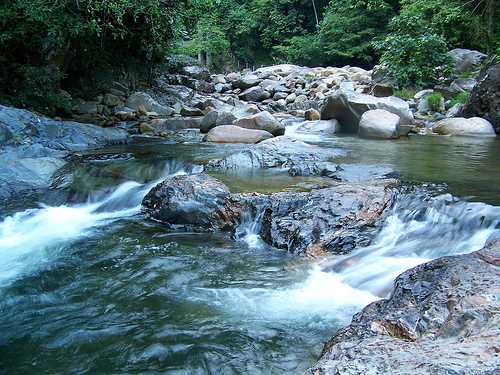
The Pasoh Caves, the southernmost limestone cave complex in Malaysia, is also located in Jelebu.  The caves are also known for being the first Paleolithic site in southern Peninsular Malaysia, as well as the southernmost in Malaysia. Some of the artefacts discovered here in an excavation are as old as 14,000 years. The Kenaboi State Park is nestled in the lush million-year-old rainforest amidst peaks of the Titiwangsa Mountains. The nature reserve is famous for being the main entry point to the tallest mountain in Negeri Sembilan, Mount Besar Hantu at 1,462 m and natural landmarks such as Lata Kijang, Lata Dinding and Lata Berungut. The Customs Museum or the Muzium Adat is a museum that exhibits the facets and lifestyle of the people of Negeri Sembilan. It was constructed in 2005 and officially opened on 2 February 2008. The museum is housed in a four-story building, with a giant replica of a Malay headdress at the top of its entrance and consists of four galleries, which include the introduction of customs, life cycle, intellectual tradition, government and power and Pepatih customs.

Seremban

Originally founded as Sungei Ujong, Seremban is the capital of Negeri Sembilan and is named after a nearby river of the same name. The town gained its city status on 20 January 2020. Sungei Ujon still exists as road names and the name of the luak or chiefdom that formed Negeri Sembilan. Among the Chinese-speaking community, the city is known as Fùhyùhng in Cantonese and Fúróng in Mandarin which means hibiscus, which comes from a phonetic approximation of Ujong. Seremban lies about 60 km south of the country’s capital, Kuala Lumpur, about 55 km south of Malaysia’s administrative centre, Putrajaya and 40 km from the Kuala Lumpur International Airport. 

Sungai Ujong, or Sening Ujong, as it was originally known, was an ancient settlement. It has been said in the Malay Annals that King Parameswara reportedly visited Sening Ujong after fleeing the kingdom of Singapura before ultimately establishing the Malacca Sultanate. It was also referred to as Sang Hyang Ujong in Javanese accounts, notably the Nagarakretagama, as well as Suneujon in Godinho de Erédia’s cartographic records, which dates back to 1613. Growth took off after the discovery of tin ore in the 1870s and the discovery of tin in Rasah saw an influx of Arab, Malay and Chinese immigrants to work in the mines and trade there.

Renamed Seremban, the town flourished not only as a mining area but also as a business centre. The Linggi River served as the sole outlet to ferry tin and supplies in and out of the town. Revenue came not only from the tin trade but also from the large amount of taxes collected, much to the displeasure of the traders and the British in the neighbouring port of Malacca. Because of the local chieftains were at odds with each other, the British were able to assert their influence and authority in Negeri Sembilan.

Before 2020, Seremban was one of four state capitals that had yet to be elevated to city status; the other three being Kota Bharu in Kelantan, Kuantan in Pahang and Kangar in Perlis. To achieve city status, the Nilai Municipal Council and Seremban Municipal Council were merged to form a new local authority, Seremban City Council.

Seremban is situated about 60 kilometres south of Kuala Lumpur, the capital city of Malaysia, 50 kilometres south of the administrative capital Putrajaya, and about 30 kilometres inland from the coast. Part of the Malaysia Vision Valley corridor and the National Growth Conurbation, Seremban is considered to be the southern limit of the Greater Kuala Lumpur metropolitan area.[14][15] It is located in the Linggi River valley, at the western fringes of the Titiwangsa Mountains. The terrain is generally hilly, and the soil is mostly reddish laterite soil, suitable for the cultivation of rubber and palm oil, thus making Seremban the agricultural centre for the state. Since the establishment of Seremban, the Linggi River has played an important role in the city’s growth. During the boom period of tin mining, the Linggi River served as the major transportation route for tin traders. Today, it is one of the major sources of water for the Seremban metropolitan area and Negeri Sembilan.

Dubbed the fish pond, Seremban Square is an area of open land in the downtown Seremban area which recently been given a new look. From a barren, neglected piece of land which was the breeding ground for mosquitoes, today it is known as Seremban Square, which decorates the main entrance to Seremban. Here, the Malaysian flag is raised on a flagpole standing 100 feet high. Taman Tasik Seremban which is also known as Seremban Lake Garden is one of Seremban’s major attractions. Surrounded by two lakes and a lush green garden, it is a jogging favourite and many local families like to come here, especially over the weekends and public holidays. One of Malaysia’s oldest natural gardens, the garden has a children’s playground and walking tracks as well as a floating stage on the lake which hosts performances over weekends. The Seremban 2 Recreational Park is another popular destination during weekends or school holidays. At this six-acre area, visitors will be greeted with breathtaking landscapes as well as a variety of colourful kite decorations flying freely in the sky.

At the border of Selangor and Negeri Sembilan lies the small town of Broga, on which lies the Bukit Broga Hill. The hill is known for its beautiful views covered with lalang grass and palm oil plantations and is famous for its steep and adventurous hike uphill, giving a mesmerising view of sunrise and sunset. To experience the magical view while walking on the trail, walk about ten minutes after which the tiring trail starts being marked by the archway of the RHB Bank. The bank board also provides three halting and viewing points at 880 feet, 1150 feet, and 1312 feet. Over the years there has been an evident amount of damage to the pathway, so one should be careful on the main path and avoid any further damage. And because of this, it is best to avoid the hill during the monsoon season and when it rains as the path gets muddy and slippery as well as during the weekends when it gets crowded. Because it can get tiring in the sun, the best time to visit is between 9:30 am and 12 noon before the day is at its hottest. Proper hiking shoes are necessary as the way to the hill is slanted and it can be difficult to climb without proper shoes and other amenities. Parking is free and the entrance fee is RM 1 per person.

The Masjid Negeri Seremban or the State Mosque is located near the Lake Gardens. The nine pillars of this mosque symbolize the nine original states of Negeri Sembilan. The mosque features modern architectural elements as well as traditional Minangkabau architectural design. It is lit up at night when it is at its best.

The first French missionary church in Seremban, the Church of the Visitation was constructed in 1848 on two acres, surrounded by a tranquil panorama. Inspired by neo-gothic architecture, the church houses a historical Parochial House, Visitation Hall, and Formation Centres. The main hall is decorated with mosaics and stained glass windows. The church’s permanent structure was constructed in 1899 with new additions made over the years. The daily mass takes place on weekdays at 6:45 am while on Saturday, it is at 6 am and 7 am on Sundays.

Perched on top of the Wu Gong Hill in Ulu Temiang, the Centipede Temple or the Then Sze Temple is set atop 264 steps. Centipedes roamed freely in and out of the temple grounds, and it is believed that if one spots a centipede, one can expect some good fortune. The centipede stone statue is the main attraction of this temple. The statue of Lord Yue Lao or the God of Marriage is also housed inside. Several couples hook red strings and lockets here and pray for a long union. Some of the other attractions include the tortoise pool, the Guan Yin statue, a pavilion dedicated to Guan Di, the Datuk Altar, and the Eight Immortals. While the Centipede Temple is a Taoist temple, it also contains Chinese and Buddhist elements. This temple is further adorned with ceiling hangings, a Qing Dynasty bell, beautiful lanterns, a drum, and an intricately decorated door. The temple is open daily between 7 am and 7 pm.

To know more about the former Negeri Sembilan Yang di-Pertuan Besar Tuanku Ja’afar, one must visit the Galeri Diraja Tuanku Ja’afar. He was the 10th Yang di-Pertuan Agong or constitutional monarch who ruled Negeri Sembilan for 42 years. Spanning across 3 storeys, this gallery is adorned with a colonial style of architecture and private collections of the late Malaysian ruler. There are nine exhibition halls, depicting the life of Tuanku Ja’afar inside the gallery. These exhibition halls depict the life of the ruler in chronological order.  Some of the details that have been showcased in the gallery include his early life, schooling, higher education, and hobbies. Photographs showcasing his meetings with famous world leaders and politicians are also housed inside the exhibition halls. The gallery also houses paintings made by the ruler himself. The museum is closed on Mondays and other days, it is open between 10 am and 5 pm. Entry fees are RM 10 for adults and RM 5 for children.

The Negeri Sembilan Museum was established in 1953 when the 8th Yamtuan or Ruler of Negeri Sembilan, Tuanku Abdul Rahman gave his consent for the relocation of the Ampang Tinggi Palace from Kuala Pilah to the Taman Bunga at Jalan Dato’ Hamzah, Seremban and this was turned into the State Museum.

The Jelita Ostrich Farm is Malaysia’s first ostrich farm as certified by the Malaysian Book of Records. It is located on the outskirts of Seremban and is famous for its ostriches. This farm is also a haven for many other animals and birds like goats, geese, ducks, turkeys and horses. A walking tour is available to explore the farm. Visitors can compete in the man-against-egg challenge where visitors bag a chance to stand on the hard-to-break ostrich egg. The farm houses a souvenir shop selling an exclusive range of ostrich oil-based hair and skin care products and some ostrich essence. Entry fees are RM 8 for adults and RM 6 for children and the farm is open daily from 9 am to 5 pm.

Sri Menanti

The royal capital of Negeri Sembilan, Seri Menanti is located 33 km northeast of the state capital of Seremban. The town houses the seat of the Yang Di-Pertuan Besar of Negeri Sembilan or Yamtuan Besar, the ruler of the state. The royal palace is known as Istana Besar. The area under which Seri Menanti is known as the Adat Circle or Adat Lingkungan in Malay. Seri Menanti also governs the surrounding chiefdoms or luaks of Terachi, Gunung Pasir, Ulu Muar, Jempol and Inas, of which they are collectively known as Luak Tanah Mengandung.

The Minangkabau people moved to the wider area of Negeri Sembilan during the 14th century as part of the Minang practice of merantau. Around the 15th century, they moved further inland from Rembau and explored the area that is known today as Seri Menanti. Among the explorers was Datuk Puteh of Pagar Ruyung. According to legend, they found three stalks of fresh green paddy and thus Datuk Puteh christened the area Padi Menanti which means awaiting paddy. Over time the name changed to Seri Menanti. It is believed that the word Seri means the Goddess of rice in the ancient Javanese tradition.

Raja Melewar arrived in Negeri Sembilan in 1773 and was installed and proclaimed as the first Yamtuan Besar in Kampung Penajis in Rembau. He later moved his palace to Seri Menanti which remains the royal town of Negeri Sembilan.

A few traditionally styled houses, a derivative of the Minangkabau design Rumah Gadang remain standing around Seri Menanti and in the adjacent villages. A significant portion of the land in Seri Menanti is Malay Reserve and Malay Customary Land or Tanah Adat.

The incumbent Tunku Besar of Seri Menanti is Tunku Ali Redhauddin, the eldest son of the Yang Di-Pertuan Besar of Negeri Sembilan Tuanku Muhriz ibni Almarhum Tuanku Munawir. The title of Tunku Besar Seri Menanti is the most senior of the Putera Yang Empat or the Four Princes. This is the third time in 120 years that the Tunku Besar Seri Menanti has been appointed. The official palace of the Yang Di-Pertuan Besar Negeri Sembilan is the Istana Besar. Completed in 1932, palace has numerous facilities with gardens that oversee the Straits of Johor. The palace complex consists of the Main Palace, the Throne Room or Balairong Seri, and the Royal Banquet Hall. However, it is not open to the public to visit but instead hosts royal banquets and events. Istana Seri Menanti is a beautiful 4-storied Malay architectural structure that was built without any nails. The palace exhibits costumes, weaponry, bed chambers as well as documents on the royal lineage on display in the museum.

The old wooden palace, known as Istana Lama, was built and officiated during the reign of Yang Di-Pertuan Besar Tuanku Muhammad Shah ibni Almarhum Tuanku Antah who reigned between 1888 and 1933. It is made in part of Chengal or Penak wood Neobalanocarpus and ironwood or Belian wood and held together using only wooden pegs. The palace took six years to build and was completed in 1908 for $45,000. The design has subtle hints of Minangkabau architecture, with five levels rising to a height of sixty-seven feet or approximately twenty meters high and has ninety-nine columns to support the main structure. The Istana Lama was a replacement for the Istana Pulih which was burned down by the British. This palace was used until 1932 after which the Yang Di-Pertuan Besar moved to the Istana Besar. The Istana Lama has been designated as a national heritage site and was converted into a Royal Museum in 1992.

The Tuanku Munawir Royal Mosque, which was built in 1964 is located next to the Royal Palace. The architectural design has been credited to the Mughals, with golden domes roofs, minarets and triangular arches. There is a verandah and a serambi that shows the local intricacies.

And this brings us to the end of this delightful state which has something for everyone. Keep watching this space as we move to explore the state of Pahang next.