In My Hands Today…

Atomic Habits: An Easy & Proven Way to Build Good Habits & Break Bad Ones – James Clear

If you’re having trouble changing your habits, the problem isn’t you. The problem is your system. Bad habits repeat themselves again and again not because you don’t want to change, but because you have the wrong system for change. You do not rise to the level of your goals. You fall to the level of your systems. Here, you’ll get a proven system that can take you to new heights.

Clear is known for his ability to distill complex topics into simple behaviors that can be easily applied to daily life and work. Here, he draws on the most proven ideas from biology, psychology, and neuroscience to create an easy-to-understand guide for making good habits inevitable and bad habits impossible. Along the way, readers will be inspired and entertained with true stories from Olympic gold medalists, award-winning artists, business leaders, life-saving physicians, and star comedians who have used the science of small habits to master their craft and vault to the top of their field.

Learn how to:

  • make time for new habits (even when life gets crazy);
  • overcome a lack of motivation and willpower;
  • design your environment to make success easier;
  • get back on track when you fall off course;
    …and much more.

Festivals of India: Vata Purnima

Also called Vata Savitri, Vata Purnima is a Hindu celebration observed by married women in the Mithila region of Bihar and Jharkhanand, some regions of Uttar Pradesh and the western states of Maharashtra, Goa and Gujarat. It is a day which celebrates a married woman’s love for her husband. The northern states celebrate Vata Savitri which usually occurs about 15 days before Vata Purnima. This year the Vata Savitri vrat was celebrated on 10 June and the Vata Purnima will be celebrated tomorrow, 24 June.

On this full moon day, called Purnima in India, during the three days of the month of Jyeshtha according to the Hindu calendar, which falls in May–June in the Gregorian calendar, a married woman marks her love for her husband by tying a ceremonial thread around a banyan tree. The celebration is based on the legend of Savitri and Satyavan as narrated in the epic Mahabharata.

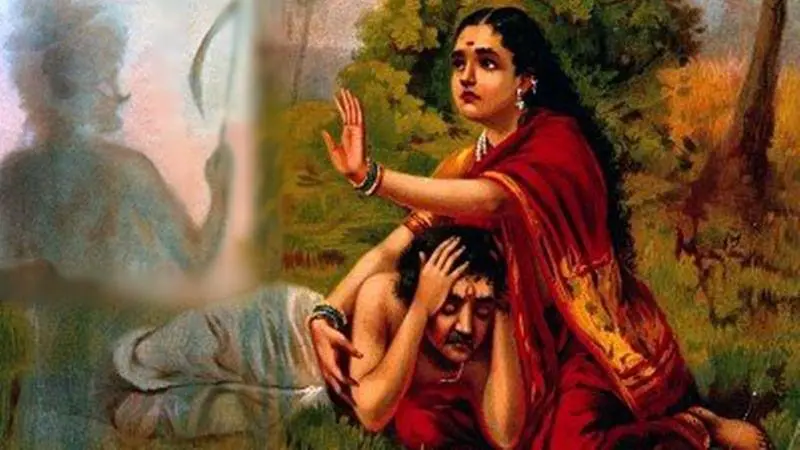
According to the legend, the childless king Aswapati and his consort Malavi wished to have a son and they pray to the God Savitr who appears before the king and tells him he will soon have a daughter who is named Savitri in honor of the God. Savitri is so beautiful and pure that no man will ask for her hand in marriage. Her father tells her to find a husband on her own and she sets out on a pilgrimage for this purpose and finds Satyavan, the son of a blind king named Dyumatsena who lives in exile as a forest-dweller. Savitri returns to find her father speaking with Sage Narada who tells her she has made a bad choice: although perfect in every way, Satyavan is destined to die one year from that day. Savitri insists on going ahead and marries Satyavan. Three days before the foreseen death of Satyavan, Savitri takes a vow of fasting and vigil. Her father-in-law tells her she has taken on too harsh a regimen, but she replies that she has taken an oath to perform the regimen and Dyumatsena offers his support. The morning of Satyavan’s predicted death, he is splitting wood and suddenly becomes weak and lays his head in Savitri’s lap and dies. Savitri places his body under the shade of a Banyan tree or Vat. Yama, the God of death, comes to claim Satyavan’s soul and Savitri follows him as he carries the soul away. She offers him praise and Yama, impressed by both the content and style of her words, offers her any boon, except the life of Satyavan. She first asks for eyesight and restoration of the kingdom for her father-in-law, then a hundred children for her father, and then a hundred children for herself and Satyavan. The last wish creates a dilemma for Yama, as it would indirectly grant the life of Satyavan. However, impressed by Savitri’s dedication and purity, he offers her one more chance to choose any boon, but this time omitting “except for the life of Satyavan”. Savitri instantly asks for Satyavan to return to life. Yama grants life to Satyavan and blesses Savitri’s life with eternal happiness. Satyavan awakens as though he has been in a deep sleep and returns to his parents along with his wife. Meanwhile, at their home, Dyumatsena regains his eyesight before Savitri and Satyavan return. Since Satyavan still does not know what happened, Savitri relays the story to her parents-in-law, husband, and the gathered ascetics. As they praise her, Dyumatsena’s ministers arrive with news of the death of his usurper. Joyfully, the king and his entourage return to his kingdom.

Though the tree does not play a significant role of the story, it is worshiped in memory of the love in the legend. The festival is followed by married women only, and is prohibited for children and widows.

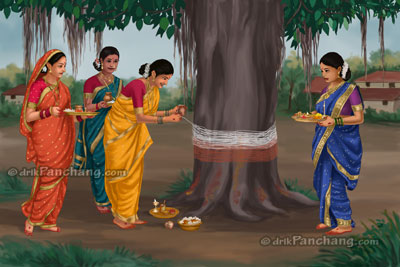
On the occasion of the festival, married women keep a fast of three days for their husbands life, just like what Savitri did. During the three days, pictures of a Vat or a banyan tree, Savitri, Satyavan, and Yama, are drawn with a paste of sandal and rice on the floor or a wall in the home. Golden engravings of the couple are placed in a tray of sand, and worshiped with mantras and banyan leaves. Women also listen to the Savitri-Satyavan katha or story and worship the banyan tree outside. A thread is wound around the trunk of the tree, and copper coins are offered. Strict adherence to the fast and tradition is believed to ensure the husband a long and prosperous life.

According to an expert, B. A. Gupte, the Puranas seem to suggest that the mythology behind the festival is symbolic of natural phenomena with the festival the representation of the annual marriage of the earth and nature represented by Satyavan and Savitri. It is like the way the earth dies every year and is rejuvenated by the powers of nature and points out that the Vat or banyan tree was likely chosen due to the mythological aspects connected to the tree known to Indians. Today, the festival is celebrated with women dressing in fine sarees and jewelry, and their day begining with the offering of any five fruits and a coconut. Each woman winds white thread around a banyan tree seven times as a reminder of their husbands and then they fast for the whole day.

In My Hands Today…

Start with Why: How Great Leaders Inspire Everyone to Take Action – Simon Sinek

Why do you do what you do?

Why are some people and organizations more innovative, more influential, and more profitable than others? Why do some command greater loyalty from customers and employees alike? Even among the successful, why are so few able to repeat their success over and over?

People like Martin Luther King Jr., Steve Jobs, and the Wright Brothers might have little in common, but they all started with why. It was their natural ability to start with why that enabled them to inspire those around them and to achieve remarkable things.

In studying the leaders who’ve had the greatest influence in the world, Simon Sinek discovered that they all think, act, and communicate in the exact same way—and it’s the complete opposite of what everyone else does. Sinek calls this powerful idea The Golden Circle, and it provides a framework upon which organizations can be built, movements can be lead, and people can be inspired. And it all starts with WHY.

Any organization can explain what it does; some can explain how they do it; but very few can clearly articulate why. WHY is not money or profit—those are always results. WHY does your organization exist? WHY does it do the things it does? WHY do customers really buy from one company or another? WHY are people loyal to some leaders, but not others?

Starting with WHY works in big business and small business, in the nonprofit world and in politics. Those who start with WHY never manipulate, they inspire. And the people who follow them don’t do so because they have to; they follow because they want to.

Drawing on a wide range of real-life stories, Sinek weaves together a clear vision of what it truly takes to lead and inspire. This book is for anyone who wants to inspire others or who wants to find someone to inspire them.

International Day of Yoga

Source

Celebrated on 21 June annually since 2015, the International Day of Yoga was first proposed by the Indian Prime Minister Narendra Modi in 2014. The date of the day, 21 June was suggested as it is the longest day of the year in the northern hemisphere and shares a special significance in many parts of the world. From the perspective of yoga, the summer solstice marks the transition to Dakshinayana, when the sun travels towards the south on the celestial sphere. The second full moon after summer solstice is known as Guru Poornima. Lord Shiva, the first yogi or Adi Yogi, is said to have begun imparting the knowledge of yoga to the rest of mankind on this day, and became the first guru.

Yoga is a group of physical, mental, and spiritual practices or disciplines which originated in ancient India and is one of the six orthodox philosophical schools of Hinduism. In the western world, yoga often denotes denotes a modern form of hatha yoga with yoga as exercise, consisting largely of the postures or asanas. The practice of yoga has been thought to date back to pre-vedic Indian traditions, possibly in the Indus valley civilization around 3000 BC and the practice is mentioned in the Rigveda and referenced in the Upanishads, though it most likely developed as a systematic study around the 5th and 6th centuries BC. Hatha yoga texts began to emerge sometime between the 9th and 11th centuries with origins in tantra. Yoga in Indian traditions is more than physical exercise, it has a meditative and spiritual core. Derived from Sanskrit, the root word for Yoga is yug which means to attach, join, harness or yoke and refers to uniting with someone or joining. The ancient Indian sage Patanjali is thought to be the Father of Modern Yoga because he is the person who codified all the aspects of Yoga into a certain format and introduced Yoga Sutras.

The International Day of Yoga aims to raise awareness worldwide of the many benefits of practicing yoga. It is important for individuals and populations to be able to make healthier choices and follow lifestyle patterns that foster good health. In this regard, it is important to reduce physical inactivity, which is among the top ten leading causes of death worldwide, and a key risk factor for non-communicable diseases, such as cardiovascular diseases, cancer and diabetes. Other than other physical activies one can do, yoga is is an activity which is more than just a physical activity. In the words of one of its most famous practitioners, the late B. K. S. Iyengar, “Yoga cultivates the ways of maintaining a balanced attitude in day-to-day life and endows skill in the performance of one’s actions.”

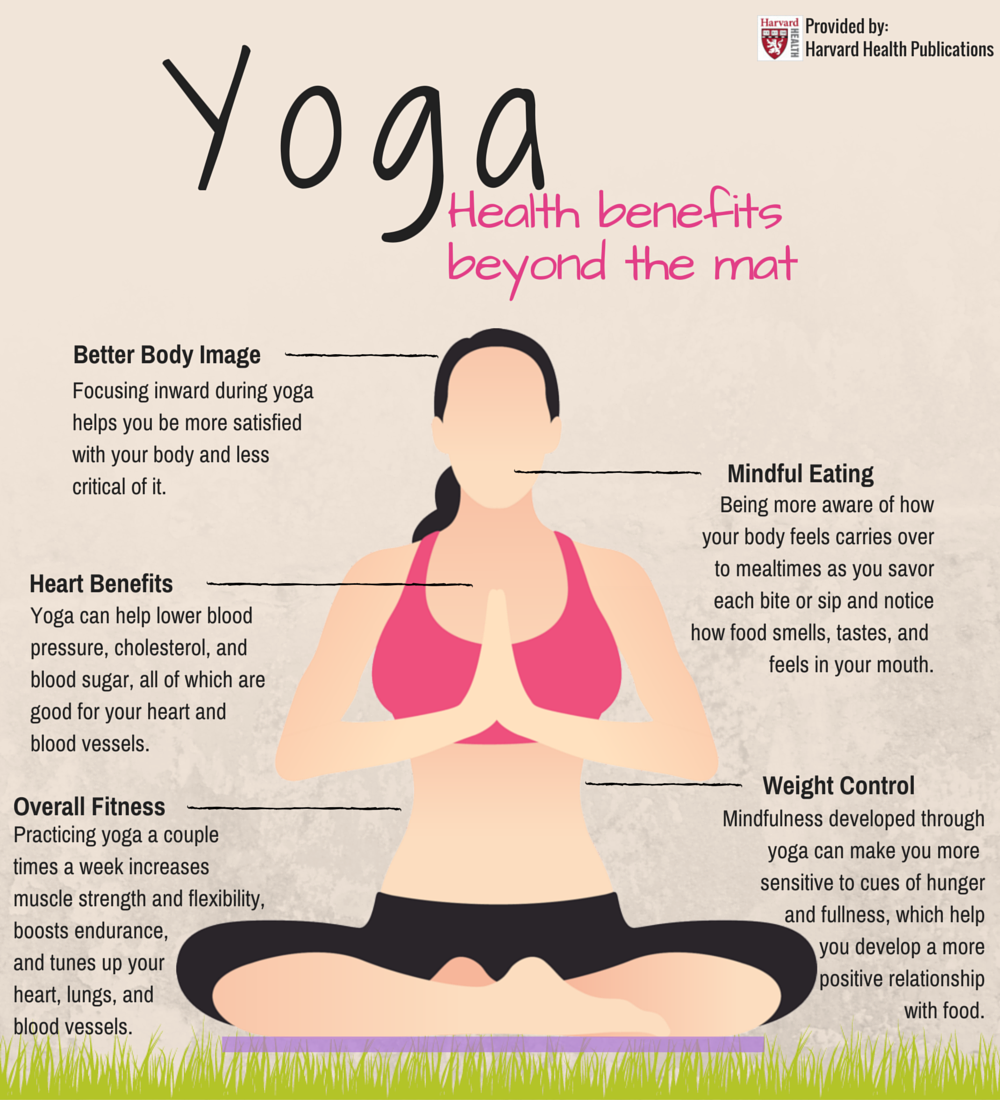
Yoga offers physical and mental health benefits for people of all ages and if one is going through an illness, recovering from surgery or living with a chronic condition, yoga can become an integral part of their treatment and potentially hasten healing. The benefits of yoga improves strength, balance and flexibility, helps with back pain relief, ease arthritis symptoms, benefits the heart health, relaxes the practitioner and help them sleep better, improve energy levels, better the mood and manage stress and promotes better self-care by providing a balance between the body, mind and soul.

So how can one celebrate this day? Create awareness about the benefits of yoga and take part in in a yoga class, preferably online or in a small group. You can also watch yoga videos on and correct your postures and share with family and friends the importance of yoga.

2021 Week 24 Update

There is a tremendous amount of determination and resilience in the human spirit and when we fail, we discover new meanings to our lives, forcing us to reach deep to find solutions to the problems that have plagued us. This is exactly what this quote attributed to Winston Churchill tells us. Whenever we feel rejected and are bogged down by failure, we must remember that this is not the end, what matters is that we must brush it off, get up and fight more.

This brings us to the worldwide fight against COVID-19 with the help of vaccinations. Singapore has about 47% of the eligible people vaccinated with at least one dose of the vaccine and the aim is to have at least 80% of the population vaccinated with at least the first dose by mid-August. Worldwide, about 21% of the population has been vaccinated with at least one dose and Asia is also pretty much at the same number. India’s 15.5% of the population has been vaccinated with at least one dose and has vaccinated about 15.5% of its population. I understand that the target to fully vaccinate the population is 31 December 2021, but at current levels of vaccinations, it would mean that the vaccine rates will need to four times more than the current rates to reach the target of 31 December.

This week, I was completely unproductive and I think it was a counterpoint to last week’s super productive week, so here’s hoping this coming week will be a good one for me. GG & BB also had a quiet week, though BB had to go back to school one day to make up for those lab lessons which had to be cancelled because of the restrictions last month.

That’s all from us this week, stay safe, stay masked and get vaccinated people!