Black Edge: Inside Information, Dirty Money, and the Quest to Bring Down the Most Wanted Man on Wall Street – Sheelah Kolhatkar
Steven A. Cohen changed Wall Street. He and his fellow pioneers of the hedge fund industry didn’t lay railroads, build factories, or invent new technologies. Rather, they made their billions through speculation, by placing bets in the market that turned out to be right more often than wrong and for this, they gained not only extreme personal wealth but formidable influence throughout society. Hedge funds now oversee more than $3 trillion in assets, and the competition between them is so fierce that traders will do whatever they can to get an edge.
Cohen was one of the industry’s biggest success stories, the person everyone else in the business wanted to be. Born into a middle-class family on Long Island, he longed from an early age to be a star on Wall Street. He mastered poker in high school, went off to Wharton, and in 1992 launched the hedge fund SAC Capital, which he built into a $15 billion empire, almost entirely on the basis of his wizard like stock trading. He cultivated an air of mystery, reclusiveness, and excess, building a 35,000-square-foot mansion in Greenwich, Connecticut, flying to work by helicopter, and amassing one of the largest private art collections in the world. On Wall Street, Cohen was revered as a genius: one of the greatest traders who ever lived.
That image was shattered when SAC Capital became the target of a sprawling, seven-year investigation, led by a determined group of FBI agents, prosecutors, and SEC enforcement attorneys. Labeled by prosecutors as a magnet for market cheaters whose culture encouraged the relentless pursuit of edge and even black edge, which is inside information SAC Capital was ultimately indicted and pleaded guilty to charges of securities and wire fraud in connection with a vast insider trading scheme, even as Cohen himself was never charged.
Black Edge offers a revelatory look at the gray zone in which so much of Wall Street functions. It’s a riveting, true-life legal thriller that takes readers inside the government’s pursuit of Cohen and his employees, and raises urgent and troubling questions about the power and wealth of those who sit at the pinnacle of modern Wall Street.
In order to be able to feed the world’s growing population, we need ever more food, which must be diverse, balanced and of good quality to ensure the progress and well-being of humankind.
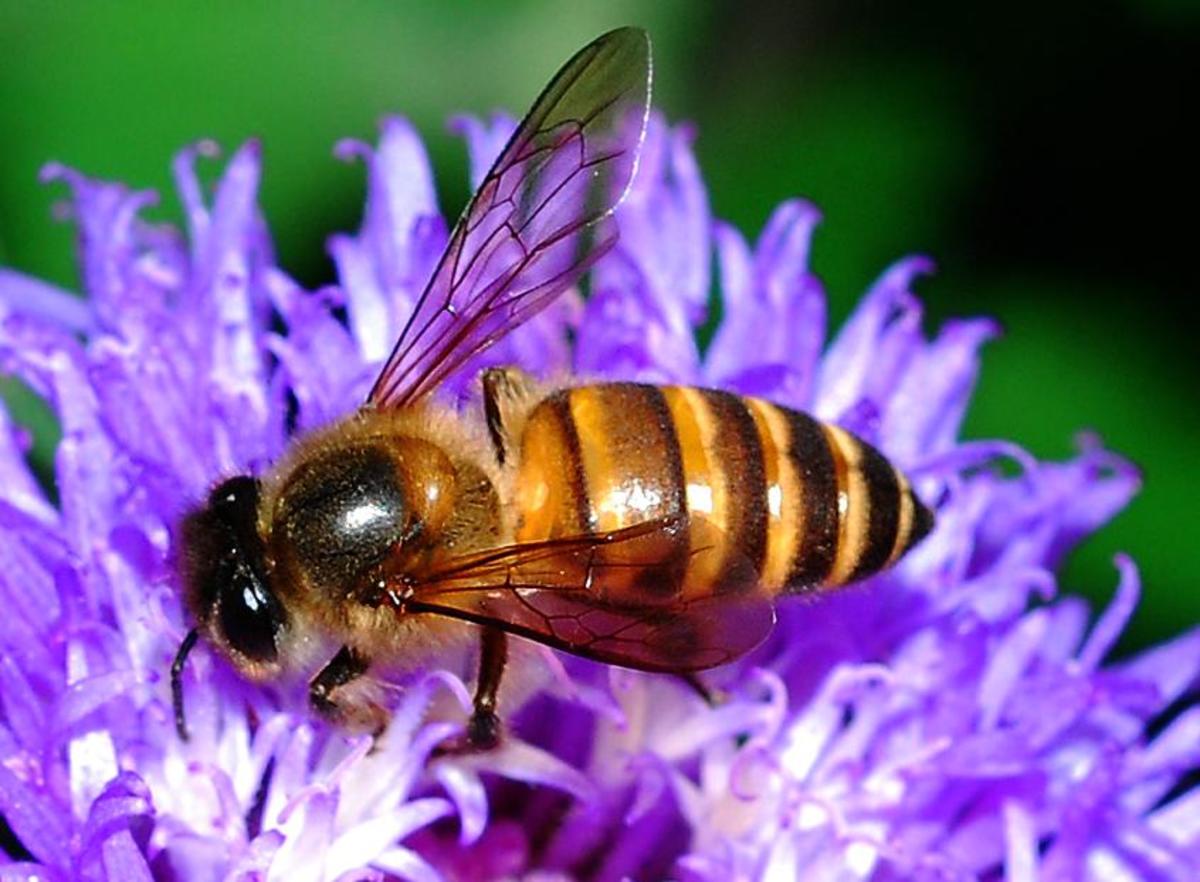
Honey bees are amazing insects that have a lot of impact on humans. They are hardworking creatures that underpin the sustenance of life in this planet earth. However, people have increasingly predisposed them to unfavorable environments, leading to massive deaths. Bees are renowned for their role in providing high-quality food like honey, royal jelly and pollen and other products used in healthcare and other sectors like beeswax, propolis and honey bee venom. The greatest contribution of bees and other pollinators is the pollination of nearly three quarters of the plants that produce 90% of the world’s food. A third of the world’s food production depends on bees, i.e. every third spoonful of food depends on pollination. In addition to being one of the major pollinators, thus ensuring food and food security, sustainable agriculture and biodiversity, bees significantly contribute to the mitigation of climate change and environmental conservation. In the long-term, the protection of bees and the beekeeping sector can help reduce poverty and hunger, as well as preserve a healthy environment and biodiversity. Scientific studies have proven that bees have become increasingly endangered and it is only through joint efforts that we can ensure the protection of bees and their habitats.
If all of the world’s bees died off, there would be major rippling effects throughout ecosystems. A number of plants, such as many of the bee orchids, are pollinated exclusively by specific bees, and they would die off without human intervention. This would alter the composition of their habitats and affect the food webs they are part of and would likely trigger additional extinctions or declines of dependent organisms. Other plants may utilize a variety of pollinators, but many are most successfully pollinated by bees. Without bees, they would set fewer seeds and would have lower reproductive success. This too would alter ecosystems. Beyond plants, many animals, such as the beautiful bee-eater birds, would lose their prey in the event of a die-off, and this would also impact natural systems and food webs.
Celebrated every year on 20 May since 2017, the World Bee Day was proposed by Slovenia, which is the birth anniversary of Anton Janša, a Slovenian beekeeper and the pioneer of modern beekeeping, who was born on this day in 1734. Also in May, the northern hemisphere sees bees and nature develop profusely, while the southern hemisphere enters autumn, when hive products are harvested and the season of honey and honey-based products begins.
This day has become increasingly important in recent times. Bees have become increasingly endangered of late. The 2015 IUCN report, which contains the first comprehensive assessment of the European bee species, states that nearly 10% of bees are facing extinction, and around 5% of them are probably endangered, while no data is available for nearly 57% of species. The number of pollinators is in decline around the world, while the need for pollination is on the rise, especially in developing countries. In some parts, this situation has become known as the pollinator crisis. According to researchers, the main reasons for the mortality of bees include diseases specific to bees, the mass use of products intended to protect plants in modern farming and their potential impact on pollinators, especially plant protection products whose harmful effect on bees has been documented, new pests which spread faster due to globalisation, urbanisation, which is shrinking the agricultural space, climate change and the global trade in low-quality honey, which impacts the beekeeping economy. A study published in the journal Lancet predicts that smaller consumption of fruit and vegetables due to climate change which also affects pollinators, will cause twice as many deaths by 2050 than hunger and malnutrition.
We need to act now. Present species extinction rates are 100 to 1,000 times higher than normal due to human impact. Close to 35 percent of invertebrate pollinators, particularly bees and butterflies, and about 17 percent of vertebrate pollinators, such as bats, face extinction globally. If this trend continues, nutritious crops, such as fruits, nuts and many vegetable crops will be substituted increasingly by staple crops like rice, corn and potatoes, eventually resulting in an imbalanced diet. Intensive farming practices, land-use change, mono-cropping, pesticides and higher temperatures associated with climate change all pose problems for bee populations and, by extension, the quality of food we grow.
So what can we as individuals do? We can plant a diverse set of native plants, which flower at different times of the year, buy raw honey from local farmers, buy products from sustainable agricultural practices, avoid pesticides, fungicides or herbicides in gardens, protect wild bee colonies when possible, sponsor a hive, make a bee water fountain by leaving a water bowl outside, help sustain forest ecosystems and raise awareness by sharing information within our communities and networks. Remember, the decline of bees affects us all!
Born with an insatiable wanderlust and inspired by an addiction to travel writing, but restricted by the demands of a full time job, Matthew Lightfoot set out to explore the world using his annual holiday allowance.
The Two Week Traveller tells the tales of his adventures in almost 150 countries.
Often described as ‘one of those people that things just happen to’, he lives up to his reputation with a collection of humorous, hair-raising and thought-provoking travel tales that span the entire globe.
Being chased by rogue elephants and robbed at gunpoint by a stoned policeman; accidentally cycling down an airport runway and getting trapped in a voodoo ceremony are the type of activities Matthew Lightfoot gets up to on his holidays.
Inspiration for budget travellers, self-drivers, trip planners and anyone who loves to travel but also has to work. And everyone who understands that the journey is as important as the destination.
The Two Week Traveller. When a fortnight on the beach isn’t enough.
The other day, when I was cooking, I started thinking about the ubiquitous kitchen aid in an Indian kitchen – the pressure cooker. Every household has at least one and many have multiple. I currently have two in different sizes and have over the years used different sizes depending on my need at that point.
In my extended family, we have almost to a person used pressure cookers from one particular brand, specifically those with a dome top which allows (according to me), slightly more items into the cooker than the other commonly available design which is slightly inserted into the pan.
For the uninitiated, pressure cooking is the process of cooking food under high-pressure steam, employing water or a water-based cooking liquid, in a sealed vessel known as a pressure cooker. High-pressure limits boiling and permit cooking temperatures well above 100 °C or 212 °F to be reached.
The pressure cooker was invented in the seventeenth century by the physicist Denis Papin. It works by expelling air from the vessel and trapping the steam produced from the boiling liquid inside. This raises the internal pressures and permits high cooking temperatures and together with high thermal heat transfer from the steam, cooks food far more quickly, often cooking in between half and a quarter the time for conventional boiling. After cooking, the steam pressure is lowered back to ambient atmospheric pressure, so that the vessel can be opened safely. Almost any food that can be cooked in steam or water-based liquids can be cooked in a pressure cooker.
In an Indian kitchen, a pressure cooker is an essential tool. An entire meal can be prepared in the cooker and many cooks including my mother do exactly that. Rice and the dal of the day are cooked together, saving both time and fuel. Many recipes, including mine, have the number of whistles from the pressure cooker as part of the recipe. For example, how many whistles to cook rice, dal or even chana is something a mother would impart to her child who is starting out using the pressure cooker. Every Indian child has memories of being woken up to the sounds of the cooker whistling or children and infants startled by the sounds. I remember BB & GG being so scared of the whistles from the cooker when they were infants and toddlers that I used to make sure I am around them to soothe them when this happened.
The early pressure cookers used to explode because of spurious spare parts and one of the original pressure cooker manufacturers in India, Prestige realised that while they could not counter the spurious spare parts sold by dealers across a country as large as India, they came up with a solution that would prevent the cookers from bursting even if spurious spare parts were used — the Gasket Release System. How this worked was whenever the cooker was overloaded or the safety valve blocked, the rubber ring or the gasket would be pushed out through a slot in the lid, thus releasing the excess steam.
Pressure cookers have many benefits. Cooking in a pressure cooker ensures that food retains most of their nutrients and are tastier. This is because food is cooked quickly and on high heat using minimal liquids which means food is less likely to lose its colour and nutrients. Pressure cooking is far more efficient than using multiple pots on separate burners and can result in significant energy savings. They are also best for one-pot recipes. Cooking time is greatly reduced as foods cook up to 70% faster when a pressure cooker is used, making it a handy tool to quickly get the meal on the table. Because you can do one-pot cooking in a pressure cooker, it is easier for clean-ups as there are fewer utensils to clean.
There is even a Pressure Cooker Baba temple in Siachen, close to India’s borders. The story behind it says that a pressure cooker in an army post on the glacier attracted a Pakistani heat-seeking missile, saving the soldiers it was aimed at. In gratitude, they built a shrine at the spot.
Today electric pressure cookers are taking over and in the distant future, the ubiquitous pressure cooker, a staple in every Indian home may find itself extinct, but till then, let’s celebrate and enjoy this kitchen gadget that has made so many yummy dishes for us.
The situation in Singapore has become quite bad with more local cases being reported daily for almost two weeks now. And the variants now associated with India, B6171 and 16172 has also landed in Singapore and this is very concerning because this variant is supposed to have a higher attack rate, are more infectious and create larger clusters. Because of this, Singapore has been put into a sort of lockdown without actually using the word. We’re all now mostly at home and don’t go out unless absolutely necessary. On Friday, when the new measures were announced, supermarkets saw panic buying, a repeat from last year when the Circuit Breaker was announced. This inspite of assurances from the supermarkets that they had sufficient supplies. GG has this week as home based learning which was announced a couple of weeks earlier, but BB was telling me that he was told by his lecturer that they may get into full home based learning very soon.
India has confirmed almost 24.5 million cases is reporting 300,000 to 400,000 cases daily. This is a marked contrast to the US, which though has reported more than 33.5 million cases is seeing a lower number of cases daily. This is because of the increased vaccination rate in the US compared to India. There does not seem to be any end in sight and everyone is having COVID fatigue and just want this to end. Let’s all pray for all of us so we can weather this crisis too.
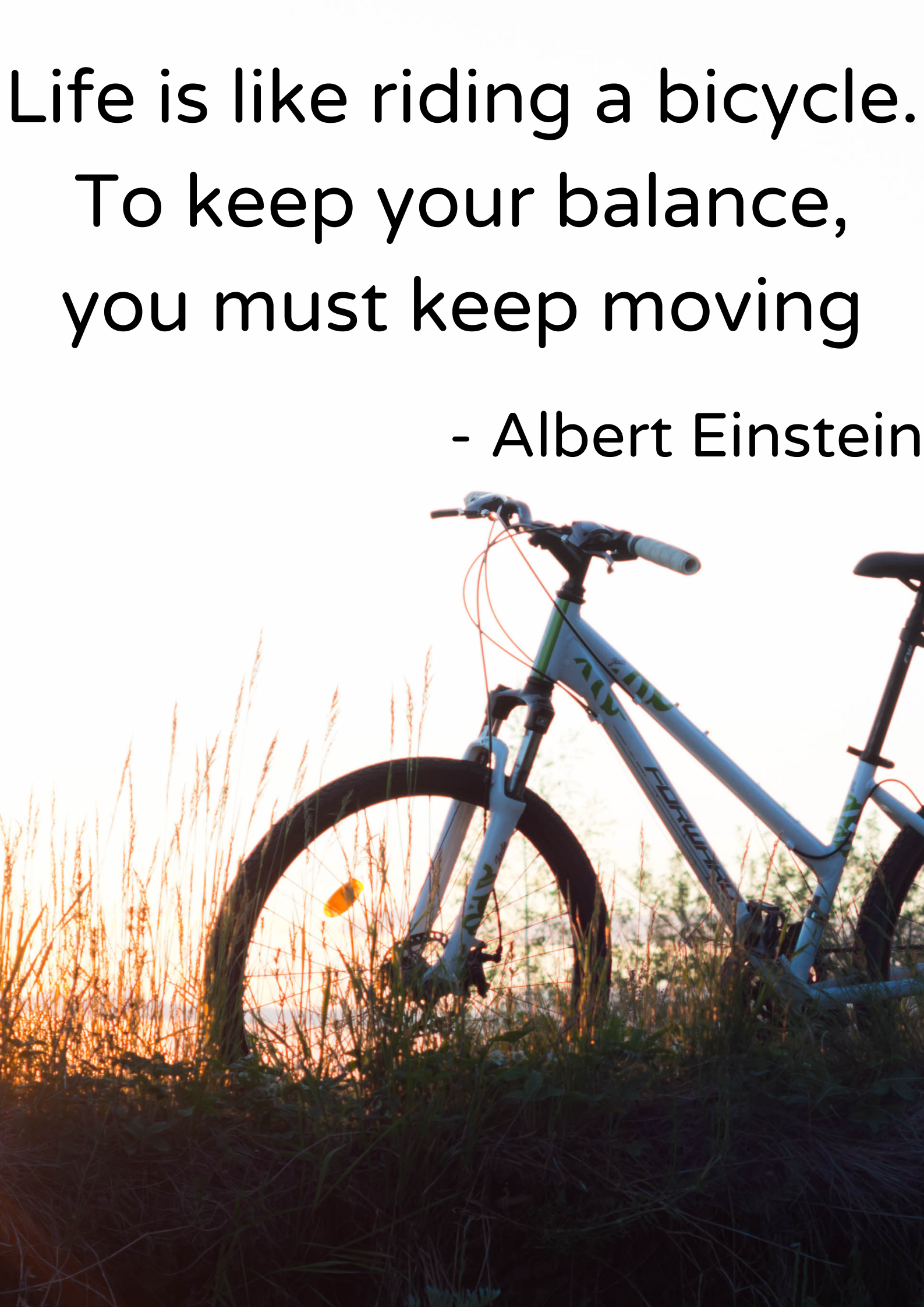
Today’s positivity quote comes from Albert Einstein who says that life is like a bicycle and one has to keep moving to stay in balance. Life is never static and is constantly moving and so to stay in balance throughout life, one my keep moving as the minute one stops, we will lose our balance and fall down.
That’s all from me this week, stay safe folks and don’t go out unless it is absolutely necessary.






 Memories and Such