Today is the festival of Avani Avittam and Raksha Bandhan. Both are festivals which are male centric festivals and which come on the same day each year. I have written about both festivals previously so will not go into the details here. I have always wondered why two diverse festivals – one celebrated in North India and the other mostly in South India, which are possibly the only festivals in the respective cultures which are a celebration of the male gender fall on the same day. Recently I had a ephipany. In both these festivals, the star of the show, if we can call it that, are threads that bind us to our loved ones, to our traditions and to our roots.
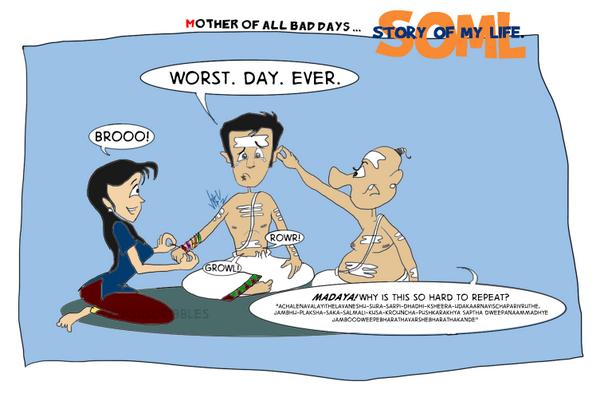
During Avani Avittam, which typically falls on the full moon day of the Shravan month, male Brahmin men and boys who have had their thread ceremony done, reaffirm their faith as a twice born and by changing their sacred thread, they symbolically throw away their sins of the previous year and start the year on a clean slate.
The festival is one of the most auspicious festivals for Brahmins and the day is an important one for those who follow the Yajurveda as on this day they start reading Yajur Veda, which they continue to read for the next six months. It is believed that on Avani Avittam, Lord Vishnu has reincarnation himself as Lord Hayagriya, who is seen as the symbol of wealth and knowledge. On this day, God Vishnu who is worshiped as the high deity power actually restored the Vedas to Brahma.
There is a story behind these sacred threads. Lord Brahma, the creator was filled with pride for knowing the entire Veda. Lord Vishnu to crush his pride created two demons Madhu and Kaitabha to steal Vedas from him. Brahma then not being able to save Vedas, he asked Vishnu to help him restore it. Lord Vishnu took the form of Hayagriva and restored the Vedas and supressed the pride of Brahma. Hence, Hayagriva incarnation is associated with knowledge and wisdom.This day is celebrated as Upakarma(Beginning) also called as Hayagriva utpatti. Restoration of Vedas is known as a mark of new beginning and hence Upakarama is celebrated.This day is also referred as Hayagriva Jayanti.
The sacred thread comprises of three strands, joined by a knot known as Brahmagranthi or the knot of Brahma. The three strands symbolise the Hindu trinity – Shiva, Vishnu and Brahma. There are other interpretations which represent many of the other triads like Mahasaraswati, Mahalakshmi and Mahakali; or the three tendencies known as sattva or harmony, rajas or passion and tamas or chaos. You could also interpret the three strands as the link between the past, present and the future or the three states of wakefulness, dream and deep sleep. Some even say that it represents the three dimensions known as heaven or swarga, earth or martyaloka and the nether regions or patala. The sacred thread is also a kind of an indication to the marital status of the wearer. An unmarried man will wear one thread of three stands, a married man will wear two and a married man who has had his first child will wear three. In the old days, when most men did not wear a upper garment, this was the indicator people had about their marital status and if they had any children.
This year, the ceremony of changing the sacred thread was done online at our home. S and BB woke up early and after completing their morning prayers, sat down in front of the laptop where they joined others across the island on a video platform where the resident priest chanted the mantras and went through the ceremony with them. We also received the new sacred thread by post last week after signing up and paying for the ceremony online.
BB had to rush for school, so GG quickly tied her thread of love on his wrist before he headed out of the house.
These are the threads that tie us to our roots and our traditions. I call these ceremonies and functions our anchors because without them, we are left floundering and rootless. Especially in today’s world which is so uncertain and vague, it is good to hold on to traditions that are special to you. Your lineage, irrespective of where you come from, goes back at least a few hundred years, if not millennia, so be proud of who you are and where you come from, so you can show your children and your grandchildren where they can go to.
Happy Raksha Bandhan and Avani Avittam to everyone celebrating these festivals.
As an old saying goes, friends are the family we choose. The role of a friend in someone’s life is great and to a large extent, many of our decisions are determined by what our friends say and do.
Friendship are as important to our wellbeing as eating right and exercising and they also help us grow through each year of our lives. The basic components of any relationship, from our marriage to our coworkers, are all founded in friendship. We learn how to interact with people because of our friends, even the ones that are opposite from us or share a different worldview.
One of the most overlooked benefits of friendship is that it helps keep our minds and bodies strong. In fact, it’s as important to our physical health as eating well and keeping fit. A recent Harvard study concluded that having solid friendships in our life even helps promote brain health. Friends helps us deal with stress, make better lifestyle choices that keep us strong, and allow us to rebound from health issues and disease more quickly. Friendship is equally important to our mental health. One study even suggested spending time with positive friends actually changes our outlook for the better.
Friends don’t completely cure loneliness, but they do help us during lonely times. They teach us how to accept kindness and also to reach out when we need help. Having a steady stream of friends lets us know that some friendships won’t last forever but each one brings something special. We learn more about ourselves and how important it is to have someone, who knows and understands you. A good friend can change our value system so we learn to inject more meaning into our lives. In spending time with friends, we fill up our lives with great conversation, heartfelt caring and support, and laugh out loud fun. When we fall on hard times, friends are there to put things in perspective and help us. When we have success, they’re smiling at our good fortune. We don’t just live when we have healthy friendships, we thrive.
The original idea for a day of friendship came from Hallmark cards in the 1930’s. Originally celebrated on 2nd August, the day was largely viewed cynically by the public as a money making exercise, sales of friendship day cards did not take off in Europe and by the mid-1940’s the day had faded into obscurity in the USA. The idea of a day to honour friendship was, however, adopted by a number of countries in Asia where it remained a popular custom to reserve a day for celebrating friendships and the exchange of gifts between friends.
The first World Friendship Day was proposed for 30 July 1958 by the World Friendship Crusade, an international civil organisation that campaigns to foster a culture of peace through friendship. Many years later, in 2011, the 30th July was declared as the International Day of Friendship by the General Assembly of United Nations.
Because friends are so important in our lives, in 1997, the UN General Assembly made a proposal to make 30 July the International Day of Friendship, which defined the culture of peace as a set of values, attitudes and behaviours that reject violence and endeavour to prevent conflicts by addressing their root causes with a view to solving problems. Recognising that enormous harm and suffering are caused to children through different forms of violence, the UN General Assembly emphasised that the promotion of a culture of peace and non-violence should be instilled in children through education. If children learn to live together in peace and harmony, as friends, that will contribute to the strengthening of international peace and cooperation.
The International Day of Friendship is also based on the recognition of the relevance and importance of friendship as a noble and valuable sentiment in the lives of human beings around the world. The day was proclaimed in 2011 by General Assembly with the idea that friendship between peoples, countries, cultures and individuals can inspire peace efforts and build bridges between communities.
The day places particular emphasis in involving young people, as future leaders, in community activities that include different cultures and promote international understanding and respect for diversity. It is also intended to support the goals and objectives of the Declaration and Programme of Action on a Culture of Peace and the International Decade for a Culture of Peace and Non-Violence for the Children of the World which was supposed to be between 2001 and 2010.
With the growing popularity of social media throughout the world, there has been an increase in celebrating World Friendship day and International Day of Friendship online as well as with community activities in local communities aimed at bringing those of different backgrounds together. How can you, as an individual mark this day? Reach out to a close friend either via telephone or using video to check on them and spend some qulity time together. Because of worldwide lockdowns, you may be unable to meet them physically, but today technology has ensured that distances are now not an issue anymore.
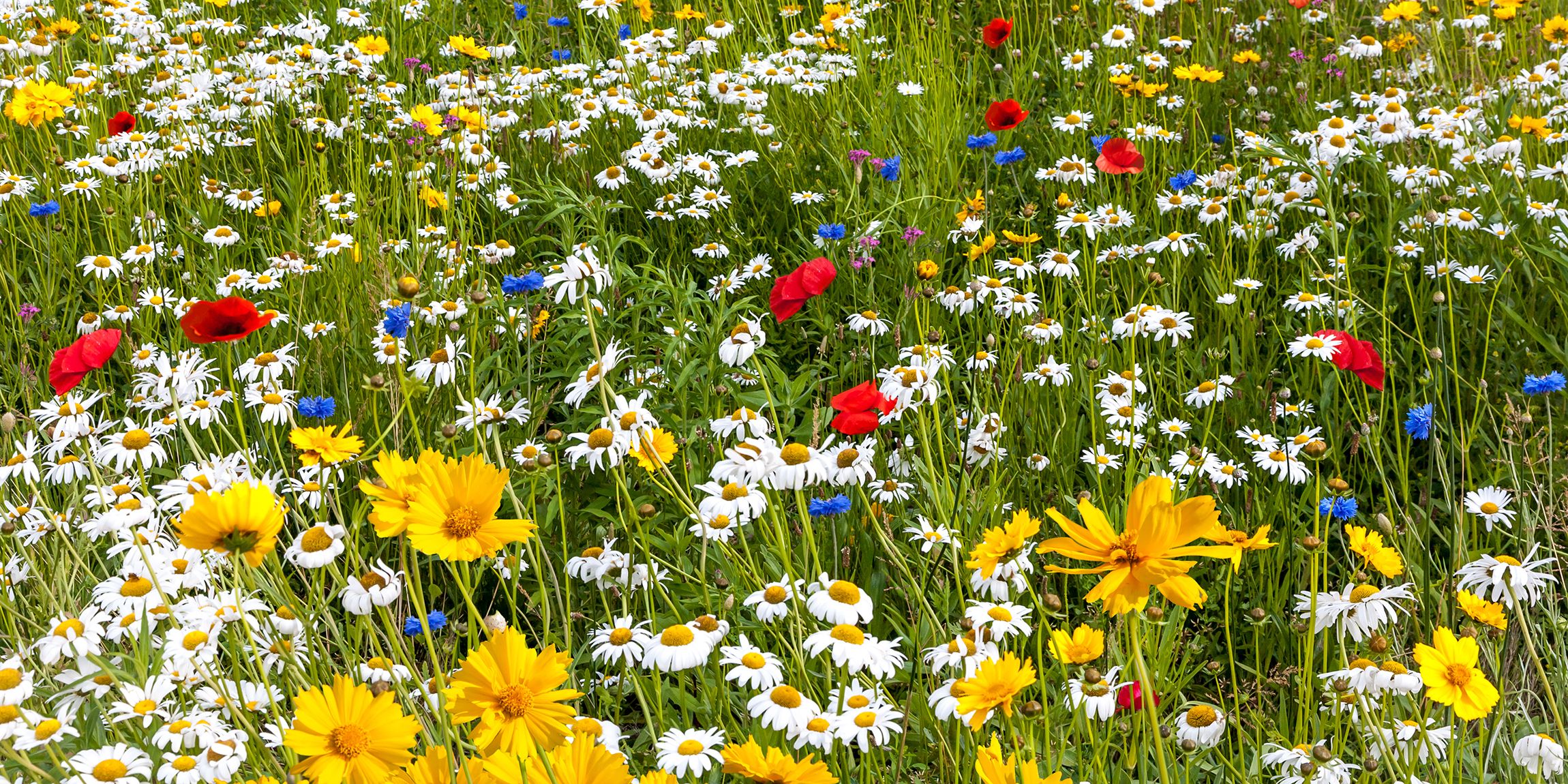
This poem came unbidden to me during Singapore’s Circuit Breaker while on a walk. I really loved the little wildflowers which bloomed during this time when the workers who are famed for keeping Singapore neat and tidy did not work. The public were thrilled with these wildflowers and after letters sent to the National Parks, they have now decided that these blooms will not be cut down in non residential areas.
I was fed up sitting inside, staring at the same four walls When I glanced outside and saw the clear blue sky
I knew I had to get out and walk, breathe in the crisp air I quickly masked up, as that is our new normal and went outside And started to walk to the nearby park
On the way, I saw empty streets and lonely void decks Deserted of the usual crowd of people, the world seen probably as small specksLimited to our own area, we are now social distancing you know We can’t move around as before, we need to keep away, go on with the flow
As I enter the park, I see the wild grass and leaves On the ground, fallen flowers make a vivid carpet which sway in the breeze Peering close, I can see small patches of wildflowers Poking their heads out, fighting to live inspite of everything
I look at these flowers as an analogy of life In today’s world, we are fighting to survive against all odds Just as these flowers poke their heads even under difficult conditions So we should take inspiration from them and try to flourish in the most adverse situations
Be like the wildflower that flourishes inspite of all odds Be like the wildflower that lives another day despite knowing it may be it’s last
Sometime back I received a video on one of my family Whatsapp groups. This was a small documentary about Sanskrit scholars who had settled down in the villages on the banks of the Tamarabarani River in Tirunelveli district in Tamil Nadu a few centuries back. They were fleeing muslim invaders, most likely the Mughals and fled to preserve their culture and way of life. These scholars are today most likely known as the Tamil Brahmins who are my ancestors. When I saw this video, I was instantly taken back to a conversation I had with my paternal grandmother a few weeks before she passed away.
We were travelling back to Bangalore from Sringeri, after a wonderful trip to celebrate my cousin’s thread ceremony and we stopped at a place, whose name escapes me now for a break. That was when she told me, possibly in passing, that her ancestors originally came from either or someplace close to Nagpur in Maharashtra and then moved to someplace in Karnataka, where they settled down for a few centuries before finally moving down south to settle on the banks of the Tamarabarani in Tirunelveli district. So when I saw that video, I immediately thought of my ammama and was very sad that she passed away before I really got to know her as an adult. I did some research on this and this is probably true. I also found writings which said that Tamil brahmins probably came down to the south from either coastal Andhra Pradesh from the Godavari basin or coastal Karnataka. This ties in to what my ammama told me.
I was very close to her and I was her favourite, maybe necause I was her first grandchild and was named after her. I am also told I resemble her a lot, both in looks as well as in temperament and in the way we look at things. I have only seen her in the traditional tambram saree called the Madisar and when I wore one at my wedding, pretty much everyone in the room, including my parents and extended family said they felt I looked like her. She loved reading and was interested in history. I really wish we had some more time with her so I could get to know her as a person, speak with her as an adult and learn more about my family.
Unfortunately, we don’t have any written family history, and those who knew the oral history have passed away. This is a very sad thing and I wish I was interested in this a lot earlier, when I could have perhaps gotten to know my own ancestral history a bit more.
While this is not really memories of my grandmother, when I read about things like this, I remember her a at that point in time and have a happy smile the rest of the day.
Resilience is defined as “The capacity to recover quickly from difficulties; or toughness”. But what exactly is resilience and why is this word so important today? In today’s post, let’s try to unpack what it means to be resilient and what you can do to cultivate this trait yourself and inculcate it in the young people in your lives.
Life is not a smooth path that you coast through without any setbacks. Life will thow you curveballs from time to time, some more serious than others from everyday challenges to perhaps a serious life-threatening illness or the death of a loved one. Every such change affetcs people in different ways, with each incident bringing with itself a unique set of thoughts, emotions and uncertainties. But in most cases, most of us generally adapt to these twists and turns in our lives, some better than others, in most part because we are resilient.
Psychologists define resilience as the process of adapting well in the face of adversity, trauma, tragedy, threats or significant sources of stress — such as family and relationship problems, serious health problems, or workplace and financial stressors. As much as resilience involves “bouncing back” from these difficult experiences, it can also involve profound personal growth. While these adverse events, much like rough river waters, are certainly painful and difficult, they don’t have to determine the outcome of your life. There are many aspects of your life you can control, modify and grow with. That’s the role of resilience. Becoming more resilient not only helps you get through difficult circumstances, it also empowers you to grow and even improve your life along the way.
Being resilient doesn’t mean that someone won’t experience difficulty or distress. People who have suffered major adversity or trauma in their lives commonly experience emotional pain and stress. In fact, the road to resilience is likely to involve considerable emotional distress. While certain factors might make some individuals more resilient than others, resilience isn’t necessarily a personality trait that only some people possess. On the contrary, resilience involves behaviours, thoughts and actions that anyone can learn and develop. The ability to learn resilience is one reason research has shown that resilience is ordinary, not extraordinary. Like building a muscle, increasing your resilience takes time and intentionality.
Nowhere else but in the workplace is resilience needed more than ever. Our fast-paced work culture results in people working hard, meeting tight deadlines, managing work relationships and staying constantly connected through mobile devices. But this pace can lead to stress and burnout and navigating through these challenges requires skills and strategies that can be developed. Resilience is a key strategy that helps employees tackle stress, a competitive job market, workplace conflicts, and address challenges on the job. Improving resilience is important because employees identify work as the number one stressor in their lives.
When employees are resilient, they are able to handle work stress better, have greater job satisfaction, work happiness, organisational commitment and employee engagement. Increased resilience also contributes to improved self-esteem, a sense of control over life events, a sense of purpose in life and improved employee interpersonal relationships and increased productivity.
For employers, to foster resilience amongst your employees, allow autonomy whenever possible and let individuals do their jobs. Reward employees for good work and allow them to have flexible schedules so they can work at a pace and time that work best for them. Also, employers need to be more reasonable about work expectationsand be more vigilent about policies on work expectations and work hours. Lastly, employers need to provide access to services and support needed to maintain good physical and mental health.
So how can you learn to be more resilient. By focusing on core components, which include connections, wellness, healthy thinking and meaning, you can empower yourself to withstand and learn from difficult and traumatic experiences. To increase your capacity for resilience to weather and grow from the difficulties, use these strategies.
Build your connections and prioritise relationships. Connecting with empathetic and understanding people can remind you that you’re not alone in the midst of difficulties. Focus on finding trustworthy and compassionate individuals who validate your feelings, which will support the skill of resilience. Do not isolate yourself when you are in a situation which causes you pain or trauma, instead accept the help and support of those who love and care for you and connect with them in a genuine way. Along with one-to-one connections, some people find that being active in groups provides them with a sense of support, purpose and joy.
Foster wellness and take care of your body. Self-care is not just a popular buzzword, but is also a legitimate practice for mental health and building resilience. I say this because stress is just as much physical as it is emotional. Promoting positive lifestyle factors like proper nutrition, ample sleep, hydration and regular exercise can strengthen your body to adapt to stress and reduce the toll of emotions like anxiety or depression.
Practice mindfulness. I can’t stress this strategy enough. Mindful journaling, yoga, meditation and prayer can help people build connections and restore hope, which can then prime you to deal with situations that require resilience. When you journal, meditate, or pray, ruminate on the positive aspects of your life and recall the things you’re grateful for, even during personal trials. At the same time, avoid negative outlets. It may be tempting to mask your pain with alcohol, drugs or other substances, but that’s like putting a bandage on a deep wound. Focus instead on giving your body the resources to manage stress, rather than seeking to eliminate the feeling of stress altogether.
Find some purpose in life and help others. When you help others by volunteering, you gather a sense of purpose, foster self-worth, connect with other people and tangibly help others, all of which can empower you to grow in resilience. During these hard times, learn to be proactive and know that it is helpful to acknowledge and accept your emotions, but it’s also important to help you foster self-discovery by asking yourself, “What can I do about a problem in my life?” If the problems seem too big to tackle, break them down into manageable pieces. Move toward your goals and develop some realistic goals and do something regularly, even if it seems like a small accomplishment, that enables you to move toward the things you want to accomplish. Instead of focusing on tasks that seem unachievable, ask yourself, “What’s one thing I know I can accomplish today that helps me move in the direction I want to go?” Look for opportunities for self-discovery. People often find that they have grown in some respect as a result of a struggle. It is seen that after a tragedy or hardship, people have reported better relationships and a greater sense of strength, even while feeling vulnerable which can increase their sense of self-worth and heighten their appreciation for life.
Compartmentalise your cognitive load. We receive more than 11 million bits of information every second, but our brains can only effectively process about 40 bits of information. So though we can’t decrease what we receive, we can compartmenalise our tasks to optimise how we can process this information. We should be more deliberate about how and what we compartmentalise and this is useful when you consider that switching from one type of task to another reduces productivity by as much as 40%. Creating dedicated times of the day to do specific types of work may create the best set of conditions to process information and make quality decisions while decreasing cognitive load and strain.
Take detachment breaks. Throughout the workday, it’s important to pay attention to the peaks and valleys of energy and productivity that we all experience, what health psychologists call our ultradian or hourly as opposed to our circadian or daily rhythms. Mental focus, clarity and energy cycles are typically 90-120 minutes long, so it is useful to step away from our work for even a few minutes to reset energy and attention. Research suggests that balancing work activity with even a brief time for detaching from those activities can promote greater energy, mental clarity, creativity and focus, ultimately growing our capacity for resilience throughout the course of the workday. The long-term payoff is that we preserve energy and prevent burnout over the course of days, weeks and months.
Embrace healthy thoughts and keep things in perspective. How you think can play a significant part in how you feel, and how resilient you are when faced with obstacles. I feel that those with a positive mindset overcome obstacles faster and better than those who see a glass as half empty. Try to identify areas of irrational thinking, such as a tendency to catastrophise difficulties or assume the world is out to get you, and adopt a more balanced and realistic thinking pattern. You may not be able to change a highly stressful event, but you can change how you interpret and respond to it. Accept change and also accept that change is a part of life. Certain goals or ideals may no longer be attainable as a result of adverse situations in your life. Accepting circumstances that cannot be changed can help you focus on circumstances that you can alter. You should also maintain a hopeful outlook in life. I know it’s hard to be positive when life isn’t going your way, but an optimistic outlook empowers you to expect that good things will happen to you. Visualisation is a good way to to see what you want, rather than worrying about what you fear. Along the way, note any subtle ways in which you start to feel better as you deal with difficult situations. And most important in this step is to learn from your past. By looking back at who or what was helpful in previous times of distress, you may discover how you can respond effectively to new difficult situations. Remind yourself of where you’ve been able to find strength and ask yourself what you’ve learned from those experiences.
Cultivate compassion. One of the most overlooked aspects of the resilience skill set is the ability to cultivate compassion; both self-compassion and compassion for others. According to some research, compassion increases positive emotions, creates positive work relationships, and increases cooperation and collaboration and such practices increase happiness and well-being and decrease stress.
Getting help when you need it is crucial in building your resilience. For most people, using their own resources and the strategies mentioned above may be enough to build their resilience, but there at times and individuals for whom and when this may not be enough. In such cases, reach out to a licensed mental health professional who can assist you in developing an appropriate strategy for moving forward in life. It is important to get professional help if you feel like you are unable to function as well as you would like or perform basic activities of daily living as a result of a traumatic or other stressful life experience.
The important thing is to remember you’re not alone on the journey. While you may not be able to control all of your circumstances, you can grow by focusing on the aspects of life’s challenges you can manage with the support of loved ones and trusted professionals.
Here are some interesting Ted Talks about resilience and how we can learn from some super resilient people!