In My Hands Today…

The Dark Side of the Mind: True Stories from My Life as a Forensic Psychologist – Kerry Daynes

Welcome to the world of the forensic psychologist, where the people you meet are wildly unpredictable and often frightening.

The job: to delve into the psyche of convicted men and women to try to understand what lies behind their often brutal actions.

Follow in the footsteps of Kerry Daynes, one of the most sought-after forensic psychologists in the business and consultant on major police investigations.

Kerry’s job has taken her to the cells of maximum-security prisons, police interview rooms, the wards of secure hospitals and the witness box of the court room.

Her work has helped solve a cold case, convict the guilty and prevent a vicious attack.

Spending every moment of your life staring into the darker side of life comes with a price. Kerry’s frank memoir gives an unforgettable insight into the personal and professional dangers in store for a female psychologist working with some of the most disturbing men and women.

Valentine’s Day

Today is Valentine’s Day which worldwide is celebrated as the day of love. Also called Saint Valentine’s Day or the Feast of Saint Valentine, Valentine’s Day is celebrated annually on February 14 and originated as a Christian feast day honouring one or two early Christian martyrs named Saint Valentine and, through later folk traditions, has become a significant cultural, religious, and commercial celebration of romance and love in many regions of the world.

There are several martyrdom stories associated with the various Valentines connected to February 14, including an account of the imprisonment of Saint Valentine of Rome for ministering to Christians persecuted under the Roman Empire in the third century. According to an early tradition, Saint Valentine restored sight to the blind daughter of his jailer and numerous later additions to the legend have better related it to the theme of love. An 18th-century embellishment to the legend claims he wrote the jailer’s daughter a letter signed “Your Valentine” as a farewell before his execution while another addition posits that Saint Valentine performed weddings for Christian soldiers who were forbidden to marry.

The Feast of Saint Valentine was established by Pope Gelasius I in 496 AD to be celebrated on February 14 in honour of Saint Valentine of Rome, who died on that date in 269 AD. The day became associated with romantic love in the 14th and 15th centuries when notions of courtly love flourished, apparently by association with the lovebirds of early spring. In 18th century England, it grew into an occasion in which couples expressed their love for each other by presenting flowers, offering confectionery, and sending greeting cards, known as valentines. By the 1900s printed cards began to replace written letters due to improvements in printing technology. Ready-made cards were an easy way for people to express their emotions in a time when direct expression of one’s feelings was discouraged. Cheaper postage rates also contributed to an increase in the popularity of sending Valentine’s Day greetings. The Valentine’s Day symbols that are used today include the heart-shaped outline, doves, and the figure of the winged Cupid. In Italy, Saint Valentine’s Keys are given to lovers as a romantic symbol and an invitation to unlock the giver’s heart, as well as to children to ward off epilepsy, also known as Saint Valentine’s Malady. Americans probably began exchanging hand-made valentines in the early 1700s. Today, according to the Greeting Card Association, an estimated 145 million Valentine’s Day cards are sent each year, making Valentine’s Day the second largest card-sending holiday of the year, after Christmas.

An official feast day in the Anglican Communion and the Lutheran Church, the day is not a public holiday anywhere. Many parts of the Eastern Orthodox Church also celebrate Saint Valentine’s Day on July 6 in honour of the Roman presbyter Saint Valentine, and on July 30 in honour of Hieromartyr Valentine, the Bishop of Interamna in modern-day Terni, Italy.

While the European folk traditions connected with Saint Valentine and St. Valentine’s Day have become marginalised by the modern Anglo-American customs connecting the day with romantic love, some remaining associations connect the saint with the advent of spring. While the custom of sending cards, flowers, chocolates and other gifts originated in the UK, Valentine’s Day remains connected with various regional customs in England. In Norfolk, a character called Jack Valentine knocks on the rear door of houses leaving sweets and presents for children with many children scared of this mystical person. In Slovenia, Saint Valentine or Zdravko was one of the saints of spring, the saint of good health and the patron of beekeepers and pilgrims as the belief is that plants and flowers start to grow on this day and has been celebrated as the day when the first work in the vineyards and the fields commences. The day is also said to mark the beginning of spring.

The oldest known valentine still in existence today was a poem written in 1415 by Charles, Duke of Orleans, to his wife while he was imprisoned in the Tower of London following his capture at the Battle of Agincourt. (The greeting is now part of the manuscript collection of the British Library in London, England.) Several years later, it is believed that King Henry V hired a writer named John Lydgate to compose a valentine note to Catherine of Valois.

Cupid is often portrayed on Valentine’s Day cards as a naked cherub launching arrows of love at unsuspecting lovers. But the Roman God Cupid has his roots in Greek mythology as the Greek god of love, Eros. Accounts of his birth vary; some say he is the son of Nyx and Erebus; others, of Aphrodite and Ares; still others suggest he is the son of Iris and Zephyrus or even Aphrodite and Zeus, who would have been both his father and grandfather. According to the Greek Archaic poets, Eros was a handsome immortal who played with the emotions of Gods and men, using golden arrows to incite love and leaden ones to sow aversion. It wasn’t until the Hellenistic period that he began to be portrayed as the mischievous, chubby child he’d become on Valentine’s Day cards.

Giving red roses may be an obvious romantic gesture today on Valentine’s Day, but it wasn’t until the late 17th century that giving flowers became a popular custom. The practice can be traced back to when King Charles II of Sweden learned the language of flowers which pairs different flowers with specific meanings on a trip to Persia and subsequently introduced the tradition to Europe. The act of giving flowers then became a popular trend during the Victorian Era, including on Valentine’s Day, with red roses symbolising deep love.

So here’s wishing everyone a very Happy Valentine’s Day. Remember, where there is love, there is life!

2022 Week 06 Update

Hello from Singapore! I am finally back from my three week holiday in India. It has been a hectic three weeks, but it was so worth it. I got to not only meet my parents after 2 years but also helped them close their home in Mumbai and shift to a senior retirement community in Bengaluru. I know it would have been very hard for them to do it themselves and I am happy that I could help them out.

Here in Bengaluru, I also got to meet relatives and cousins, some of whom I had not met in years, so that was another plus. But now I am back home and will go back to my usual routine of meditation and walking which I had missed while in India.

Ever since I landed in India, Omicron cases have been increasing in Singapore. We’ve been getting more than 10,000 cases daily. India’s cases on the other hand seem to be dropping after a peak in the third week of January.

Today’s quote is something that the American author, coach, speaker, and philanthropist Tony Robbins has said. Robbins who is is known for his infomercials, seminars, and self-help books reminds us that our past does not equal our future. Simple, to the point and something we all tend to forget most of the time. So forget what you did yesterday, focus on today and tomorrow.

And with that, bye from me for this week!

In My Hands Today…

Truck de India!: A Hitchhiker’s Guide to Hindustan – Rajat Ubhaykar

“The share auto I squeeze into next seems unusually vulnerable after a night in the truck – too compact, too low down. Perhaps, these are the usual side effects of prolonged riding with the king of the road, I think to myself. But it is only when I fill in ‘truck’ as my mode of transportation in the hotel ledger at Udaipur does the utter ludicrousness of my endeavour truly hit home”

Think truck drivers, and movie scenes of them drunkenly crushing inconvenient people to their gravelly deaths come to mind. But what are their lives on the road actually like?

In Truck De India!, journalist Rajat Ubhaykar embarks on a 10,000 km-long, 100% unplanned trip, hitchhiking with truckers all across India. On the way, he makes unexpected friendships; listens to highway ghost stories; discovers the near-fatal consequences of overloading trucks; documents the fascinating tradition of truck art in Punjab; travels alongside nomadic shepherds in Kashmir; encounters endemic corruption repeatedly; survives NH39, the insurgent-ridden highway through Nagaland and Manipur; and is unfailingly greeted by the unconditional kindness of perfect strangers.

Imbued with humour, empathy, and a keen sense of history, Truck De India! is a travelogue like no other you’ve read. It is the story of India, and Indians, on the road.

A VUCA World and how it impacts us

The past few years have shown us in no uncertain words how volatile our world is. Every week brings new changes and most of us are unable to make any plans because we don’t know what next week will bring us.

This is encapsulated very well in the acronym VUCA which stands for Volatile, Uncertain, Complex and Ambiguous which stands for what our world is today. First used in 1987, the acronym draws on the leadership theories of Warren Bennis and Burt Nanus, to describe or to reflect on the volatility, uncertainty, complexity and ambiguity of general conditions and situations. The U.S. Army War College introduced the concept of VUCA to describe the more volatile, uncertain, complex and ambiguous multilateral world perceived as resulting from the end of the Cold War and more frequent use and discussion of the term VUCA began from 2002. It has subsequently taken root in emerging ideas in strategic leadership that apply in a wide range of organizations, from for-profit corporations to education.

The deeper meaning of each element of VUCA serves to enhance the strategic significance of the VUCA foresight and insight as well as the behaviour of groups and individuals in organisations. It discusses systemic failures and behavioural failures, which are characteristic of organisational failure.

V stands for Volatility which is the nature and dynamics of change, and the nature and speed of change forces and change catalysts. It refers to the speed of change in an industry, market or the world in general. It is associated with fluctuations in demand, turbulence and short time to markets and it is well-documented in the literature on industry dynamism. The more volatile the world is, the more and faster things change.

U is Uncertainty or the lack of predictability, the prospects for surprise, and the sense of awareness and understanding of issues and events. Uncertainty refers to the extent to which we can confidently predict the future. Part of the uncertainty is perceived and associated with people’s inability to understand what is going on. Uncertainty, though, is also a more objective characteristic of an environment. Truly uncertain environments are those that don’t allow any prediction, also not on a statistical basis. The more uncertain the world is, the harder it is to predict.

C means Complexity which is the multiplex of forces, the confounding of issues, no cause-and-effect chain and confusion that surrounds organisations. It refers to the number of factors that we need to take into account, their variety and the relationships between them. The more factors, the greater their variety and the more they are interconnected, the more complex an environment is. Under high complexity, it is impossible to fully analyse the environment and come to rational conclusions. The more complex the world is, the harder it is to analyse.

And lastly, A stands for Ambiguity which encompasses the haziness of reality, the potential for misreads, and the mixed meanings of conditions and the cause-and-effect confusion. These elements present the context in which organizations view their current and future state, present boundaries for planning and policy management and come together in ways that either confound decisions or sharpen the capacity to look, plan and move ahead. It points to a lack of clarity about how to interpret something. A situation is ambiguous, for example, when information is incomplete, contradicting or too inaccurate to draw clear conclusions. More generally it refers to fuzziness and vagueness in ideas and terminology. The more ambiguous the world is, the harder it is to interpret.

The particular meaning and relevance of VUCA often relate to how people view the conditions under which they make decisions, plan forward, manage risks, foster change and solve problems. In general, the premises of VUCA tend to shape an organisation’s capacity to anticipate the issues that shape, understand the consequences of issues and actions, appreciate the interdependence of variables, prepare for alternative realities and challenges and interpret and address relevant opportunities. For most organisations, VUCA is a practical code for awareness and readiness.

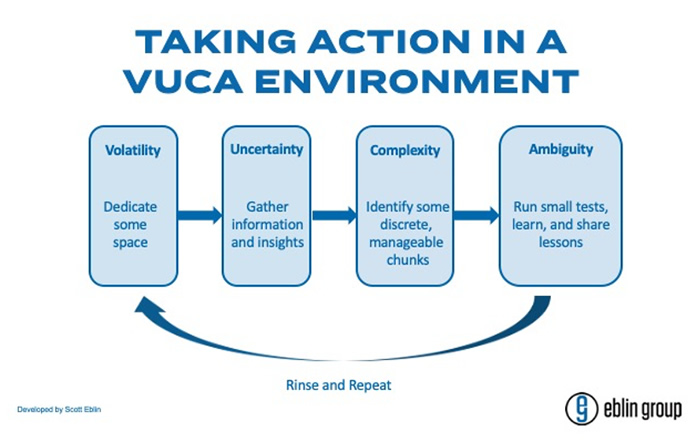
So how can we try and navigate a VUCA World? Though it may seem inescapable in certain situations and industries, one can use it to advantage. The key to managing is to break VUCA down into its parts and to identify volatile, uncertain, complex, or ambiguous situations. Each type of situation has its causes and resolutions, so one should aim to deal with one at a time.

  • Counter volatility with vision. Accept and embrace change as a constant and don’t resist it.
  • Create a strong, compelling statement of objectives and values, and develop a clear, shared vision of the future. Have flexible goals which can be amended quickly.
  • Meet uncertainty with understanding which can help understand and develop new ways of thinking and acting in response to VUCA’s elements.
  • Make investing in, analysing and interpreting business and competitive intelligence a priority, so that one doesn’t fall behind. Stay up to date with industry news, and listen carefully to find out what others want.
  • Review and evaluate performance. Consider what one did well, what came as a surprise, and what one could do differently next time.
  • Simulate and experiment with situations, so that one can explore how they might play out, and how one might react to them in the future. Aim to anticipate possible future threats and devise likely responses. Gaming, scenario planning, crisis planning and role-playing are useful tools for generating foresight and preparing responses.
  • Communicate clearly because in complex situations, clearly expressed communication help to understand direction.
  • Develop and promote collaboration. VUCA situations are often too complicated for one person to handle, so strong teams that can work effectively in a fast-paced, unpredictable environment is essential.
  • Fight ambiguity with agility by promoting flexibility, adaptability and agility. Plan, but build in contingency time and be prepared to alter plans as events unfold.
  • Hire, develop and promote people who thrive in VUCA environments as these people are likely to be collaborative, comfortable with ambiguity and change, and have complex thinking skills.
  • Encourage people to think and work outside of their usual functional areas, to increase their knowledge and experience. Job rotation and cross-training can be excellent ways to improve agility.
  • Lead teams, but don’t dictate to or control them, instead develop collaborative environments and work hard to build a consensus. Encourage debate, dissent and participation from everyone.
  • Embrace an ideas culture. Reward team members who demonstrate vision, understanding, clarity, and agility.

When one is affected by VUCA, one has a choice. Either one allows VUCA to manage, overload and overwhelm them, or they accept and manage it so that they can mitigate its effects. When one decides to accept VUCA, they choose to make themselves and others less vulnerable and empower everyone to deal with uncontrollable, unpredictable forces.