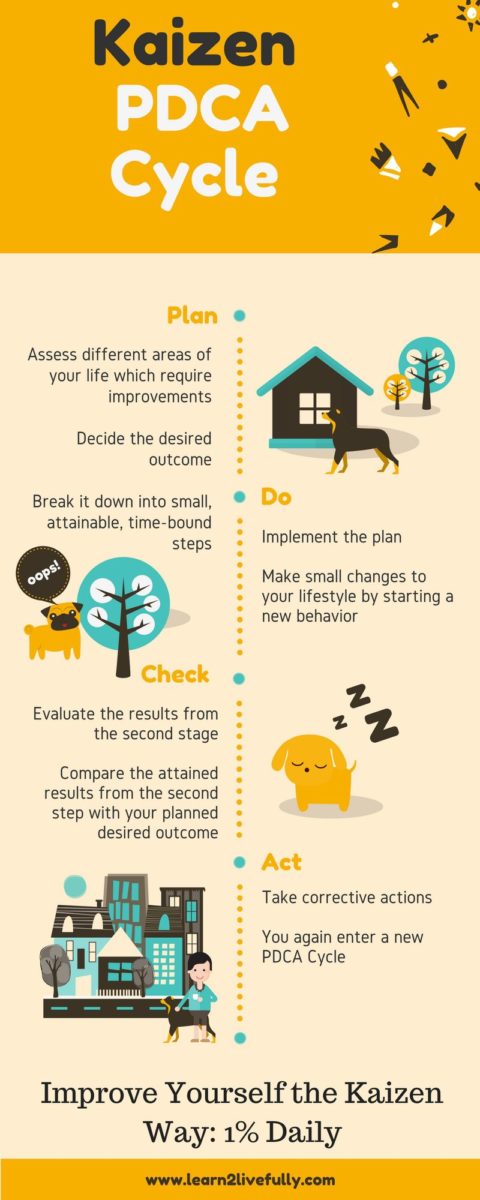
Continous Improvement: Getting better everyday

Coming from the manufacturing sector, a continual improvement process, also often called a continuous improvement process or CIP or CI, is an ongoing effort to improve products, services, or processes. These efforts can seek incremental improvement over time or breakthrough improvement all at once. Some successful implementations use the Japanese approach known as Kaizen where kai means change and zen which stands for good is improvement. Kaizen the Sino-Japanese word for improvement, is a concept referring to business activities that continuously improve all functions and involve all employees from the CEO to the assembly line workers. By improving standardised programmes and processes, kaizen aims to eliminate waste and redundancies. Kaizen was first practiced in Japanese businesses after World War II, influenced in part by American business and quality-management teachers, and most notably as part of The Toyota Way. It has since spread throughout the world and has been applied to environments outside business and productivity.

So how can this be applied to our daily lives? How can we use Continous Improvement to improve ourselves and make us better individuals? Read on.

We live in a world of never-ending disruption and change. By adopting the philosophy of Kaizen, we can become more adaptable, flexible and resilient to deal with the constant demands and disruptions we face in our lives. By adopting continuous improvement, we can live our lives to the fullest by continuously learning, growing and thriving. This philosophy is based on the concept that instead of making big changes at once, the continuous improvement approach focuses on making a small improvement over time.

Kaizen is often referred to as the strategy for 1% gains. It is these 1% gains that athletes focus on to improve their performance. The 1% gains are incremental and if one keeps building on the 1% gains the rewards are phenomenal. Continuous improvement is perpetual and so to maintain gains and improvement, one needs to work on them continuously. Continuous improvement is perpetual and so to maintain gains and improvement; you need to work on them continuously.
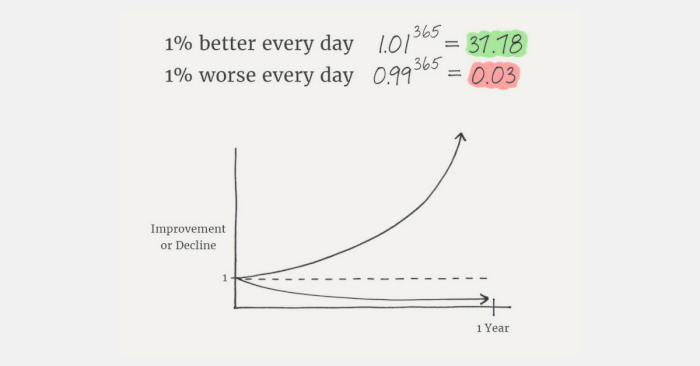
An easy example is the new year resolution we make every year. How many of these do we actually fulfil and maintain all through the year? At some point, we slip up and then many of the resolutions fall by the wayside. But there is that small group of people, dedicated and committed, who are able to maintain and fulfil all their goals for the year. However, if one commits to continuously improving themselves, then the motivation to achieve the goals set will never die. One will never have to struggle with giving up or giving in because it is hard. The achievements and success in life will be a result of one taking continual incremental steps toward their goals. Continuous improvement is not about reaching the big goals in life but about taking small steps and improving and refining those goals along the way.

To be successful at the adoption of a continuous improvement lifestyle, the first thing to do is to embrace and accept that the journey of self-improvement and growth will never end, it is a lifelong journey of learning. The steps to improve continuously are as follows:

Step 1: Set goals based on the philosophy of 1% incremental achievements. The setting of the goal is the east part, keeping motivated, focused and on track to achieving the goal is the hard part. Continous Improvement provides one with a system or a process that one can you commit to to enable one to achieve any goal they set. 1% does not seem much, but being slightly better today as compared to yesterday will gradually add up and the goal will be achieved in no time. This system of being slightly better each day enables one to avoid feeling like a failure and being subject to self-anger and derision when one gives up.

Step 2: Break down the system into small actions: When one is attempting to be just 1% better each day, then it’s not about random bursts of improvement in fits and bursts. Continuous improvement is a journey of personal growth where one is making long-term steady progress. This approach of self-improvement will give one the sustainable long-term changes they seek to improve their lives and achieve goals.

As an example, if you are trying to lose weight, instead of obsessing with the ideal weight, start by thinking on how you are going to achieve a healthy lifestyle. Create a system which includes diet and exercise and then break that system down into smaller actions or behaviours which you can follow without exerting yourself too much. Like, you could start walking or exercising and everyday or every week, do something slightly more. Commit to these actions on a daily basis until it becomes a habit. Keep going until the goal is reached.

Step 3: Keep track of your 1% success: It is very important that you measure and track your 1% successes. This is a crucial factor about incremental achievement. Evaluating and measuring improvements are important for one’s own motivation and commitment to the journey. If one is not measuring progress, the subconscious brain will kick in and sabotage progress by convincing one that it is all too hard and that they are not making any progress at all. The subconscious brain only believes what one tells it. Unfortunately, we have told our brain a lot of untruthful things over a long period of time about how we are a failure, not motivated and never really achieved anything in life. The subconscious brain, as a result, believes all these facts that we have told it to be true. Measuring and evaluating our 1% successes is key to us retraining our subconscious to believe that Yes – we can achieve our goals and succeed in life.

Source

Continuous Improvement does not focus on making huge gains or big improvements all at once. Instead, it focuses on long-term steady progress. When one follows the philosophy of Continuous Improvement, they won’t radically change their life, but over time with consistent and constant improvement and change, they will find that they are living their life to the fullest – empowered, resilient and thriving.


2021 Week 43 Update

It’s the end of October and just two more months before 2022 comes around.

This month, I have not really been walking much, especially in the last week since I have been busy with preparations for Diwali which will take place next week. So far, I have made some sweets and savouries, but need to make a couple more before I can call it a day.

This month, I managed to hit my reading goals for the year and any more books I am reading now are just the icing on the cake. Let me see exactly how many I manage to finish by December.

GG & BB are busy with school and some days I barely get to see them, except in the morning and then in the evening after lessons are over for the day. It’s good that they keep busy, hopefully, this semester is good for them.

This week’s quote is a continuation of last week’s quote. Being grateful for things and people around you makes sense of one’s past, brings peace today and creates a vision for what one wants for tomorrow. Gratitude is the one thing that is special and unique to you and being grateful for the little things in life makes life worth living.

Cases in Singapore are surging and showing no signs of reducing. This is quite worrying and is putting the country in a risky category across the world. But we must persevere and hope for the surge to stop just as suddenly as it started. I have also gotten an appointment to get my booster shot, so that’s a bit safer.

That’s all from me this week. To all my readers, Hindu or otherwise, here’s wishing you a very Happy Diwali. May the festival of lights banish all darkness from your lives and make it joyful, happy and prosperous.

In My Hands Today…

Kitchen Confidential: Adventures in the Culinary Underbelly – Anthony Bourdain

A deliciously funny, delectably shocking banquet of wild-but-true tales of life in the culinary trade from Chef Anthony Bourdain, laying out his more than a quarter-century of drugs, sex, and haute cuisine.

New York Chef Tony Bourdain gives away secrets of the trade in his wickedly funny, inspiring memoir/expose. Kitchen Confidential reveals what Bourdain calls “twenty-five years of sex, drugs, bad behavior and haute cuisine.”

Festivals of India: Kojagari Pournnima

Also known as Sharad Purnima, Kumara Purnima and Navanna Purnima, the festival of Kojagiri Purnima will take place tomorrow. Kojagiri Purnima is a harvest festival celebrated on the full moon day of the Hindu lunar month of Ashwin which is around September to October, marking the end of the monsoon season. It is said that Kojagiri Purnima is the day when the moon is seen with all the sixteen kalas, which are the different phases of the moon. It is also called Kojagiri Lakshmi Purnima as the day is dedicated to Goddess Lakshmi.

On this auspicious day, many divine pairs like Radha Krishna, Shiva Parvati, and Lakshmi Narayan are worshipped along with the moon and are offered flowers and kheer, a sweet dish made of rice and milk. Deities in temples are usually dressed in white signifying the brightness of the moon and many observe a full day of fasting on this day.

Kojagari Purnima is all about the observance of the Kojagara Vrata or fast. People perform this Vrata under the moonlight after fasting for the day. Lakshmi, the Hindu Goddess of Wealth, is worshipped on this day as it is believed to be her birthday. Lord Indra, the God of Rains, along with his elephant Airavata is also worshipped. It is believed that on the night of Sharad Purnima, the raas which is a form of dance of Radha Krishna also takes place along with their gopis or attendants. To participate in this divine raas, Lord Shiva takes the form of Gopeshwar Mahadev. Vivid descriptions of this night are given in the Brahma Purana, the Skanda Purana, and the Linga Purana. It is also believed that, on this full moon night, Goddess Lakshmi descends on the earth to watch the actions of human beings.

People usually stay awake at night to celebrate the festival and special pujas are offered to goddess Lakshmi and it is believed that the moon is close to earth on this day. Many sages believe that the moonlight on this night have healing power and is beneficial for mind and soul. As the rays of the moon are said to have curative properties, people come out of their house at night to soak in the moonlight. In many regions, sweets like kheer are prepared on this day and are left under the rays of the moon. These sweets are consumed and distributed later as prasad. In some regions, people do not see the moon directly on this night. A vessel is filled with boiling milk and the reflection of the moon in that vessel is seen. This is also the day to begin the Purnimasi fasting for the year. This fasting is observed by newly-wed women.

This day is celebrated differently in different parts of the country. In Odisha, on this day which is celebrated as Kumar Lakshmi or Lakshmi Puja, unmarried women keep fast with the popular belief of getting their suitable groom. This festival starts with maidens welcoming the Sun God at sunrise with a coconut-leaf-made-vessel called kula filled with fried paddy containing 7 fruits including coconut, banana, cucumber, betel nut, sugar-cane and guava followed by an aarti. In the evening they break their fast by preparing a dish containing the fried paddy of the morning along with the fruits, yoghurt and jaggery to offer to the Moon God in front of the tulsi plant. After this maidens play games and sing songs under the light of the full moon. It is one of the most important festivals of the state and is dedicated to Kumar or Lord Kartikeya, the son of Lord Shiva. According to legend, this was the day when Lord Kartikeya engaged in battle against a demon called Tarakasur. Although the day is dedicated to Kartikeya or Kumar, there are no specific puja or rituals for him. Some people light 108 lamps for the puja. Traditionally, cool milk and rice flakes are consumed on this night.

In Bengali households, the festival is widely celebrated as Lokkhi Pujo. On this day, devotees of Goddess Laxmi observe a fast to please the deity by waking up early, preparing delicious bhog or offering filled with fruits and the delicious payesh and offer these delights in the grand puja conducted in the evening. The ritual of drawing beautiful alpnanas which is a special type of rangoli and paduka or the feet of Goddess Lakshmi is also common in several Bengali households. It is believed that Goddess Laxmi loves these artful decorations and enters the homes of devotees which are clean and beautifully maintained. The alpana and the Goddess’ feet are drawn using a special type of paste made of powdered rice. In Hindu mythology, Goddess Lakshmi is said to symbolise wealth and prosperity and her feet are always shown coming into the house, symbolising Goddess Lakshmi’s entry and presence inside the house.

In Mithila, an offering of paan or the betal leaf, makhana or fox nut, batasha or sugar crystals and kheer or payas which is a milk sweet is made specially for the diety. These delicacies are kept out in the open overnight so that they are bathed in the pious Sharad Purnima moonlight also known as Amrit Barkha or the nectar rain. The occasion is also believed to hold immense significance for a newly wedded couple. People clean the courtyard and decorate it by drawing elaborate rangolis using rice flour paste and the household Gods are place in the courtyard and worshipped. It is an important festival for the newly-weds where the house is decorated by the new bride and the newly-wed couple spend the night playing games with other family members. The new bride’s family sends new clothes for the couple and the in-laws along with a big basket filled with items like silver pennies or tortoise or fishes, cardamom, threads, sweets and Mithila paintings. Another ritual followed is that people keep spicy food out along with a small amount of a sweet dish with a larger serving of the sweet dish kept inside. This practice is based on the belief that the Alakshmi brings bad luck and she likes spicy food, whereas her twin sister, Lakshmi brings good luck and likes sweet dishes. So the people keep spicy food outside for Alakshmi to have her fill and go away without entering the house. A small portion of the sweet dish is kept outside the house to invite Lakshmi to invite her in for a larger serving and stay inside. Goddess Kali is also worshipped in some parts of the Mithila region.

In Maharashtra, the family’s eldest child is honoured on this day. In many parts of the Gujarat, garba, a form of dance with many people takes place in the presence of the moon light.

There are several stories and legends associated with Sharad Purnima or Kojagari Purnima. According to legend, Goddess Lakshmi pays a visit to homes and showers blessing on those she finds awake. The word Kojagiri means one who is awake.  In one legend, there was once a King in the eastern part of the country, who promised his artisans that he would buy any object that remained unsold. One artisan made an idol of Alakshmi or the Goddess of Poverty. Keeping his promise the king had to buy the idol and soon misery struck his kingdom. The erstwhile prosperous kingdom was in deep peril, when someone advised the queen to observe the Kojagari Lakshmi vrat on the full moon night of Ashwin, and do the Lakshmi puja as per the rituals. Soon, the kingdom won back its lost glory and established itself once again.

The festival is also known as the Kaumudi celebration where Kaumudi means moonlight and it celebrates the divine Ras Leela of Lord Krishna with gopis. According to another popular legend, the divine ras leela was performed by Krishna along with his consort Radha and the gopis of Vrindavan on Sharad purnima. It sis said that the gopis were woken up by the sweet music from Krishna’s flute. They sneaked out of their homes and came to the forest where they danced with Krishna on the night of Sharad Purnima. Krishna replicated himself to dance with each one of them. On this night Krishna showered bhakti raas on Radha and the gopis. The day is also celebrated by lovers. Couples express their love for each other on this night of full moon.

While they fast, the people also sing devotional songs praising the deity asking her to take shelter in their homes. The devotees break the fast at night by taking some parched rice or chiwda and milk. One can consume milk, coconut water, kheer, dry fruits and fresh fruits while fasting.

In My Hands Today…

The Cartiers: The Untold Story of the Family Behind the Jewelry Empire – Francesca Cartier Brickell

The captivating story of the family behind the Cartier empire and the three brothers who turned their grandfather’s humble Parisian jewelry store into a global luxury icon–as told by a great-granddaughter with exclusive access to long-lost family archives

The Cartiers is the revealing tale of a jewelry dynasty–four generations, from revolutionary France to the 1970s. At its heart are the three Cartier brothers whose motto was “Never copy, only create”.

Francesca Cartier Brickell, whose great-grandfather was the youngest of the brothers, has traveled the world researching her family’s history, tracking down those connected with her ancestors and discovering long-lost pieces of the puzzle along the way. Now she reveals never-before-told dramas, romances, intrigues, betrayals, and more.