“You could not remove a single grain of sand from its place without thereby … changing something throughout all parts of the immeasurable whole.” – Fichte, The Vocation of Man (1800)
Have you ever wondered that sometimes a small act in one part of the world has huge consequences in another part of the world. This is what is known as the Butterfly Effect which essentially means that that small things can have non-linear impacts on a complex system. The concept is imagined with a butterfly flapping its wings and causing a typhoon.

In chaos theory, which is a branch of mathematics focusing on the study of chaos — the states of dynamical systems whose apparently random states of disorder and irregularities are often governed by deterministic laws that are highly sensitive to initial conditions, the butterfly effect is the sensitive dependence on initial conditions in which a small change in one state of a deterministic nonlinear system can result in large differences in a later state. The term, closely associated with the work of Edward Lorenz, is derived from the metaphorical example of the details of a tornado with the exact time of formation and the exact path taken being influenced by minor perturbations such as the flapping of the wings of a distant butterfly several weeks earlier. Lorenz discovered the effect when he observed that runs of his weather model with initial condition data that were rounded in a seemingly inconsequential manner would fail to reproduce the results of runs with the unrounded initial condition data. A very small change in initial conditions had created a significantly different outcome.
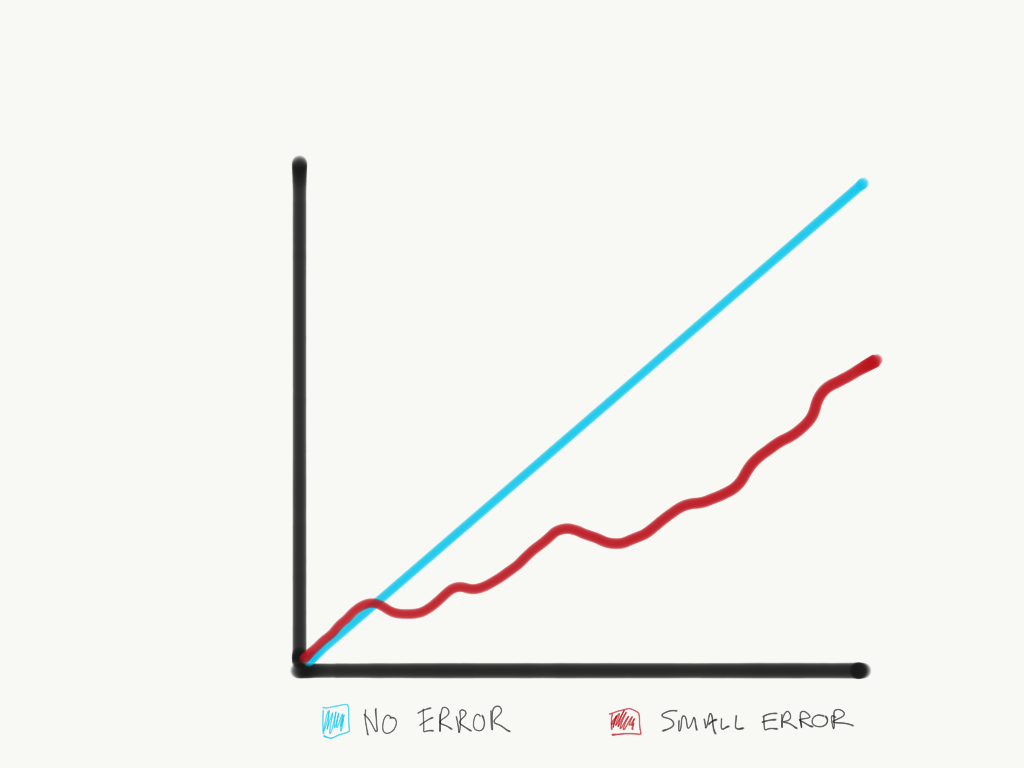
In an experiment to model a weather prediction, he entered the initial condition as 0.506, instead of 0.506127. The result was surprising with a somewhat different prediction. From this, he deduced that the weather must turn on a dime. A tiny change in the initial conditions had enormous long-term implications. By 1963, he had formulated his ideas enough to publish an award-winning paper entitled Deterministic Nonperiodic Flow. In simpler language, he theorized that weather prediction models are inaccurate because knowing the precise starting conditions is impossible, and a tiny change can throw off the results. To make the concept understandable to non-scientific audiences, Lorenz began to use the butterfly analogy.
The idea that small causes may have large effects in general and in weather specifically was earlier recognized by French mathematician and engineer Henri Poincaré and American mathematician and philosopher Norbert Wiener. Edward Lorenz’s work placed the concept of instability of the Earth’s atmosphere onto a quantitative base and linked the concept of instability to the properties of large classes of dynamic systems which are undergoing nonlinear dynamics and deterministic chaos.
Of course, a single act like the butterfly flapping its wings cannot cause a typhoon. Small events can, however, serve as catalysts that act on starting conditions.
However, in popular culture, the term “butterfly effect” is almost always misused. It has become synonymous with “leverage”—the idea of a small thing that has a big impact, with the implication that, like a lever, it can be manipulated to a desired end. This misses the point of Lorenz’s insight. The reality is that small things in a complex system may have no effect or a massive one, and it is virtually impossible to know which will turn out to be the case.
There’s a proverb that’s been around since the 14th century in English and since the 13th century in German. Benjamin Franklin offered a poetic perspective in his variation of the proverb, long before the theory of the bufferfly effect came to being. The proverb goes like this:
For want of a nail the shoe was lost, For want of a shoe the horse was lost, For want of a horse the rider was lost, For want of a rider the battle was lost, For want of a battle the kingdom was lost, And all for the want of a horseshoe nail.
So the lack of one horseshoe nail could be inconsequential, or it could indirectly cause the loss of a war and therefore a kingdom. There is no way to predict which outcome will occur.
The butterfly effect is somewhat humbling—a model that exposes the flaws in other models. It shows science to be less accurate than we assume, as we have no means of making accurate predictions due to the exponential growth of errors. During the early days of computers, many people believed they would enable us to understand complex systems and make accurate predictions. People had been slaves to weather for millennia, and now they wanted to take control. With one innocent mistake, Lorenz shook the forecasting world, sending ripples which spread far beyond meteorology.

Beyond science, the Butterfly effect can also be seen in business. Marketplaces are, in essence, chaotic systems that are influenced by tiny changes. This makes it difficult to predict the future, as the successes and failures of businesses can appear random. Periods of economic growth and decline sprout from nowhere. This is the result of the exponential impact of subtle stimuli—the economic equivalent of the butterfly effect. According to Tom Breuer, we live in an interconnected, or rather a hyper-connected society with organisations and markets behaving like networks. This triggers chaotic and complex rather than linear behavior.
Preparing for the future and seeing the logic in the chaos of consumer behavior is not easy. Once-powerful giants collapse as they fall behind the times while tiny start-ups rise from the ashes and take over industries. Small alterations in existing technology transform how people live their lives. Fads capture everyone’s imagination, then disappear. Businesses have two options in this situation: build a timeless product or service, or race to keep up with change. Many businesses opt for a combination of the two. This approach requires extreme vigilance and attention to consumer desires in an attempt to both remain relevant and appear timeless. Businesses leverage the compounding impact of small tweaks that aim to generate interest in all they have to offer.
According to Dr. Rajagopal in The Butterfly Effect in Competitive Markets, most global firms are penetrating bottom-of-the-pyramid market segments by introducing small changes in technology, value perceptions, marketing-mix strategies, and driving production on an unimagined scale of magnitude to derive a major effect on markets. Companies like Procter & Gamble, Kellogg’s, Unilever, Nestlé, Apple, and Samsung, have experienced this effect in their business growth. Well-managed companies drive small changes in their business strategies by nipping the pulse of consumers. Most firms use such effect by making a small change in their strategy in reference to produce, price, place, promotion, posture which is developing their corporate image, and proliferation which is to gain higher market share and profit in a short span.
For most businesses, incessant small changes are the most effective way to produce the metaphorical typhoon. These iterations keep consumers engaged while preserving brand identity. If these small tweaks fail, the impact is hopefully not too great. But if they succeed and compound, the rewards can be monumental.

By nature, all markets are chaotic, and what seem like inconsequential alterations can propel a business up or down. Rajagopal explains how the butterfly effect connects to business. Globalisation and frequent shifts in consumer preferences toward products and services have accelerated chaos in the market due to the rush of firms, products, and business strategies. Chaos theory in markets addresses the behavior of strategic and dynamic moves of competing firms that are highly sensitive to existing market conditions triggering the butterfly effect. The initial conditions which include economic, social, cultural and political in which a business sets up are vital influences on its success or failure. Lorenz found that the smallest change in the preliminary conditions created a different outcome in weather predictions, and we can consider the same to be true for businesses. The first few months and years are a crucial time when rates of failure are highest and the basic brand identity forms. Any of the early decisions, achievements, or mistakes have the potential to be the wing flap that creates a storm.
Some historic examples of the butterfly effect, which have shaped our lives include the following:
The bombing of Nagasaki: The US initially intended to bomb the Japanese city of Kuroko, with the munitions factory as a target. On the day the US planned to attack, cloudy weather conditions prevented the factory from being seen by military personnel as they flew overhead. The airplane passed over the city three times before the pilots gave up. Locals huddled in shelters heard the hum of the airplane preparing to drop the nuclear bomb and prepared for their destruction. Except Kuroko was never bombed. Military personnel decided on Nagasaki as the target due to improved visibility. The implications of that split-second decision were monumental. We cannot even begin to comprehend how different history might have been if that day had not been cloudy. Kuroko is sometimes referred to as the luckiest city in Japan, and those who lived there during the war are still shaken by the near-miss.
The Rise of Hitler: The Academy of Fine Arts in Vienna rejecting Adolf Hitler’s application, twice. In the early 1900s, a young Hitler applied for art school and was rejected, possibly by a Jewish professor. By his own estimation and that of scholars, this rejection went on to shape his metamorphosis from an aspiring bohemian artist into the human manifestation of evil. We can only speculate as to how history would have been different. But it is safe to assume that a great deal of tragedy could have been avoided if Hitler had applied himself to water colors, not to genocide.
The assassination of Archduke Franz Ferdinand: A little-known fact about the event considered to be the catalyst for both world wars is that it almost didn’t happen. On the 28th of June, 1914, a teenage Bosnian-Serb named Gavrilo Princip went to Sarajevo with two other nationalists to assassinate the Archduke. The initial assassination attempt failed; a bomb or grenade exploded beneath the car behind the Archduke’s and wounded its occupants. The route was supposed to have been changed after that, but the Archduke’s driver didn’t get the message. Had he actually taken the alternate route, Princip would not have been on the same street as the car and would not have had the chance to shoot the Archduke and his wife that day. Were it not for a failure of communication, both world wars might never have happened.
The Chernobyl disaster: In 1986, a test at the Chernobyl nuclear plant went awry and released 400 times the radiation produced by the bombing of Hiroshima. One hundred fifteen thousand people were evacuated from the area, with many deaths and birth defects resulting from the radiation. Even today, some areas remain too dangerous to visit. However, it could have been much worse. After the initial explosion, three plant workers volunteered to turn off the underwater valves to prevent a second explosion. It has long been believed that the trio died as a result, although there is now some evidence this may not have been the case. Regardless, diving into a dark basement flooded with radioactive water was a heroic act. Had they failed to turn off the valve, half of Europe would have been destroyed and rendered uninhabitable for half a million years. Russia, Ukraine, and Kiev also would have become unfit for human habitation. Whether they lived or not, the three men—Alexei Ananenko, Valeri Bezpalov, and Boris Baranov—stilled the wings of a deadly butterfly. Indeed, the entire Chernobyl disaster was the result of poor design and the ineptitude of staff. The long-term result, in addition to the impact on residents of the area was widespread anxiety towards nuclear plants and bias against nuclear power, leading to a preference for fossil fuels. Some people have speculated that Chernobyl is responsible for the acceleration of global warming, as countries became unduly slow to adopt nuclear power.
The Cuban Missile Crisis: We all may owe our lives to a single Russian Navy officer named Vasili Arkhipov, who has been called “the man who saved the world.” During the Cuban Missile Crisis, Arkhipov was stationed on a nuclear-armed submarine near Cuba. American aircraft and ships began using depth charges to signal the submarine that it should surface so it could be identified. With the submarine submerged too deep to monitor radio signals, the crew had no idea what was going on in the world above. The captain, Savitsky, decided the signal meant that war had broken out and he prepared to launch a nuclear torpedo. Everyone agreed with him—except Arkhipov. Had the torpedo launched, nuclear clouds would have hit Moscow, London, East Anglia and Germany, before wiping out half of the British population. The result could have been a worldwide nuclear holocaust, as countries retaliated and the conflict spread. Yet within an overheated underwater room, Arkhipov exercised his veto power and prevented a launch. Without the courage of one man, our world could be unimaginably different.
So you see, something very small and something we think is inconsequential has far reaching impact on not just our world, but also on future generations.
I will end this post with a video, in which the science behind this phenomenon is explained.