Mother’s Day

Source

Yesterday Mother’s Day was celebrated across most of the world, including Singapore. Given what is currently happening worldwide, you may or may not have been able to celebrate it with your own mother since many countries worldwide are still under a lockdown. But this day is not just to celebrate a mother, it can also be used to celebrate maternal bonds and this can be any woman who has had a strong influence in your life.

Today, what we celebrate as Mother’s Day began in the United States, at the initiative of Anna Jarvis in the early 20th century. In 1908, Anna Jarvis held a memorial for her mother at St Andrew’s Methodist Church in Grafton, West Virginia. But she had begun campaigning for the day to be recognised since 1905 when her mother Ann Reeves Jarivis passed away. Ann Jarvis had been a peace activist who cared for wounded soldiers on both sides of the American Civil War, and created Mother’s Day Work Clubs to address public health issues. So Anna Jarvis wanted to honor her mother by continuing the work she started and to set aside a day to honor all mothers because she believed a mother is “the person who has done more for you than anyone in the world”.

In 1908, the U.S. Congress rejected a proposal to make Mother’s Day an official holiday, but because of Anna Jarvis’s efforts, by 1911 all the US states observed the holiday, with some of them officially recognizing Mother’s Day as a local holiday. In 1914, the then US President, Woodrow Wilson signed a proclamation designating Mother’s Day, held on the second Sunday in May, as a national holiday to honor mothers. By the 1920s, the day had become quite commercialised with Hallmark and other companies selling Mother’s Day cards and gifts. Jarvis became resentful with this development and believed that these companies had misinterpreted and exploited her idea of the day and that the day should emphasise on the sentiment and not on profit. As a result, she started to organise boycotts of Mother’s Day, and threatened to issue lawsuits against the companies involved. She believed that people should appreciate and honor their mothers through handwritten letters expressing their love and gratitude, instead of buying gifts and pre-made cards. She protested at a candy makers’ convention in Philadelphia in 1923, and again at a meeting of American War Mothers in 1925. By this time, carnations had become associated with Mother’s Day, and the selling of carnations by the American War Mothers to raise money angered Jarvis, who was arrested for disturbing the peace.

Even though today Mother’s Day is celebrated as a result of Anna Jarvis’ efforts, there have been many traditional celebrations of mothers and motherhood that have existed throughout the world over thousands of years, such as the Greek cult to Cybele, Rhea the Great Mother of the Gods, the Roman festival of Hilaria. And even today, in some countries, Mother’s Day is still synonymous with these older traditions.

The ancient Greeks used to celebrate their annual spring festival to honor Rhea, wife of Cronus and the mother of many deities of Greek mythology. Ancient Romans also celebrated a spring festival by the name of Hilaria in honor of Cybele, a mother goddess, some 250 years before Christ was born.

The ancient Egyptians held an annual festival to honor Isis, one of the most popular and enduring goddesses of ancient Egypt who represented the ideal mother and wife and was the patroness of nature and magic. According to ancient Egyptian mythology, Isis was the wife of Osiris, who was also her brother. When Osiris was murdered by their envious brother Set, Isis gathered Osiris’s body parts that had been scattered around Egypt and used them to impregnate herself. She then gave birth to Horus, who avenged his father’s death and killed Set, becoming the first ruler of Egypt. As a result, Isis was regarded as the mother of all pharaohs and became symbolic of motherhood, and an annual festival was held in her honor.

In the United Kingdom, Mother’s Day is linked to Easter and is typically falls on the fourth Sunday during the period of Lent and is called Mothering Sunday. This day is celebrated to honour mothers and maternal figures and an occasion for children to honour and give presents to their hardworking mums. Originally linked to religion, this day has now lost most of its connections to the church and is mainly a family day. In the past, domestic servants were given the day off to return to their hometown and worship with their families. On their way home, these youths would pick wild flowers to place in the church – or give to their mums.

So what have you done to celebrate this day for your mum? And if you have children, have they done something special for you?

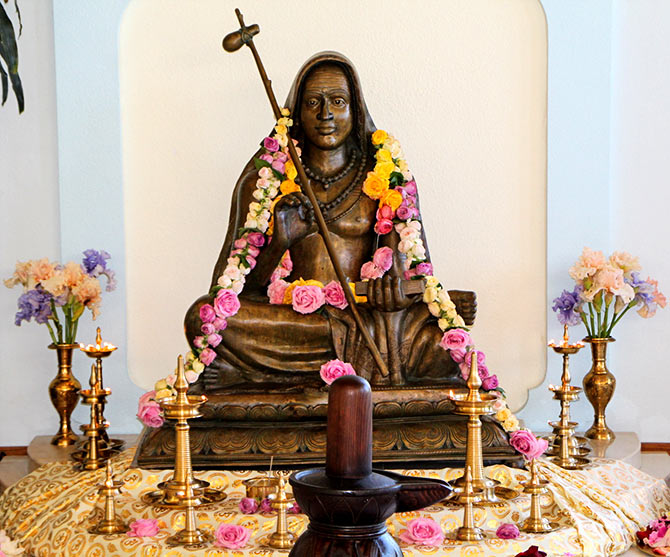
Festivals of India: Adi Shankaracharya Jayanti

Today’s topic is not exactly a festival which is celebrated in India, but given that it is the birth anniversary of the man who is credited with consolidating the Advaita Vedanta doctrine and reviving it at a time when Sanatana Dharma or Hindusim and the Hindu culture was on a decline, I thought it is something we all, but especially practicing Hindus should celebrate, even if it is as a small private prayer.

Yesterday was the 1232nd birth anniversary of Adi Shankaracharya, who is credited with consolidating the doctrine of Advaita Vedanta and with unifying and establishing the main currents of thought in Hinduism. You could call him the founder of the religion, but that’s not entirely right as Hinduism is more a way of life rather than an organised religion and has been around for centuries before him. Adi Shankaracharya Jayanti is observed on Panchami Tithi during Shukla Paksha of Vaishakha month which falls between April and May each year.

While there is no really consensus on where and when he was born, most scholars and historians agree as do the oldest biographies written about him, that he was born in what is today the southern Indian state of Kerala, in a village named Kaladi which is sometimes spelt as Kalady, Kalati or Karati to Nambudiri Brahmin parents in 788. His parents, Shivaguru and Aryamba, were an aged, childless, couple who led a devout life of service to the poor. They named their child Shankara, meaning “giver of prosperity”. A legend associated with Adi Shankaracharya considers him an incarnation of Lord Shiva himself, who had appeared in Aryamba’s dream and promised to take birth as her child. This could also be the reason for his name, which is one of the names of Lord Shiva. His father died while Shankara was very young and so his upanayanam or thread ceremony, the initiation into student-life, had to be delayed due to the death of his father, and was then performed by his mother. He was someone who was attracted to the life of Sannyasa or being a hermit from early childhood which his mother naturally disapproved.

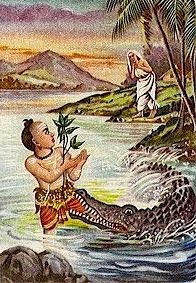
A story, found in all biographies, describe Shankara at age eight going to a river with his mother, Sivataraka, to bathe, and where he is caught by a crocodile. Shankara called out to his mother to give him permission to become a Sannyasin or else the crocodile will kill him. The mother agrees, Shankara is freed and leaves his home for education. He reaches a Saivite sanctuary along a river in a north-central state of India, and becomes the disciple of a teacher named Govinda Bhagavatpada. The various stories about him then diverge in the details about the first meeting between Shankara and his Guru, where they met, as well as what happened later. Several texts suggest Shankara’s schooling with Govindapada happened along the river Narmada in Omkareshwar, in present day Madhya Pradesh, which a few place it along river Ganges in Kashi or Varanasi as well as Badari which is now Badrinath up in the Himalayas in present day Uttarakhand. It is said that Lord Vishnu visited Shankara at Badrinath and asked him to make a statue of the deity on the Alaknanda River. Today, this temple is popular as the Badrinarayan Temple.

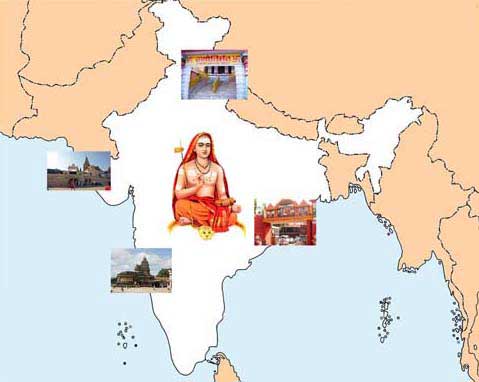
The biographies vary in their description of where he went, who he met and debated and many other details of his life. Most mention Shankara studying the Vedas, Upanishads and Brahmasutra with Govindapada, and Shankara authoring several key works in his youth, while he was studying with his teacher. It is with his teacher Govinda, that Shankara studied Gaudapadiya Karika, as Govinda was himself taught by Gaudapada. Most also mention a meeting with scholars of the Mimamsa school of Hinduism namely Kumarila and Prabhakara, as well as Mandana and various Buddhists, in Shastrarth which is an Indian tradition of public philosophical debates attended by large number of people and sometimes with royalty. After this, the biographies about Shankara vary significantly. Different and widely inconsistent accounts of his life include diverse journeys, pilgrimages, public debates, installation of yantras and lingas, as well as the founding of monastic centers in north, east, west and south India. Most biographies mention that Shankara traveled widely within India, from Gujarat to Bengal and from Tamil Nadu to Kashmir and participating in public philosophical debates with different orthodox schools of Hindu philosophy, as well as heterodox traditions such as Buddhists, Jains, Arhatas, Saugatas, and Carvakas. During his tours, he is credited with starting several Matha or monasteries and ten monastic orders in different parts of India are generally attributed to Shankara’s travel-inspired Sannyasin schools, each with Advaita notions, of which four have continued in his tradition: Bharati in Sringeri, Karnataka, Saraswati in Kanchipuram, Tamil Nadu and Tirtha and Asramin in Dwarka, Gujarat. Other monasteries that record Shankara’s visit include Giri, Puri, Vana, Aranya, Parvata and Sagara – all names traceable to Ashrama system in Hinduism and Vedic literature.

Adi Shankara’s works are the foundation of Advaita Vedanta school of Hinduism and his masterpiece of commentary is the Brahmasutrabhasya which is literally, the commentary on the Brahma Sutra, a fundamental text of the Vedanta school of Hinduism. The term Advaita refers to its idea that the true self, Atman, is the same as the highest metaphysical reality of the universe, Brahman. Advaita Vedanta is the oldest extant sub-school of Vedanta, which is one of the six orthodox or astika Hindu philosophies or darsanas tracing its roots back to the first century BC.

The word Advaita is a composite of two Sanskrit words – the prefix “A” which has similar meaning of english prefix “Non” and “Dvaita” which means ‘Duality’ or ‘Dualism’. The word Vedanta is a compostion of the two Sanskrit words, the word Veda referring to the whole corpus of vedic texts, and the other word “Anta” meaning ‘End’. The meaning of Vedanta can be summed up as “the end of the vedas” or “the ultimate knowledge of the vedas”.

Adi Shankarachrya has an unparallelled status in the tradition of Advaita Vedanta. He travelled all over India to help restore the study of the Vedas. His teachings and tradition form the basis of Smartism and have influenced Sant Mat lineages. He introduced the Pancayatana form of worship, which is the simultaneous worship of five deities – Ganesha, Surya, Vishnu, Shiva and Devi. Adi Shankaracharya explained that all deities were but different forms of the one Brahman, the invisible Supreme Being.

Adi Shankara is regarded as the founder of the Dasanami Sampradaya of Hindu monasticism and Ṣaṇmata of the Smarta tradition. He unified the theistic sects into a common framework of Shanmata system. Advaita Vedanta is, at least in the west, primarily known as a philosophical system. But it is also a tradition of renunciation.

Adi Sankarachatya organised the Hindu monks of these ten sects or Dasanami Sampradaya under four Maṭhas or monasteries, one in each direction in India with the headquarters at Dwaraka. Gujarat west, Jagannatha Puri in Odisha in the east, Sringeri in Karnataka in the south and Badrikashrama or as it’s called today, Badrinath in Uttarakhand in the north. Each math was headed by one of his four main disciples, who each continue the Vedanta Sampradaya. The mathas which he built exist until today, and preserve the teachings and influence of Shankara. My family is follows the advaita form of Hindusim and I have written about the Sringeri Sarada Peetham Matha which we follow. We also follow the Yajur veda philosophy, which I think a majority of at least Tamil Brahmins follow (there are exceptions) which is falls under the Sringeri Sarada Peetham.

Despite historical links with Shaivism, advaita is not a Shaiva sect, instead advaitins are non-sectarian, and they advocate worship of the Lords Shiva and Vishnu equally with that of the other deities of Hinduism, like Shakti, Ganapati and others.

Adi Sankara is commonly believed to have died aged 32, at Kedarnath in the northern Indian state of Uttarakhand, in the foothills of the Himalayas in 820. Texts say that he was last seen by his disciples behind the Kedarnath temple, walking in the Himalayas until he was not traced. Some texts locate his death in alternate locations such as Kanchipuram in Tamil Nadu and somewhere in his home state of Kerala.

Festivals of India: Akshaya Tritiya

Also known as Akti or Akha Teej, Akshaya Tritiya is an annual spring time festival celebrated by Hindus and Jains. It falls on the third Tithi or lunar day of bright half or Shukla Paksha of the Vaisakha month which falls every year between April and May according to the lunisolar Hindu calendar. It is observed as an auspicious time regionally by Hindus and Jains in India and Nepal, as signifying the “third day of unending prosperity”. The word Akshaya means “never diminishing” as the festival is associated with wealth, prosperity and happiness and Tritiya means third day. This year’s Akshaya Tritiya fell yesterday, April 26. This day is said to be very auspicious if you are planning on starting a new venture as anything started on this day will be successful.

Akshaya Tritiya has lot of religious significance for both Hindus and Jains. This day is the birthday of Lord Parashurama, one of the ten Dashavataras of Lord Vishnu and is also the starting day of Treta Yuga after Satya Yuga. It was on Akshaya Tritiya that the poor Brahmin Sudama offered flattened rice or aval to Lord Krishna, who in turn blessed him with bountiful wealth and happiness. On this day, it is said Lord Krishna gave the Akshaya Patra to Draupadi when the Pandavas started for the Vanavasa, so that they always have food in abundance. The sage Veda Vyasa started writing the epic Mahabharata on this day and it was the day when the holy river Ganges descended upon the Earth. The annual Puri Jagannath Rath Yatra also begins on this day.

Source

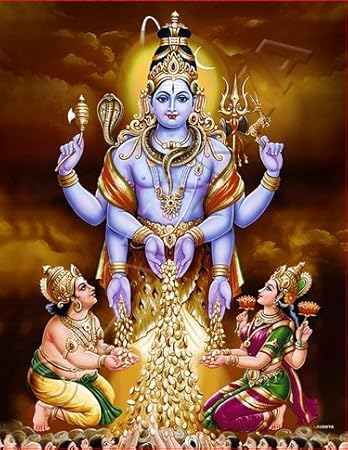
It is also belived that the God of Wealth and the treasurer of all deities ‘Kubera’ received his riches and position by praying to Lord Shiva at Shivapuram on Akshaya Tritiya. For the Jains, this day commemorates the day the first Tirthankara, Rishabhdev ended his year-long asceticism by consuming sugarcane juice poured into his cupped hands. Some Jains refer to the festival as Varshi Tapa and on this day, fasting and ascetic austerities are marked by Jains, particularly at pilgrimage sites such as Palitana in Gujarat.

Akshaya Tritiya is considered a very auspicious day because it is a day of manifold blessings. People believe that any good work done on this day will give exponential returns. This is why this day is considered very auspicious to buy gold, silver and precious stones. Goddess Lakshmi signifies wealth and it is said that if one invests in gold, silver or precious stones silver on this day, she will bless you with prosperity and wealth.

This year’s festivities are bound to be very muted because of the COVID-19 panademic worldwide, but if there is just one thing I would pray for on this way would be that we find a cure to this virus soon and things get back to normal!

Leaving you with this Kanakadhara Stotram which Adi Shankaracharya recited for a poor couple on this day at whose house he stopped for Bhiksha or alms and was offered their only available gooseberry. This version of the stotram is sung by the unparalleled M.S Subbalakshmi and is my favourite version.

World Book and Copyright Day

Also known as World Book Day and or International Day of the Book, the World Book and Copyright Day is an annual event organized by the United Nations Educational, Scientific and Cultural Organization or UNESCO to promote reading, publishing, and copyright. World Book Day was first celebrated on 23 April 1995, and continues to be recognized on that day. A related event in the United Kingdom and Ireland is observed in March.

I have written in detail about the event previously here, here and here, so just pop by there for more information on the history of this day.

World Book and Copyright Day is a celebration to promote the enjoyment of books and reading. Each year, on 23 April, celebrations take place all over the world to recognize the scope of books – a link between the past and the future, a bridge between generations and across cultures. On this occasion, UNESCO and the international organizations representing the three major sectors of the book industry – publishers, booksellers and libraries, select the World Book Capital for a year to maintain, through its own initiatives, the impetus of the Day’s celebrations.

The 2020 World Book Capital or WBC is Kuala Lumpur, Malaysia. Kuala Lumpur or KL as it is known in the region, was selected on the recommendation by the World Book capital Advisory Committee, comprising representatives of the International Publishers Association (IPA), the International Federation of Library Associations (IFLA) and UNESCO based on applications received from cities all over the world. To know more, here’s the link to the website of the Kuala Lumpur World Book Capital. Previous World Book Capitals have been Sharjah in 2019, Athens in 2018, Conakry in 2017 and Wroclaw in 2016. UNESCO is also accepting applications for the World Book Capital for 2022 and the deadline for the same is Thursday 25 June 2020 in case anyone is interested for their city to become the WBC. The application form and more information is available on the UNESCO website.

Why April 23? It is because 23 April is a symbolic date in world literature. It is the date on which several prominent authors, William Shakespeare, Miguel Cervantes and Inca Garcilaso de la Vega all died. Therefore this date was a natural choice for UNESCO at its 1995 General Conference, held in Paris, to pay a world-wide tribute to books and authors on this date, encouraging everyone to access books.

Today with schools and other institues of learning closed because of the panademic caused by Covid-19, and people having to limit their time spent outside their homes, it is all the more important that all of us continue to read, to leverage the immense power that books wield and expand their horizons. Books are the best medium to stimulate our minds and creativity, while ensuring we stay inside.

For parents, please take time to read on your own or with your children not just in April, but throughout the year. With your children, celebrate the importance of reading, foster your children’s growth as readers and promote a lifelong love of literature.

Books allow you to travel distances, go to worlds not available on this earth and have zany adventures, all from the comfort of your chair, sofa or bed. Books are the best ways to allow your imagination to soar and combat the lonliness that most of us are feeling right now.

As someone who loves reading, I can’t emphasise books enough. Today when electronic gadgets affect our minds to the extent that we get bored in a matter of minutes, a good book, which can capture and sustain our interest for a few hours is invaluable. We read and then we grow our minds, our thinking not only becomes critical, we also become open to other view points.

From a parents perspective, reading is essential for a child’s mental well-being. I remember dragging myself down to our community library about 15 days post partum, armed with BB & GG’s birth certificates to get them their own library cards. I also used to borrow books for them on a weekly basis until they were old enough to borrow their own books.

A 2019 study published in the US found that parents who regularly read with their toddlers were less likely to be overly harsh with them and the children more likely to be better behaved. Of course, we all know that a child who reads performs better academically. A European study published earlier this year in February suggested that children and teens who read a good quality book daily may benefit from improved academic performance at school. Reading naturally improves your language and it doesn’t just have to be English, but yes, that’s the language that has the biggest benefit because we generally tend to read more in this language. But if you want to improve any langague, read more in that language and see how your spoken and written skills bloom. Reading can also improve children’s receptive language skills. A British study which reviewed 40 years of reading intervention studies from the US, South Africa, Canada, Israel and China, found that children who were read to at a young age showed improved receptive language skills, which is the ability to understand information. The children who were read to also showed smaller but still positive improvements in their expressive language, which is how a child puts their thoughts into words such as vocabulary and grammar, and pre-reading skills, such as how words are structured.

So there you have it, the benefits of reading and what a good book does to you. So spend this time where we are quarantined, locked down or just advised not to venture out with a good book and read together as a family! Sit in a comfortable position, grab a good book, have some hot coffee or tea next to you with some snacks and read away! Aah, bliss!!!

International Mother Earth Day

Our planet is at a turning point. The massive global migration underway now from countryside to cities demands huge investments in energy, water, materials, waste, food distribution and transportation. At the same time, we are dealing with the fight against carbon emissions, climate change, air pollutants, marine debris and contaminated ground water.

Today, the 22nd of April is celebrated as International Mother Earth Day. This day is a globally celebrated holiday that often extends into Earth Week – a full seven days of events focused on green awareness. Typically on April 22 men, women, and children around the world will collect garbage, plant trees, clean up coral reefs, show movies, sign petitions, and plan for a better future for our planet.

Mother Earth is a common expression for the planet Earth in a number of countries and regions, which reflects the interdependence that exists among human beings, other living species and the planet we all inhabit. The Earth and its ecosystems are our home. In order to achieve a just balance among the economic, social, and environmental needs of present and future generations, it is necessary to promote harmony with nature and the Earth.

Source

International Mother Earth Day is celebrated to remind each of us that the Earth and its ecosystems provide us with life and sustenance. It promotes the view that the Earth as an entity sustains all living things found in nature. Shared responsibilities and inclusiveness is at the heart of this day which allows us to rebuild man’s troubled and fractured relationship with nature. This cause can also unite people across nations as it is a common cause not dependant on existing strife and enemity. Today, more than ever, we need to remember what the Earth does for us and what we have given back to the Earth.

This Day also recognizes a collective responsibility, as called for in the 1992 Rio Declaration, to promote harmony with nature and the Earth, to achieve a just balance among the economic, social and environmental needs of present and future generations of humanity. The International Mother Earth Day provides an opportunity to raise public awareness around the world to the challenges regarding the well-being of the planet and all the life it supports.

The United Nations designated 22 April as International Mother Earth Day through a resolution adopted in 2009, joining civic groups that celebrated Earth Day earlier. The resolution recognises that “the Earth and its ecosystems are our home” and that “it is necessary to promote harmony with nature and the Earth.” The term Mother Earth is used because it “reflects the interdependence that exists among human beings, other living species and the planet we all inhabit”

In fact, the original roots go back to 1970 with the first American protests against air pollution due to amounts of leaded gas through massive and inefficient automobiles and irresponsible industries. Environmental protection was not a priority of the political agenda. Soon awareness of environment grew and the movement went global, especially during the nineties, with more than 140 countries joining the initiative through different environmental platforms. In 1992, the Rio Declaration on Environment and Development, and the Statement of principles for the Sustainable Management of Forests were adopted by more than 178 Governments at the Rio de Janeiro Earth Summit, the first major conference in which Sustainable Development was the main issue discussed by member states.

Today many companies are implementing strategic ecological thinking as part of their strategy to be responsible global businesses. How can all of us be ecological warriors in our own small ways?

We should avoid driving and take public transportation when we leave our homes. Organisations should also allow employees to work remotely, which is what is happening in a huge way today. I really hope that once organisations see how effective remote working is, they do this even after we beat Covid-19 and lockdowns across the world are lifted. Building authorities across the world should look and mandate green materials when building or renovating. Everyone should avoid printing unnecessarily and if you do need to print anything, print it on both sides of the paper and also use paper that has been certified as being made from recycled paper. Recycle and upcycle everything you can including paper, clothes, bottles and cans. Save energy by turning off computers monitors, printers, copiers and lights at the end of each working day in your workplace and all switches which are not being used at home. You should also remove plugs when not needed. If you are using airconditioning, make sure you don’t keep the thermostat lower than 24 or 25 degrees celcius and also use a timer to maximise efficiency.

Did you know?
Recycling one aluminum can saves enough electricity to run a TV for 3 hours
Recycling one glass bottle or jar saves enough electricity to light a 100-watt bulb for four hours
Recycling one ton of plastic saves the equivalent of 1,000–2,000 gallons of petrol
More than 30 million trees are cut down to produce a year’s supply of newspapers
Recycling a pound of steel saves enough energy to light a 60-watt light bulb for 26 hours.
One drip per second from a faucet wastes 540 gallons of water a year.
It takes between 400 and 500 years for a Styrofoam cup to decompose. It takes an orange peel six months to decompose.
Using recycled glass uses 40% less energy than making products from all new materials.

A ton of paper made from recycled paper saves:
7,000 gallons of water
Between 17 and 31 trees
60 pounds of air pollutants

There’s an old Cree Indian proverb which is very apt here as an ending to this post – Only after the last tree has been cut down; Only after the last river has been poisoned; Only after the last fish has been caught; Only then can you find that money can’t be eaten. Remember we don’t have a Planet B!