SuperFreakonomics: Global Cooling, Patriotic Prostitutes And Why Suicide Bombers Should Buy Life Insurance – Steven D. Levitt and Stephen J. Dubner
The New York Times best-selling Freakonomics was a worldwide sensation, selling over four million copies in thirty-five languages and changing the way we look at the world. Now, Steven D. Levitt and Stephen J. Dubner return with SuperFreakonomics, and fans and newcomers alike will find that the freakquel is even bolder, funnier, and more surprising than the first.
Four years in the making, SuperFreakonomics asks not only the tough questions, but the unexpected ones: What’s more dangerous, driving drunk or walking drunk? Why is chemotherapy prescribed so often if it’s so ineffective? Can a sex change boost your salary?
SuperFreakonomics challenges the way we think all over again, exploring the hidden side of everything with such questions as:
How is a street prostitute like a department-store Santa? Why are doctors so bad at washing their hands? How much good do car seats do? What’s the best way to catch a terrorist? Did TV cause a rise in crime? What do hurricanes, heart attacks, and highway deaths have in common? Are people hard-wired for altruism or selfishness? Can eating kangaroo save the planet? Which adds more value: a pimp or a Realtor?
Levitt and Dubner mix smart thinking and great storytelling like no one else, whether investigating a solution to global warming or explaining why the price of oral sex has fallen so drastically. By examining how people respond to incentives, they show the world for what it really is – good, bad, ugly, and, in the final analysis, super freaky.
Freakonomics has been imitated many times over – but only now, with SuperFreakonomics, has it met its match.
As you now I studied in JB Vachha High School. What you don’t know was that my paternal grandparents were strictly against me and then my sister attending this school. They wanted me to attend the nearby South Indian school which was my father, his siblings and all his cousins alma mater. But my mother stood strong and in the face of intense opposition, went ahead and got me enrolled into my school. Amma, my mother, used to see my neighbours and other girls in our neighbourhood wear the blue and white uniform on their way to school and insisted her daughters also should be in the same school.
The biggest objection my grandparents had was that my father’s alma mater offered Tamil as the mother tongue language and this was not offered in my school, which offered French as the second language. They worried, and probably rightly, that if we didn’t learn the language of our ancestors, we would no longer be good Tamil girls. But amma had her way and we started school in the school of her choice.
The other day, I was thinking what if amma did not get her way and me and my sister ended up in the school of my grandparents choice? Actually I don’t have to look too far to see this, as I did have friends in the building and in the neighbourhood who did go to the school. I would say, we would be fluent in Tamil, which today, we can only speak, but can’t read or write. And this in turn, would have made me get BB & GG to take Tamil as their mother tongue language instead of Hindi which they took.
It’s quite likely that we would be slightly more conservative and not have too many friends from other community groups. In our school, we developed a more liberal mindset and because our classmates came from not only different strata of society, but also from different communities, we learnt to be able to have a live and let live attitude.
And the most important thing, according to me is our school is a girls school while the other school is a co-ed school. And if I think back, with the exception of our physical education teacher, a music teacher and some peons in the school, all our teachers and staff were women. This means that while in school, we had no filter! We spoke what we wanted, especially when teachers were not around and because there were no boys, we spoke about things that may have been either taboo or spoken in a hush-hush way in a co-ed school. Remember, this was the eighties India where the country was still in the throes of socialism and liberalisation was still at least four-five years away. The con, atleast for me was that I was unconfortable with boys, until I entered graduate school because my degree programme also had a higer percentage of girls compared to boys and so I barely interacted with them. Being in a single sex school does allow the school to tailor the teaching style according to the students and my school also offered a whole suite of extra curricular activities which in that day and age, hardly any school offered. Of course, the bulk of these extra curricular activities were geared towards making us good moms and housewives, but still in that India, when we used to speak with our friends and family from other schools, they barely had anything more than a library and physical education period. We used to have music, dance, cookery, laundry, stiching, embroidery, girl guides, social service and typing. I am probably missing some, but in hindsight, all these are things that probably would have made more sense half a century back.
If my amma had not had her way, I would not be the person I am today and because we spent a good portion of our early lives in school, we spent 12 to 13 years in the same school, the school and its ethos and philosophy have moulded us. For this I am so very thankful that amma took a stand and ensured she gave us the opportunities going to this school offered us.
So how did your school mould you? I would love to hear in the comments below.
GG & BB had their first dose of the COVID-19 vaccine this week. Though both Pfizer and Moderna are available in Singapore, both got the Pfizer vaccine because they are below 18 years old and Moderna is available only to those 18 and above. Other than a slight pain in the arm where he was vaccinated for about a day, BB had no side effects. GG on the other hand, had pain for a couple of days and also her arm seemed to be slightly swollen.
Singapore has started easing out restrictions and now up to five people can visit and go out together from the two during the heightened alert period. From 20-30 cases a day, we have come back to single digit cases. Even India has started seeing a drop in the daily case count, but a couple of days back recorded a daily high of deaths attributed to Covid.
This week’s quote comes from the motivational speaker, Tony Robbins who said that life is a gift and this gift is a privilege and an opportunity and it is our responsibility to give back to this gift by becoming more than what we are today. That we should strive to become better versions of ourselves everyday is my take away from this quote.
For me, I had a super productive week, both in terms of my writing as well as my steps. I made some changes to my daily routine which I will share once they become more regular and maybe that will help someone else. But that’s material for another blog post.
That is all from my side this week. As always, stay safe, stay masked and get vaccinated as soon as you can.
Good to Great: Why Some Companies Make the Leap… and Others Don’t – James C. Collins
To find the keys to greatness, Collins’s 21-person research team read and coded 6,000 articles, generated more than 2,000 pages of interview transcripts and created 384 megabytes of computer data in a five-year project. The findings will surprise many readers and, quite frankly, upset others.
The Challenge Built to Last, the defining management study of the nineties, showed how great companies triumph over time and how long-term sustained performance can be engineered into the DNA of an enterprise from the very beginning.
But what about the company that is not born with great DNA? How can good companies, mediocre companies, even bad companies achieve enduring greatness?
The Study For years, this question preyed on the mind of Jim Collins. Are there companies that defy gravity and convert long-term mediocrity or worse into long-term superiority? And if so, what are the universal distinguishing characteristics that cause a company to go from good to great?
The Standards Using tough benchmarks, Collins and his research team identified a set of elite companies that made the leap to great results and sustained those results for at least fifteen years. How great? After the leap, the good-to-great companies generated cumulative stock returns that beat the general stock market by an average of seven times in fifteen years, better than twice the results delivered by a composite index of the world’s greatest companies, including Coca-Cola, Intel, General Electric, and Merck.
The Comparisons The research team contrasted the good-to-great companies with a carefully selected set of comparison companies that failed to make the leap from good to great. What was different? Why did one set of companies become truly great performers while the other set remained only good?
The Findings The findings of the Good to Great study will surprise many readers and shed light on virtually every area of management strategy and practice. The findings include: Level 5 Leaders: The research team was shocked to discover the type of leadership required to achieve greatness.
The Hedgehog Concept (Simplicity within the Three Circles): To go from good to great requires transcending the curse of competence.
A Culture of Discipline: When you combine a culture of discipline with an ethic of entrepreneurship, you get the magical alchemy of great results. Technology Accelerators: Good-to-great companies think differently about the role of technology.
The Flywheel and the Doom Loop: Those who launch radical change programs and wrenching restructurings will almost certainly fail to make the leap.
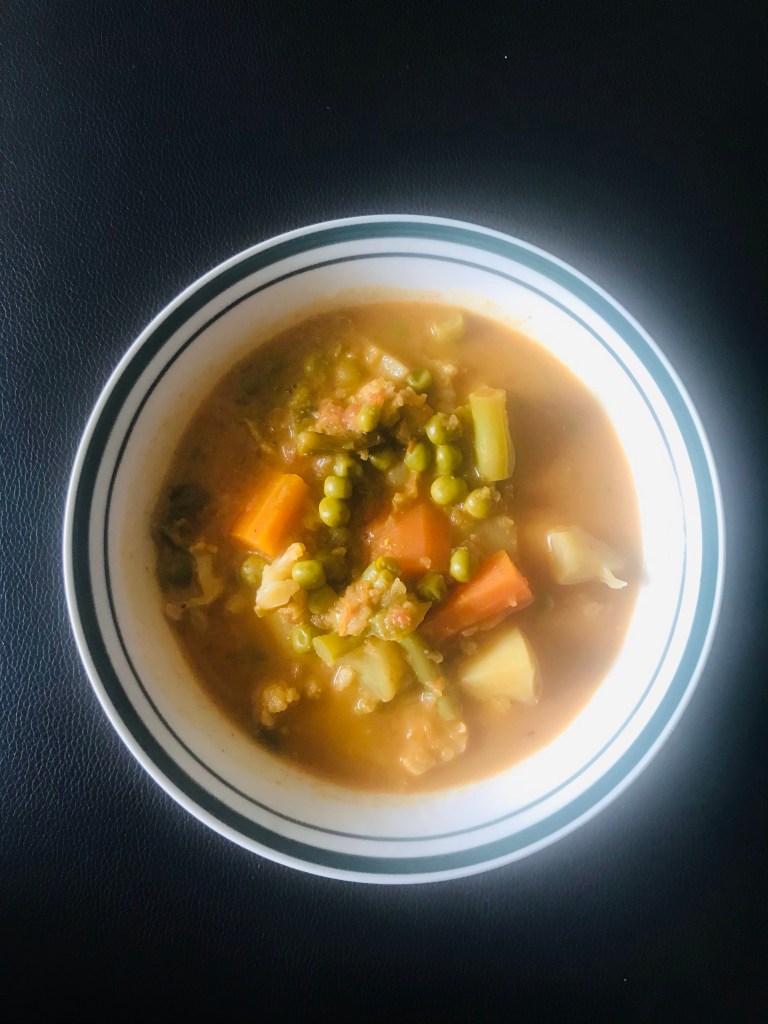
In another episode of no rice Sunday, I was wondering what to make. I had made soups and some roasted vegetables the last few weeks and wanted something different. I was thinking of making a vegetable stew,but didn’t want to make a Kerala-styled coconut milk one. So I decided to improvise and hope and pray it turned out to be edible!
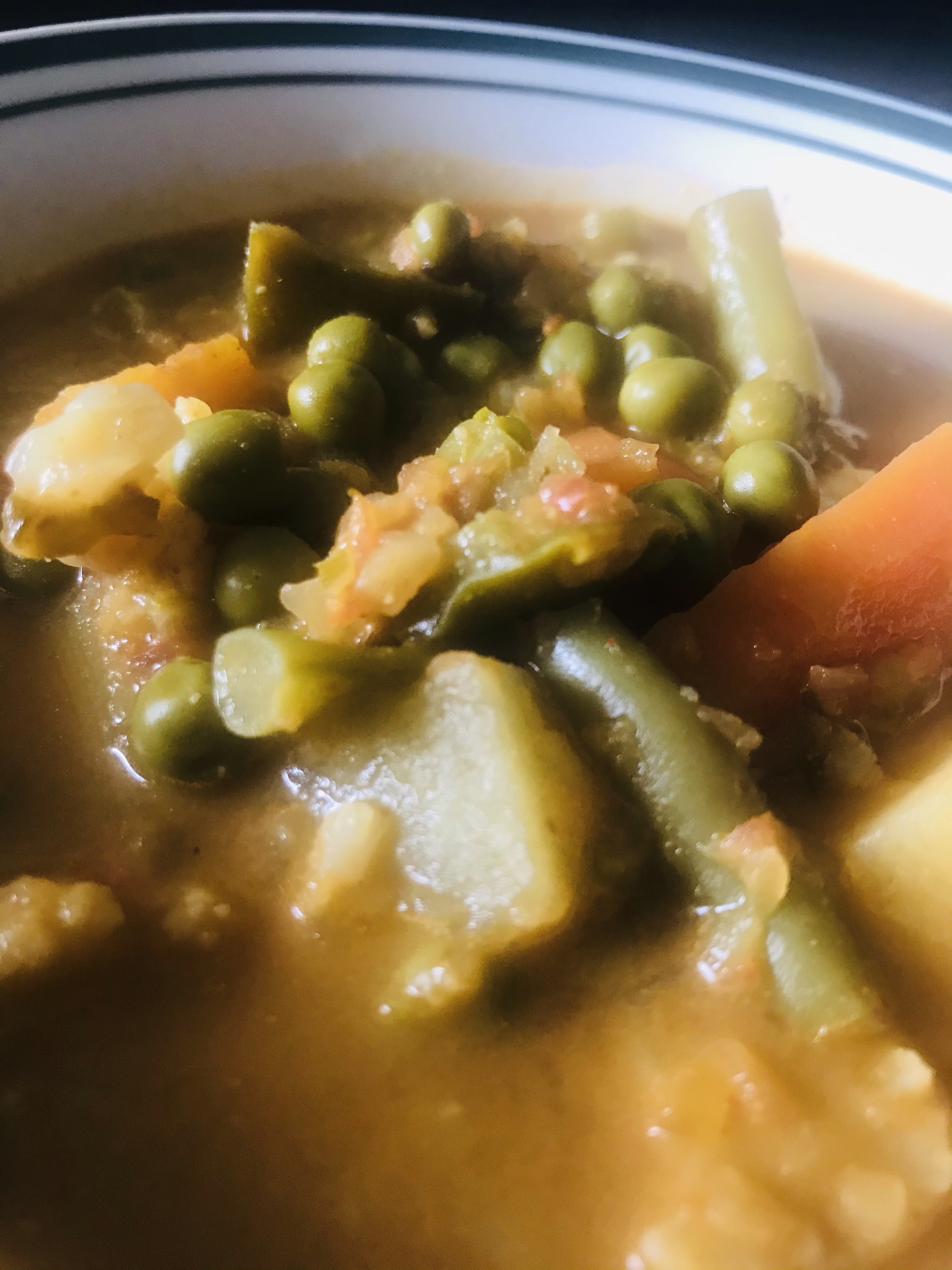
The recipe turned out to be a cross between a soup and a gravy curry and was so flavourful. It is also very healthy with just a tbsp of oil used in the entire recipe. Another good thing about the recipe is that it is a one-pot recipe and would work beautifully for a slow cooker. It just cooks by itself and you need not sit around, stirring and adding ingredients.
My family loved it and I am blogging about it so I can add it to my reportoire and make it another day.
Hearty Vegetable Soup
Ingredients:
3 medium sized onions, minced
2 carrots, chopped bigger than bite sized
2 potatoes, chopped
1 head of cauliflower, chopped
1 green bell pepper, chopped
1 small cup frozen green peas
3-4 medium sized tomatoes, minced
2 green apples, minced (optional)
1 tsp red chilli powder
1/4 tsp turmeric powder
1 tsp cumin powder
1 tsp coriander powder
1-2 tsp garam masala powder
1 tsp cumin seeds
1 tsp fennel seeds
15 cashew nuts, soaked in hot water for 15-20 minutes
15-20 peanuts, soaked in hot water for 15-20 minutes
1 tbsp oil
Salt to taste
Water as required
Method:
Chop the vegetables into pieces larger than bite-sized. I chopped them roughly into 3/4 to 1 inch pieces. Just make sure all the vegetables, with the exception of the green peas are of roughly the same size. Wash and keep aside.
Mince the onions into small, fine pieces. I did this using my food processor which took me seconds as compared to chopping by hand.
Heat the oil in a large pan or dutch oven and when the oil warms up, add the cumin seeds and let them splutter. Then add the fennel seeds and stir for a couple of seconds.
Now add the onions and stir well and let the onions soften and become translucent.
Once the onions are translucent, add the chopped green bell pepper and let it cook for about 3-4 minutes.
Then add the dry spices – turmeric powder, red chilli powder, cumin powder and coriander powder and stir well.
Now add the other chopped vegetables and stir well so the vegetables are covered with the spices. Cover and cook on a medium flame for about 5 minutes.
While this is cooking mince or grate the tomatoes and green apples and keep aside. I again used the food processor and minced both ingredients together.
Then add the minced tomatoes and green apple to the vegetables, lower the flame to a medium-low and let it cook till the vegetables are about 80% cooked. You can also add water to the vegetables at this point, because it will become quite thick with all the vegetables.
While the vegetables are cooking, blend the cashewnuts and peanuts into a smooth paste. Keep aside.
Once the vegetables are about 80% cooked, add the garam masala and the blended cashew-peanut paste and add any seasoning if needed.
Let it continue to cook on a low flame till the vegetables are completely cooked and serve hot with some crusty bread.
If you plan to make this ahead of time, then you may need to add some water when you heat it up before serving because it will thicken up because of the cashewnuts and peanuts. If you are going to add more water, then you will need to check seasoning also which may become diluted.







 Memories and Such