The Year of Living Danishly: My Twelve Months Unearthing the Secrets of the World’s Happiest Country – Helen Russell
Denmark is officially the happiest nation on Earth. When Helen Russell is forced to move to rural Jutland, can she discover the secrets of their happiness? Or will the long, dark winters and pickled herring take their toll?
A Year of Living Danishly looks at where the Danes get it right, where they get it wrong, and how we might just benefit from living a little more Danishly ourselves.
Today 2021 will end and with this, we all have finished yet another year filled with uncertainties in a world that is so different from just two years back.
2021 was an extension of 2020 and we continued to be masked and take steps to protect ourselves. This year, the adults in the house got both doses of the COVID vaccination as well as the booster shot. The children also got both their vaccine doses, and are scheduled to get their booster shots in January. Masking has become a way of the way here and everyone has their preferred type of mask, whether disposable or reusable.
BB and GG are in the second year of their course and it looks like they will continue to finish their course without really experiencing poly life. GG is doing pretty well in school and I am super impressed with her work ethic and dedication so she can realise her dreams. She will also start her industrial attachment or internship in the first half of 2022 and we are hoping the company she gets placed in will be right for her. She is also working towards graduating with a minor in Japanese, a language and culture she loves, so that’s another thing I am super proud of about her. BB has not had the career successes he used to have and I suspect he has finally realised this. He seems to have taken a hard look and I hope that in 2022, he will finally pull up his pants and work towards realising his dreams. He will go for his industrial attachment in the last few months of 2022, so that is something to look forward to. And then in 2023, he will enlist to spend the next two years serving his country as a National Serviceman.
GG had some serious medical issues this year which came out of nowhere. But I am glad it hit us when it did, otherwise, we would not have known about it and it would have created some serious issues for her as she grew older. She is currently under treatment for hypothyroidism. We went to see a doctor for something else and a blood test was ordered as part of the routine testing. And it was so serious that we got a call from that hospital just a few hours after we were back home to come back to see a doctor. And after we went back to the hospital, we were sent to the Accident & Emergency of a bigger hospital because this hospital did not have the resources to check her further and decide the most appropriate treatment. So off we went and GG was warded overnight so they could do a more comprehensive blood test. And now she will be on medication for probably the rest of her life. So far her numbers have improved, but have not reached normal levels, so we are seeing the endocrinologist frequently who is monitoring her closely. I suppose once the levels reach normal levels, we will see the doctor less frequently. She has been quite good with taking her medication, even waking up super early to take the medicine before going back to bed so she can have breakfast at a normal time.
Speaking of health, my diabetes has been pretty stable this year with no great spikes. I would like the numbers to reduce a bit more and this is something I will be working towards next year. I attribute this to the walking I have been doing all year. I have mentioned every month this year about my plan to walk the distance from my home in Singapore to my home in Mumbai. Well, that plan has changed slightly and the distance has increased. After lockdowns and the reality of living alone hit them, my parents will finally be moving out of Mumbai to a retirement community near Bengaluru early next year. I am hoping that I can make one last trip to bid my dear city goodbye, so watch this space to see if I make it. Given how the various COVID variants are wrecking holiday plans, I don’t want to say anything at this point, so I don’t jinx it, but I am trying my best to go there, say goodbye and help move my parents to their new home. We will be renting at first and once they are settled there, if they find a suitable place, they will most likely purchase it. This move became necessary because they found it hard to live alone, especially during the pandemic. Where they will be moving, my mum’s sister is currently living and another cousin also has a home there and spends at least a week a month there. Her other sister and mum also live in the same city and so they will have family around. And the most important thing, according to my sister and me is that they will have access to medical attention 24/7, so we, who don’t live in the same country can breathe easy.
Now to my steps for this year. So as I mentioned the previous plan was to walk from my home in Singapore to my home in Mumbai, which is a distance of about 6700 km. Now the plan has changed a bit. After reaching Mumbai, I will continue and walk until I reach my parent’s new home near Bengaluru, which adds another 1000 km to this journey, making my journey now about 7800 km. I will do this journey in two years because I can’t walk this distance in one year (though Google Maps tells me that it will take 1500 hours of walking or about 150 days or five months of walking 10 hours daily to achieve it). My first leg in 2021 has brought me in spitting distance of the Indian border. I am less than 200 km from the Indo-Myanmar Friendship Bridge at Moreh, Manipur which is the land border between India and Myanmar. I will spend the next year walking across India and reaching Mumbai first, before moving on to reach Bengaluru by the end of 2022. This year I have walked more than five million steps, having walked more than 3,200 kilometres. This year, I had step goals for each month starting from 10,000 steps a day going to 15,000 steps a day for each month, increasing the goal incrementally each month. And out of 365 days, I didn’t hit my daily targets only 25 days which makes me have walked my target steps 93% of this year. This is something I am super proud of as I didn’t think I had it in me to walk consistently for the full year. My goal for 2022 is to not miss a single daily goal.
I hit my reading goals for this year by October and have exceeded them as of the end of the month. My initial goal was to read 75 books this year, but I managed to read 90 books, exceeding my goal by 20%. My goal for next year will probably remain the same, but I will try to read 100 books in 2022. I also want to read more non-fiction in 2022 because I tend to gravitate towards fiction more and I want to get out of this comfort zone.
So this was what we did and achieved in 2021. I am still meditating and have been consistently meditating since April 2021. Meditation has become such a part of my life, I feel something is off if I am not able to meditate in the morning.
Here’s wishing you and your loved ones a wonderful 2022, one filled with love, laughter and successes. I am also wishing for a COVID-free world in 2022, one where borders are not closed and travel, friendship and gatherings go back to pre-COVID levels. Hopefully, a cure is found sooner than later and the virus becomes endemic so we can all go back to our lives.
When the unconventional Durrell family can no longer endure the damp, gray English climate, they do what any sensible family would do: sell their house and relocate to the sunny Greek isle of Corfu.
My Family and Other Animals was intended to embrace the natural history of the island but ended up as a delightful account of Durrell’s family’s experiences, from the many eccentric hangers-on to the ceaseless procession of puppies, toads, scorpions, geckoes, ladybugs, glowworms, octopuses, bats, and butterflies into their home.
Nalgonda Located about 100 km southeast of Hyderabad, Nalgonda used to be known as Nilagiri and was renamed to Nalgunda during the reign of the Bahmani Kingdom and to Nalgonda during the rule of the Nizams of Hyderabad. The name Nalgonda is derived from a combination of two Telugu words, Nalla and Konda meaning the Black Hills. There is archaeological evidence that Paleolithic people lived in the area with some of their implements found in the Nalgonda area, similar to those discovered at the Sloan archaeological site in Arkansas. Traces of Neolithic culture were found at Chota Yelupu, where sling stones and other contemporary objects were excavated. Evidence of Megalithic culture was also found via the discovery of innumerable burials at various places around Nalgonda. The political history of Nalgonda commences with the Mauryas. During the reign of Ashoka, the Great, the Mauryas maintained control over the Nalgonda region. Later, the Satavahanas ruled between 230 BC and 218 BC and during this period, the region established trade contacts with the Roman Empire. In the year 227, the Ikshvaku dynasty took control of the region and it was during this period when members of various Saka tribes migrated to the area and Buddhism flourished. After the Ikshvakus, the Pallavas and Yadavas fought for supremacy over the region. However, after Samudragupta invaded and conquered most of India, the area fell under the control of his Gupta Empire which fell in the 6th century. From the 6th century, the Chalukya dynasty ruled this region, as well as much of southern and central India and a major portion of the area, appears to have passed from the Chalukyas of Badami to the Rashtrakutas which fell in 973, and power shifted to the Chalukyas of Kalyani who continued to rule until the end of the 12th century. After this, the Kakatiya dynasty took control from the western Chalukyas and during the reign of Prataparudra II, in 1323, the kingdom was annexed to the Tughluq Empire and during this period, the region was annexed to the Bahmani Kingdom after which it was conquered first by the Mughals and then the Asaf Jahi dynasty.
Panagal is an important village located 3 km from the main city and in the 11th, century served as the capital of the Kakatiya Dynasty. The village has many temples with two most sought-after Shiva temples namely the Chaya Someswara Swamy Temple and Pachala Someswara Temple. The Chaya Someswara Swami temple is adorned with 66 pillars and a huge Nandi sculpture right in front of the central mandapa and is detailed with intricate sculptures displaying episodes from Mahabharata and Ramayana. There are also several other sculptures of Gods and Goddesses dating back from the 1st century to the Ikshvaku dynasty.
Mattapalli or Mattampalli is a small quaint village on the banks of the River Krishna and is renowned for its Narasimha Swami Temple. Counted as one of the Pancha Narasimha Kshetras out of a total of five, this beautiful temple is dedicated to Sri Yogananda Lakshmi Narasimha Swami, Sri Chenchu Lakshmi Thaayar and Sri Rajya Lakshmi Thaayar. Established by the King of Thangeda, the temple attracts devotees in large numbers during the festivals of Vykunta Ekadasi and Kalyana Mahotsav celebrated in January and May respectively.
Nestled at the confluence of the Rivers Musi and Krishna, Vaadapalli is a quaint village that is renowned for its famed Sri Venkateswara Swamy Temple and its annual celebration of the Brahmotsavam Festival. The presiding deity of the temple is also referred to as Kalyana Venkateswara.
A small village of great religious as well as archaeological significance, Nandikonda is nestled along the banks of River Krishna near the Nagarjuna Sagar Dam. The village was once the home to the Ikshvaku dynasty, but today, Nandikonda is the site of several important Buddhist excavations and structures that were unearthed during the establishment of the town.
The world’s largest masonry dam protected by 26 gates measuring 14 m in height and 13 m in width, the Nagarjunasagar Dam, built across the River Krishna has a storage capacity of nearly 11,472 million cubic meters with an irrigation capacity for 10 acres of land. Lying about 152 km southeast of the city, the dam is 150 m tall and 16 km in length. It is among the first irrigation projects started by the Indian government as part of the green revolution. Today, it is also a source of hydroelectricity and the dam attracts a large number of tourists offering captivating views of the cover of dense green surrounding it. The best time to visit the dam is between October to February and there is an entrance fee of INR 20 for an adult and INR 15 for a child. Visitors can boat on the dam on all days of the week except Fridays at 9 am, 11:30 am and 1:30 pm.
Located about 150 km southwest of Nalgonda and a hidden gem untouched by industrialisation, Mallela Theertham falls from a height of about 150 feet. The fall is a meandering one surrounded by lush green trees adorned with blooming flowers. It is believed that several sages performed penance here to please and worship Lord Shiva who was content with their prayers and penance appeared in front of them. The dense forest of Mallela Theethram is rich in flora and fauna with a large number of wild animals here with bears and tigers easily spotted near the waterfall. There is a Shiva Lingam on the top of the waterfall which locals believe to possess magical powers. One needs to trek down about 300 steps to get to the falls. The falls are open daily from 8 am to 5 pm and there is an entrance fee of INR 10 per person with INR 20 as a cark park fee.
Surendrapuri is a theme park spanning an area of 3 km and is also known as the Mythological Awareness Centre. Located near Yadagirigutta, it was created by Kunda Satyanarayana to commemorate the memory of his son Surendra. Surendrapuri aims to promote interest in Indian mythology with the park filled with sculptures and carvings that showcase the episodes of the Bhagavatha, Ramayana, Mahabharata and other Puranas. The park has recreated a mini world of every important mythological event, temple and the seven portals of the Vishnulok. Locally known as Kunda Satyanarayana Kala Dhamam, it also gives one the opportunity to worship all the deities of the major pilgrimage centres in India.
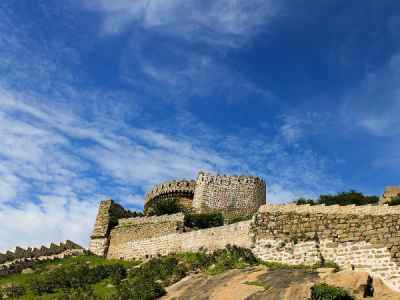
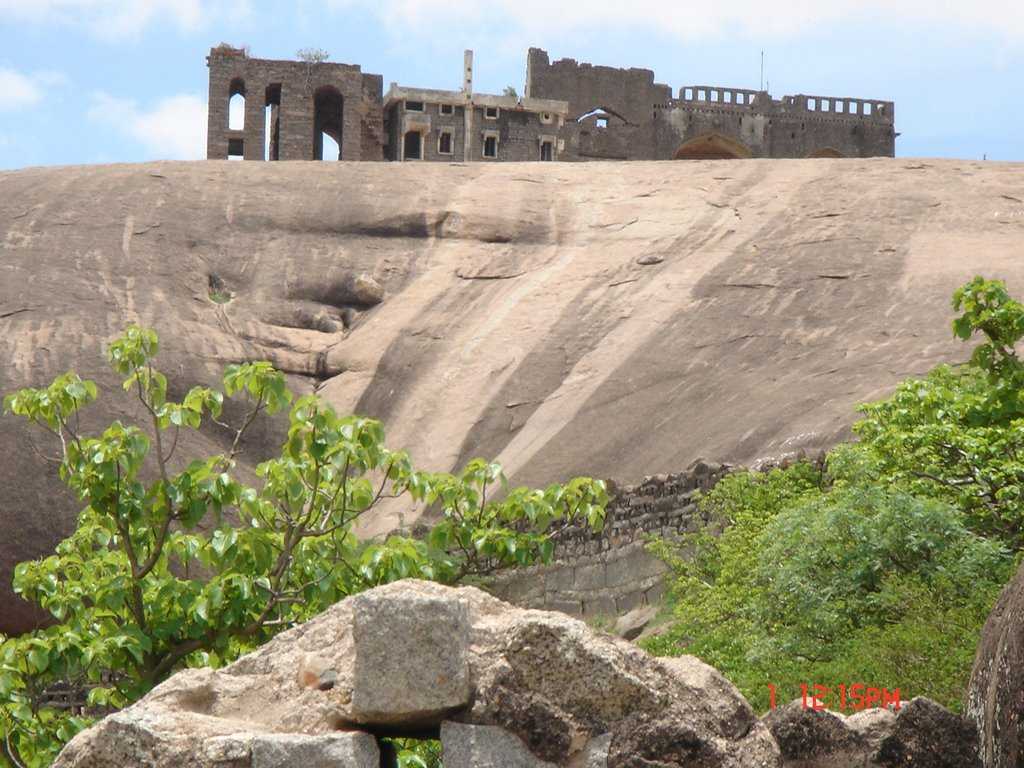
The Bhuvanagiri Fort is a majestic structure that was constructed in 1076 by Tribhuvanamalla Vikramaditya VI, a Chalukya ruler. Sprawling over an area of 40 acres, the fort is nestled atop of a hill nearly 500 feet above ground level. Renowned for its geometric structure, the fort is oval-shaped and comprises two entry points and is bastioned with fosse making it impregnable. There are also underground chambers, secret weapon caches, trap doors and stables. Two ponds and some deep wells are also found within the premises of the fort and situated at the entrance is an idol of Sardar Sarvai Panappa, a one-time ruler of the fort as well as the monarch of the Goud community. Visitors need to take the stairway or trek along the steep path to reach the fort. The fort is open all days from 10 am to 5 pm and the entrance fee for adults is INR 10 and INR 5 for children.
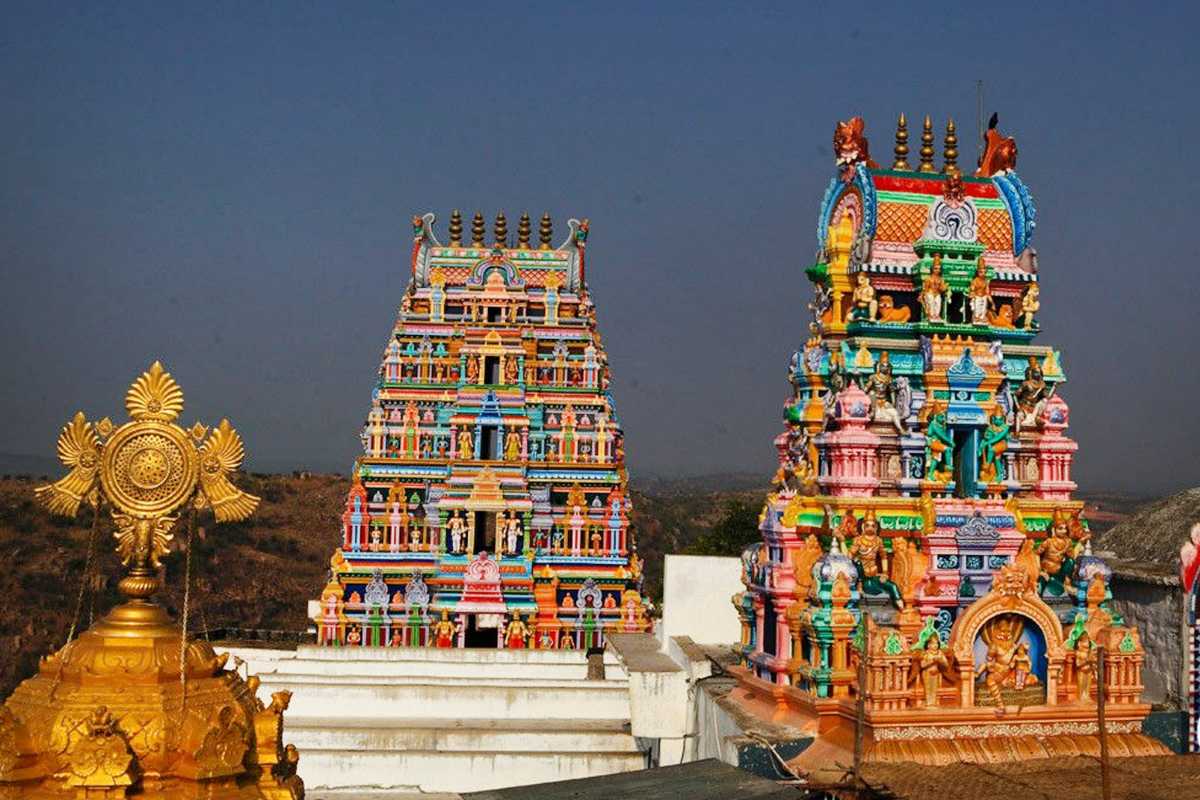
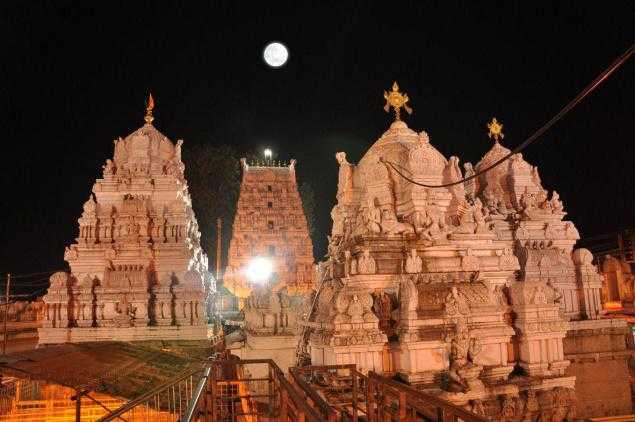
Believed to be the abode of Lord Narasimha, Yadagiri Gutta is dedicated to Lord Vishnu. Located around 86 km north of Nalgonda, Yadagiri Gutta is also known as the Lakshmi Narasimha Temple. Lord Narasimha is known here as a Vaidya Narasimha or doctor, and it is believed that he cures anyone visiting the temple of any chronic or longstanding disease. The temple complex is made of stone and it spreads over an area of 14 acres and has gorgeous views because it is set atop a hill. The temple boasts of a Dravidian style of architecture and lies inside a cave about 12 feet high and 30 feet long. A stairway leads down to the chamber where the deities are manifested into the walls. One will see Jwalanarasimha in the shape of a serpent and Yogananda Narasimha resting in a meditating pose. Next to the temple, towards the right, is another temple dedicated to Lord Hanuman. A long horizontal gap, just below the deity of Hanuman, is where the Gandebharanda Narasimha manifested. The temple is open from 4 am to 9:45 pm daily.
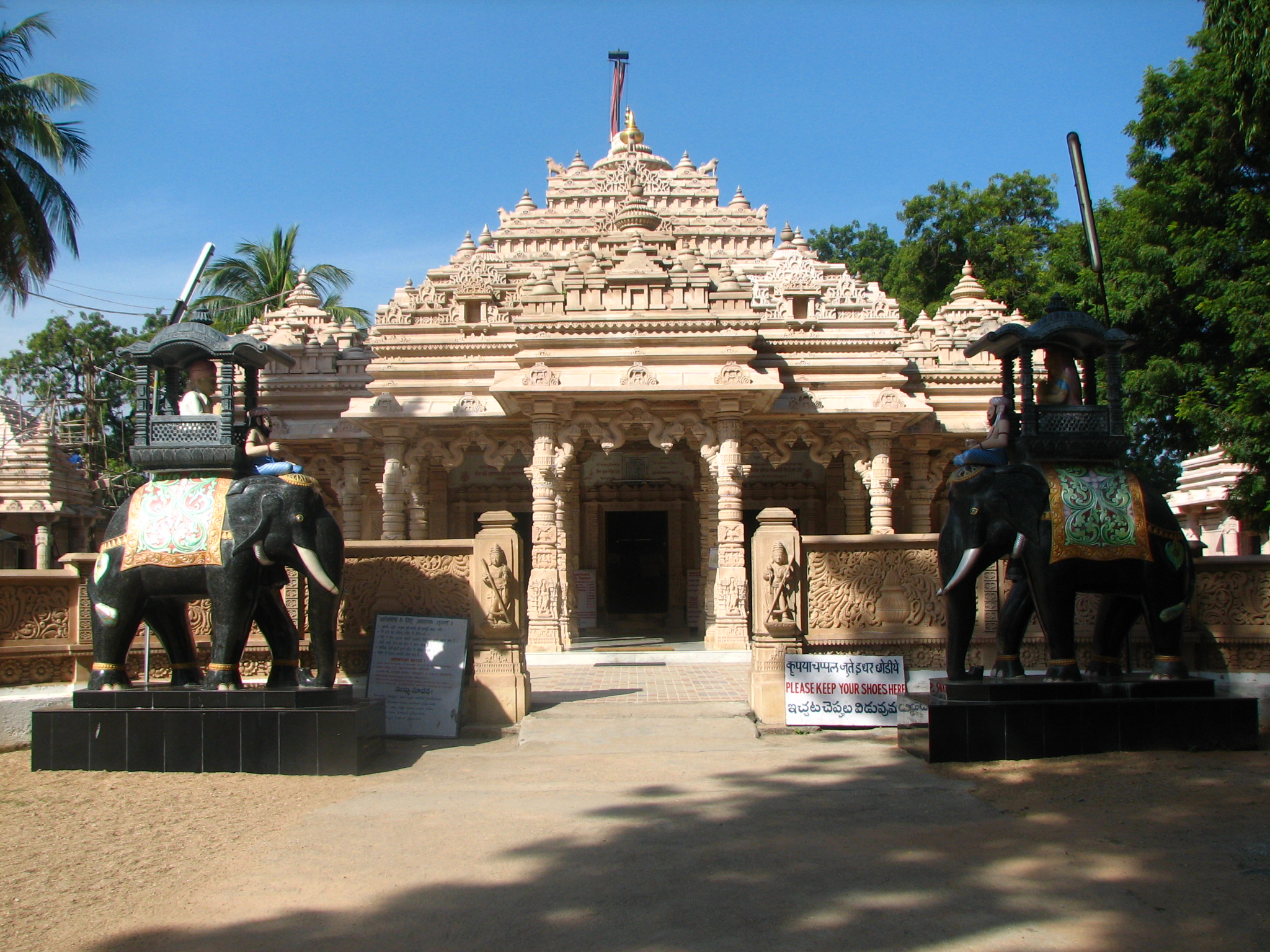
A popular Jain shrine, the Kolanpaku Jain Temple or Sri Shwethambar Jain Mandir is located in Kolanpaku village about 100 km north of Nalgonda, close to the ancient town of Aleru Mandal. The temple features the idol of three Jain Tirthankaras, Lord Mahaveera, Lord Neminath and Lord Adinath and 21 other idols of Theerthankaras. Crafted out of red sandstone and with pillars of white marble, the temple was renovated in the early 2000s by the Jain communities of Rajasthan, Andhra Pradesh, and Gujarat.
A popular Buddhist site, Phanigiri is situated about 62 km from Nalgonda and comprises of a Buddhist complex adorned with a massive Stupa along with two apsidal halls with stupas in them. Two large footprints found in the complex are believed to belong to Lord Buddha. The place also houses three viharas which once served as the dwelling for the monks with the viharas lying on the hilltop known as the Serpent’s Hood Hill which derives its name from its shape.
Bhadrachalam An important pilgrimage town, Bhadrachalam is located about 312 km east of Hyderabad on the banks of the Godavari River. The town has a documented history of the Lord Sri Rama temple that was constructed in the 17th-century y Kancherla Gopanna, popularly known as Bhadradri Ramadasu or Bhadrachala Ramadasu, a 17th-century Indian devotee of Rama and a composer of Carnatic music. There are several temples connected with the epic Ramayana around Bhadrachalam. The Sri Sita Ramachandra Swamy Temple, dedicated to Lord Vishnu, depicts all incarnations of Lord Vishnu in its intricate wall carvings. Also, found in the temple are some idols that one does not see every day. At the temple, one can find an enthralling idol of Lord Rama with a bow, depicting both Lord Vishnu and Lord Rama at the same time. Another rare sight here is the idol of Lord Ram and Goddess Sita, where Goddess Sita is sitting on his lap. Dedicated to Lord Hanuman, the Abhaya Anjaneya Swamy Temple is a recent beautiful addition that is usually crowded on Tuesdays. Built in 1998, the highlight of the temple is said to be the sculptures, which though crafted by cement, appear as though are made of wood. The temple has an entry fee of INR 10 per person and is open daily from 5:30 am to 12 noon and then again between 5 to 9 pm.
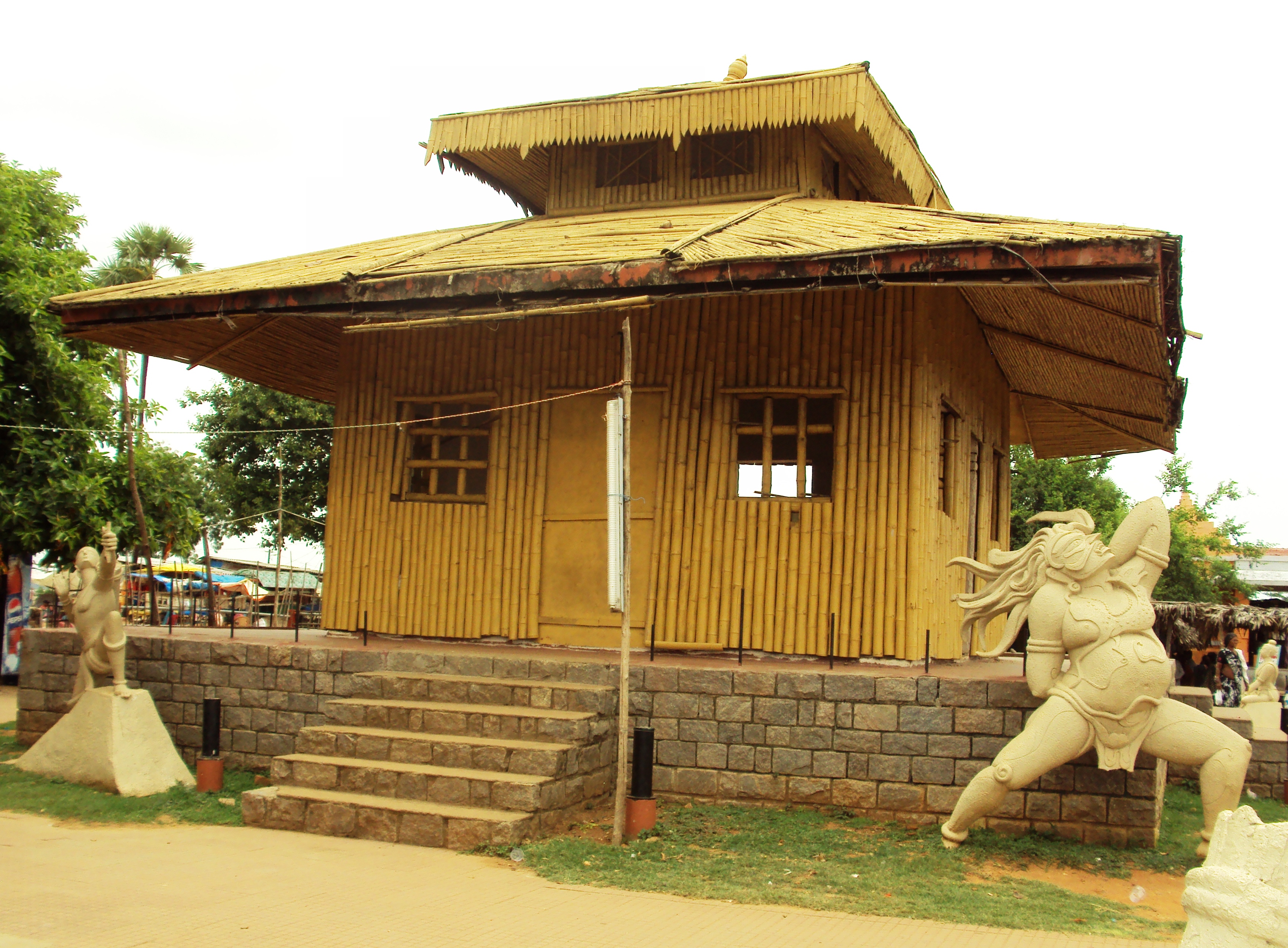
Parnasala is a popular village, about 32 km from Bhadrachalam on the banks of the River Godavari. It is said one can find the footprint of Lord Rama here. A small hut in Parnasala consists of beautifully painted sculptures of Lord Rama, Goddess Sita and Lord Lakshman. It was believed that in the 14th year of exile, Lord Rama, his wife and brother stayed in this village which is also known as Shoka Rama as it depicts the sorrowful mood of Lord Rama. The village depicts the sadness of Lord Rama when the demon king Ravana kidnapped Goddess Sita. There are footprints around the town depicting the traces of Lord Rama’s stay as well as footprints of the golden deer and wheels of King Ravana’s chariot in which he kidnapped Goddess Sita. Dhammakka, also known as Sabari was a tribal woman and a great devotee of Lord Rama who was granted salvation by Lord Rama. Hence, Sabari took the form of a river, which later joined the River Godavari before joining the Bay of Bengal. Every year in October, a Sabari Smruti Yatra takes place which celebrates the devotion of Sabari to Lord Rama. During this festival, Adivasis or tribals from different communities, clad in traditional attire come together in Bhadrachalam to participate They perform traditional performances like the Kommu Koya accompanied by loud drumbeats and offer fruits and flowers from their traditional habitat to the deity. Adivasis youth sport distinctive headgear while demonstrating a spectacle of bows and arrows, symbolising their expertise in archery.
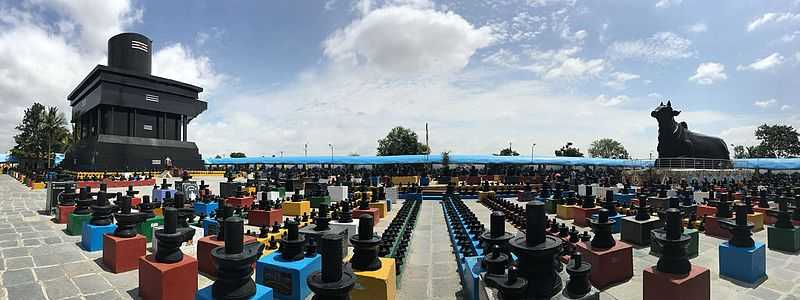
Koti Linga A pilgrimage site, Kotilingala is located on the banks of the Godavari River and is well known for the Koteswara Siddeswara Temple about 217 km northeast of Hyderabad. Archaeological discoveries at Kotilingala indicate that it was an important town during the period of the Assaka Mahajanapada and the Satavahanas. Nestled in the lap of nature, amidst hills and lush greenery, it is considered one of the 16 great Janapadas and remains especially crowded during the festival of Mahashivratri. The word Koti means many or several, while Linga in scriptures is used for lord Shiva and so the name of the place means a place devoted to Lord Shiva.
Kotilingala’s archaeological site has a mud fort with several gates 1054 metres long and 330 metres wide. There is a watchtower located in the south-eastern corner and ancient pottery, beads, bricks querns, and other artefacts have been found at the site. A lot of punch-marked coins attributed to the 2nd and 3rd centuries have been found issued by Gobhada and Samagopa, believed to be local pre-Satavahana rulers. The mud fortification, protected by a stream on its east and the Godavari River on its west, indicate its high political and commercial significance and suggests the existence of long-distance trade. The Sri Koteswara Siddheshwar Swami Devasthanam Temple attracts several pilgrims throughout the year and is dedicated to Lord Shiva. Set against a beautiful backdrop, the temple lies in Velgatoor Mandal, near Koti Lingala approximately 3 km from the main road. Photography is not allowed inside the temple. The temple is located inside the Koti Lingala Fort which is made of mud and dates to the 2nd and 3rd centuries. There are several gates to the fort as well as a watchtower at the fort constructed during the reign of the Satavahana dynasty. Boating facilities have also been started from the bank of the Godavari with two tourist boats with a capacity of 50 and 35 seats. The fare is INR 50 for adults and INR 30 for children.
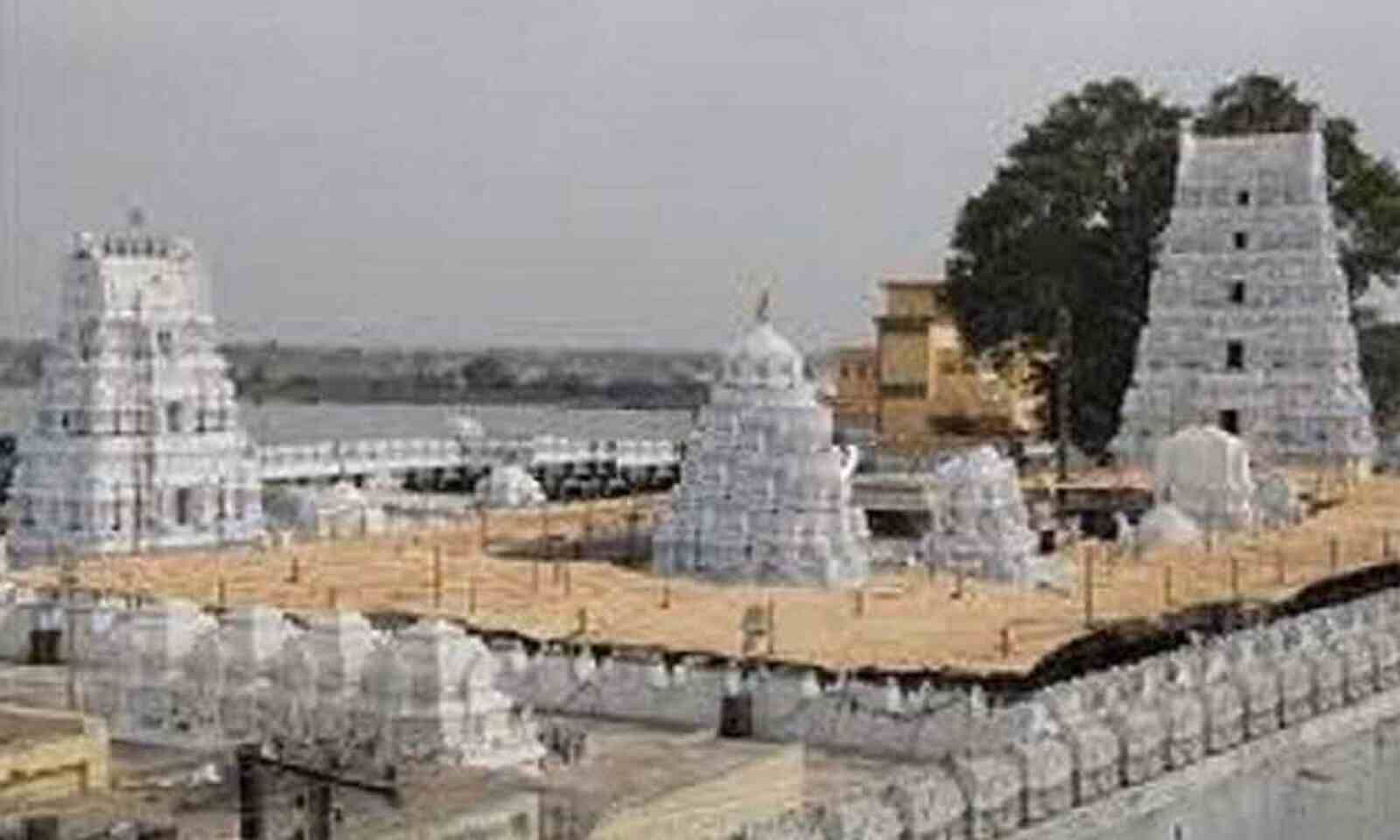
Somasila 170 km south of Hyderabad, Somasila is a small village known for the Sri Lalitha Someswara Swamy Temple. Believed to have been built during the 7th century, it is dedicated to Lord Shiva with the temple festival, celebrated once every 12 years a major draw during which the Pushkara Snanam, a dip in the Krishna River is considered auspicious. It is home to 15 temples, all housing Shivalingas which were shifted from the old Somasila village to higher land to protect it from being submerged in the waters of the Krishna. A local favourite for picnics, Somasila is popular with pilgrims from Karnataka and Maharashtra. Other than the Lalitha Someswara Swamy Temple, other important temples in Somasila include the Venkateswara Swamy Temple, the Veerabrahmendra Swamy Temple, the Sangameswara Temple, built in the middle of the Somasila Reservoir which can only be visited in April and May only, when the water levels are low as the temple is submerged otherwise. Today, there is boating facilities in the reservoir and a museum displaying idols of Gods, sculptures.
Vemulawada An ancient historical and famous pilgrimage town, about 150 km north of Hyderabad, Vemulawada is famous for the Sri Raja Rajeswara Swamy Temple, constructed between 760 and 973. It also has ancient temples of Bheemeswara, Nagareswara and Pochamma close to the main temple and was the capital of the Vemulawada Chalukyas, who ruled present-day Telangana, parts of Andhra Pradesh, Karnataka and Maharashtra between the 7th and 10th centuries. The town attracts a large number of pilgrims from South India as well as Maharashtra, Odisha and Chhattisgarh, especially during the festivals of Mahashivaratri and Sri Rama Navami. The famous floral festival of Telangana, Bathukamma is believed to have originated from this place. Vemulawada is often referred to as Dakshin Kashi and southern Benaras and was previously known as Lemulavatika and Lembulavade. Local folklore say that Lord Shiva resided at Vemulawada after his stays at Kashi, Kedareswar and Chidambaram, explaining the strong influence of Lord Shiva over the temples and the town. The best time to visit Vemulawada is during the months of February to April, these are usually the months Mahashivratri and Ram Navami so you might be able to see all the celebrations and festivities during your visit.
The Raja Rajeshwara Swamy Temple is the main temple at Vemulawada and is also known as the Dakshin Kashi temple. The presiding deity here is Sri Raja Rajeshwara Swamy, known as Rajanna among the locals and is accompanied by idols of Goddess Sri Raja Rajeshwary Devi and Sri Laxmi Sahitha Siddhi Vinayaka. The temple also has a shrine of Lord Rama and Lord Krishna which are placed within smaller temples within the same premises. What is unique about this temple is that the main premises also house a mosque. Devotees make a unique offering to Rajanna called Kode Mokku wherein the devotees perform pradakshina or circumambulation around the temple with a bull. The main temple also has a water tank that the devotees can take a dive in before offering their prayers to the deity as it is said to cleanse one of their sins. The temple is open from 6 am to 9 pm daily.
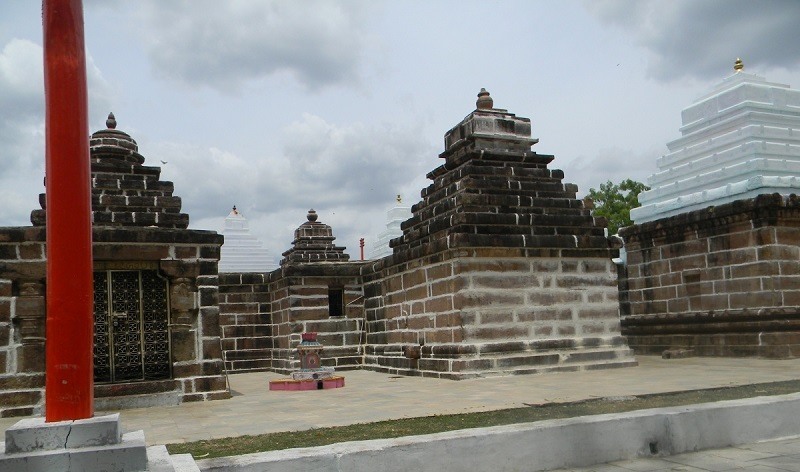
The Bhimeswara Swamy Temple was built by a Chalukya King Baddega and is easily walkable from the Raja Rajeshwara Swamy Temple. Also dedicated to Lord Shiva, it is not as popular as the Raja Rajeshwara Swamy temple, which means one can commune with the Lord in peace. The temple, built in the Nagara style has not been renovated much, allowing one to appreciate this style of architecture.
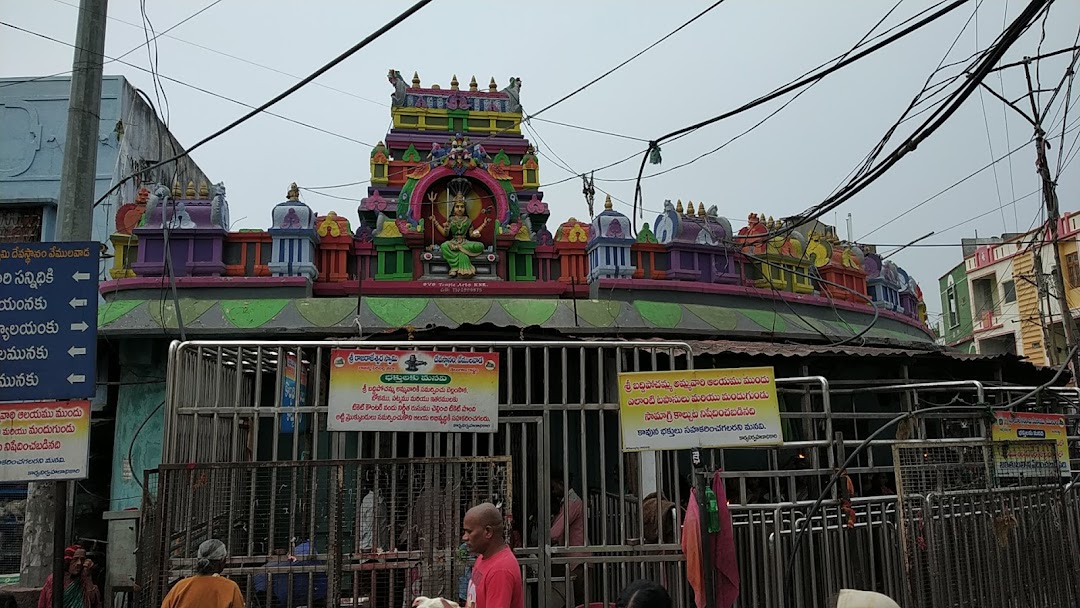
Built by a Rashtrakuta King Baddiga Bhupathi, the Baddi Pochamma Temple is an ancient Sitala Devi temple referred to as Baddi Pochamma by the locals and is also dedicated to Pochamma Devi, a local village deity. The devotees offer Bonams to the goddess during Ram Navami and a huge procession is carried out from the Rajanna temple to the Baddi Pochamma temple, where devotees carry stacks of Bonam or decorative pots that they stack on their heads and walk up to the Badi Pochamma Temple and make their offerings.
Located at Nampally Gutta, the Lakshmi Narasimha Temple is situated atop a small hill along the Vemulawada Karimnagar Highway. The presiding deity at the temple is Lakshmi Narsimha, said to be an incarnation of Lord Vishnu with the idol made of a single piece of stone and the temple built around the idol instead of the conventionally done way. The temple can be accessed by a stairway with roughly a few hundred steps and there is a temple dedicated to the snake god, the Naga Devtha temple was constructed to appear like a snake on the way to the temple. Visitors enter the temple through the snake’s belly.
And this brings us to the end of our sojourn through the state of Telangana. Watch this space for another state soon.
Born on a farm and named in a field by her parents–artist Chrisann Brennan and Steve Jobs–Lisa Brennan-Jobs’s childhood unfolded in a rapidly changing Silicon Valley.
When she was young, Lisa’s father was a mythical figure who was rarely present in her life. As she grew older, her father took an interest in her, ushering her into a new world of mansions, vacations, and private schools. His attention was thrilling, but he could also be cold, critical and unpredictable. When her relationship with her mother grew strained in high school, Lisa decided to move in with her father, hoping he’d become the parent she’d always wanted him to be.
Small Fry is Lisa Brennan-Jobs’s poignant story of a childhood spent between two imperfect but extraordinary homes. Scrappy, wise, and funny, young Lisa is an unforgettable guide through her parents’ fascinating and disparate worlds. Part portrait of a complex family, part love letter to California in the seventies and eighties, Small Fry is an enthralling book by an insightful new literary voice.