On Sunday, hundreds of thousands of women, mostly belonging to the northern part of India will take part in a ritual immortalised in hundreds of Indian films, the festival of Karva Chauth.
Karva Chauth is a festival celebrated by Hindu women from mostly the northern part of the Indian subcontinent on the fourth day after the full moon or Purnima in the month of Kartika, about mid-October to mid-November. On Karwa Chauth, married women, especially in North India, observe a fast from sunrise to moonrise for the safety and longevity of their husbands. The Karva Chauth fast is traditionally celebrated in the states of Delhi, Haryana, Rajasthan, Punjab, Jammu and Kashmir, Uttar Pradesh, Bihar, Himachal Pradesh and Madhya Pradesh and is celebrated as Atla Tadde in Andhra Pradesh.
Karva is another word for a pot or a small earthen pot of water and chauth means fourth in a reference to the fact that the festival falls on the fourth day of the dark-fortnight, or Krishna paksh, of the month of Kartik. One hypothesis for this festival is that military campaigns were often conducted by men in far off places whereby men would leave their wives and children at home to go off to the war and their wives would often pray for their safe return. The festival also coincides with the wheat-sowing time or the beginning of the Rabi crop cycle. Big earthen pots in which wheat is stored are sometimes called Karwas, so the fast may have begun as a prayer for a good harvest in this predominantly wheat-eating Northwestern region.
Another story about the origin of this festival relates to the bond of feminine friendship. With the custom of arranged marriage being prevalent, the newlywed is supposed to reside with her husband and in-laws. Being new to the family, the custom arose of befriending another woman as her friend or kangan saheli or sister or dharam behn for life. The friendship would be sanctified through a Hindu ritual during the marriage ceremony itself. The bride’s friend would usually be of the same age or slightly older, typically married into the same village, so that she would not go away and not directly related to her in-laws, so there was no conflict of interest later. This emotional and psychological bond would be considered akin to a blood relationship and it is said that the Karva Chauth festival evolved to include celebrating this special bond of friendship.
There are legends associated with the Karva Chauth festival. In some tellings, the tales are interlinked, with one acting as a frame story for another. The story of Queen Veervati is about a beautiful queen called Veervati who was the only sister of seven loving brothers. She spent her first Karwa Chauth as a married woman at her parents’ house. She began a strict fast after sunrise but, by evening, was desperately waiting for the moonrise as she suffered severe thirst and hunger. Her seven brothers couldn’t bear to see their sister in such distress and created a mirror in a sacred fig or peepal tree that made it look as though the moon had risen. The sister mistook it for the moon and broke her fast. The moment she took the first morsel of food, she sneezed. In her second morsel she found hair. After the third she learned the news of her husband, the King, was dead. Heartbroken, she wept through the night until a Goddess appeared and ask why she crying. When the queen explained her distress, the Goddess revealed how she had been tricked by her brothers and instructed her to repeat the Karwa Chauth fast with complete devotion. When Veervati repeated the fast, Lord Yama, the God of death was forced to restore her husband to life. In a variant of this story, the brothers build a massive fire behind a mountain instead and trick their sister by convincing her that the glow is the moon. She breaks her fast and word arrives that her beloved husband has died. She immediately begins running to her husband’s house, which is somewhat distant, and is intercepted by Lord Shiva and Goddess Parvati. Goddess Parvati reveals the trickery to her, cuts her own little finger to give the wife a few drops of her holy blood, and instructs her to be careful in keeping the complete fast in the future. The wife sprinkles Parvati’s blood on her dead husband and, coming back to life, they are reunited.
In a legend from the Mahabharata, Draupadi, too, is said to have observed this fast. Once Arjun went to the Nilgiris for penance and the rest of the Pandavas faced many problems in his absence. Draupadi, out of desperation, remembered Lord Krishna and asked for help. Lord Krishna reminded her that on an earlier occasion, when Goddess Parvati had sought Lord Shiva’s guidance under similar circumstances, she had been advised to observe the fast of Karwa Chauth. In some tellings of this legend, Shiva tells Parvati the story of Veervati to describe the Karwa Chauth fast. Draupadi followed the instructions and observed the fast with all its rituals. Consequently, the Pandavas were able to overcome their problems.
The legend of Karva tells us the story of a woman named Karwa who was deeply devoted to her husband. Once, while bathing at a river, her husband was caught by a crocodile. Karva bound the crocodile with cotton yarn and asked Lord Yama, the God of death to send the crocodile to hell. When Yama refused, Karva threatened to curse Yama and destroy him. Yama, who was afraid of being cursed by a devoted wife, sent the crocodile to hell and blessed Karva’s husband with long life and Karva and her husband enjoyed many years of wedded bliss.
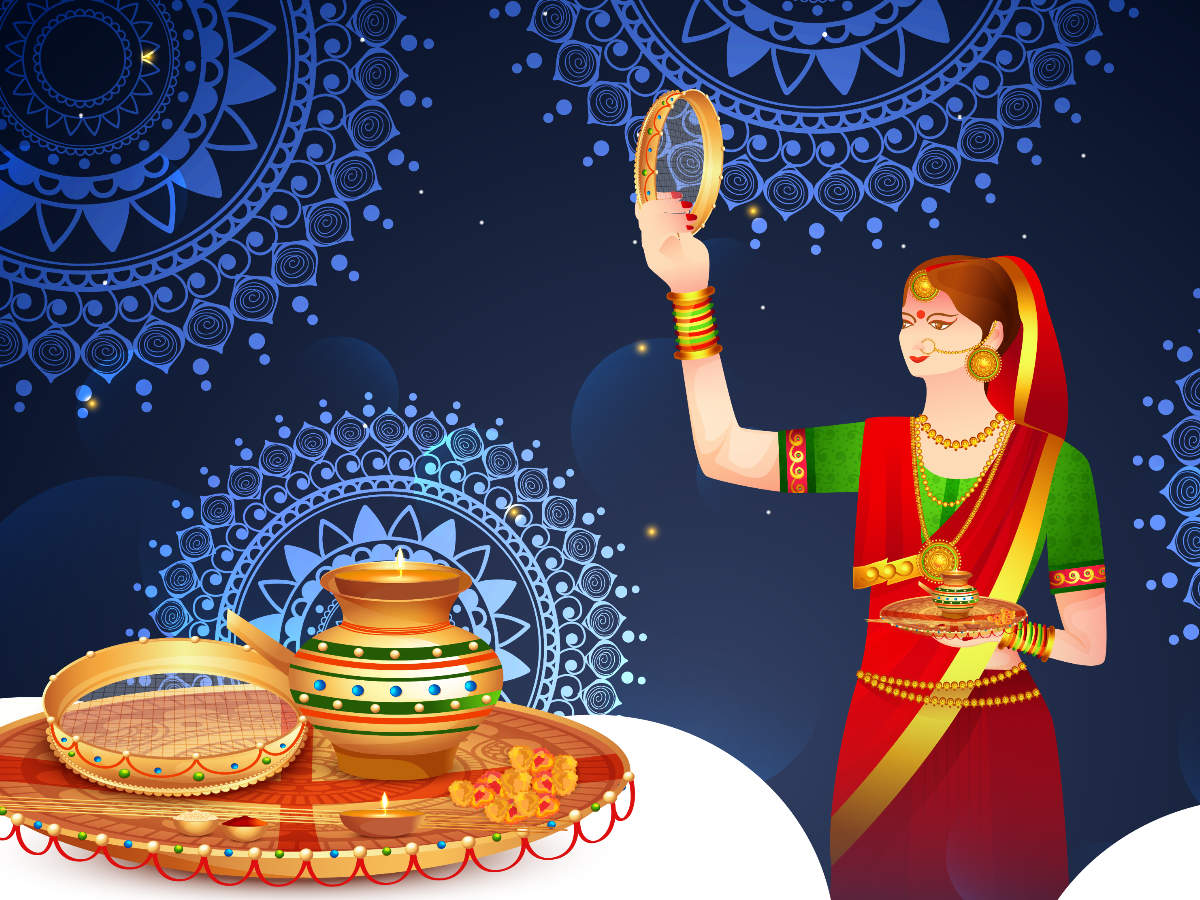
A few days before Karva Chauth, married women would buy new Karvas or spherical clay pots, 7-9 inches in diameter and of 2–3 litres capacity and paint them on the outside with beautiful designs. Inside, they would put bangles and ribbons, home-made candy and sweets, make-up items, and small clothes. The women would then visit each other on the day of Karva Chauth and exchange these Karvas. Women begin preparing for Karva Chauth a few days in advance, by buying adornments or shringar, jewelry, and prayer or puja items, and the decorated prayer plate or puja thali. On the day of the fast, women from Punjab awake to eat and drink just before sunrise. In Uttar Pradesh, celebrants eat soot feni with milk in sugar on the eve of the festival. It is said that this helps them go without water the next day. In Punjab, sargi is an important part of this pre-dawn meal and always includes fenia. It is traditional for the sargi to be sent or given to the fasting woman by her mother-in-law. If she lives with her mother-in-law, the pre-dawn meal is prepared by the mother-in-law. On the occasion of Karva Chauth, fasting women choose to wear traditional wear like a sari or lehenga.
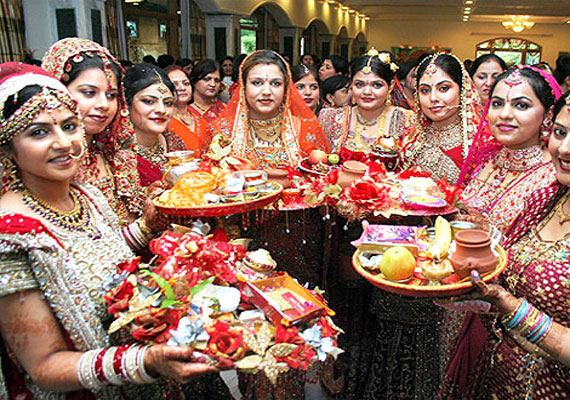
The fast begins at dawn. Fasting women do not eat during the day. In traditional observances of the fast, the fasting woman usually does no housework. Women apply henna and other cosmetics to themselves and each other and the day passes in meeting friends and relatives. In some regions, it is customary to give and exchange painted clay pots filled with goodies. Since Karva Chauth follows soon after the Kharif crop harvest in the rural areas, it is a good time for community festivities and gift exchanges. Parents often send gifts to their married daughters and their children. In the evening, a community women-only ceremony is held. Participants dress in fine clothing and wear jewellery and henna, and in some regions dress in the complete finery of their wedding dresses. The dresses are frequently red, gold or orange, which are considered auspicious colours. The fasting women sit in a circle with their puja thalis and depending on the region and community, a version of the story of Karva Chauth is narrated, with regular pauses. The storyteller is usually an older woman or a priest, if one is present. During the pauses, the festival song is sung collectively with the singers passing their thalis around in the circle. In Uttar Pradesh, a priest or an elderly woman of the family narrates the story of Beejabeti or Veervati. Thereafter, the fasting women offer baayna or a melange of goodies to the idols and hand them over to their mother-in-law or sister-in-law.
The ceremony concluded, the women await the rising of the moon. Once the moon is visible, depending on the region and community, it is customary for a fasting woman, to view the moon or its reflection in a vessel filled with water, through a sieve, or through a dupatta. Water is offered to the moon to secure its blessings with women praying briefly for their husband’s life in some regions. It is believed that at this stage, spiritually strengthened by her fast, the woman can successfully confront and defeat death, personified by Lord Yama. Her husband then takes the water from the thali and offers it to his wife and by taking her first sip of water during the day, the fast is now broken and the woman can have a complete meal.
In modern Northern and Northwestern Indian society, Karva Chauth is considered to be a romantic festival, symbolising the love between a husband and wife. Thanks to Bollywood, Karva Chauth isn’t limited to be a North Indian or Punjabi festival anymore and is now glamorised and widely popular in pan India. There have been calls to modify or eliminate the festival by commentators who hold it to be anti-women and to perpetuate the notion of women’s dependence on men. Karva Chauth has also been cited as a symbol of cultural repression of women by some Indian feminists with others calling the festival empowering for women because the festival enables them to quit housework completely for the day and expect gifts from their husbands.
To those celebrating the festival, here’s wishing you a very Happy Karva Chauth!