This week BB & GG finally went for their second dose of the COVID-19 vaccine and with their our entire household is fully vaccinated. They took the vaccine on Friday afternoon so that any aftermath could be dealt with over the weekend and they would not have to miss school. BB had a bit of fever, but other than pain and soreness in the arm which was vaccinated, they escaped relatively unscathed.
This week’s quote continues to tell us that we need to be the attitude we want around us. If we want positivity, we should be positive ourselves. We need to be that what we want around us, we need to see what we are in others.
GG & BB have been busy with school and so this week has been pretty quiet. I have also been writing and walking and of course, working as usual. So in essence, life goes on as normal. Hopefully with more residents fully vaccinated, life can start moving back to a new semblance of normal. I have also heard that we would need booster shots sometime next year, so perhaps a year or so from when we would have taken the second shot, I suppose.
But the one thing I miss is the ability to travel, which I am sure many share the same sentiment! We will get there sooner or later, we just need to make sure we get vaccinated and persuade anyone we know who has still not been vaccinated and maintain proper social distancing protocols. So take care folks and stay safe!
Seven and a Half Lessons About the Brain – Lisa Feldman Barrett
Have you ever wondered why you have a brain? Let renowned neuroscientist Lisa Feldman Barrett demystify that big gray blob between your ears.
In seven short essays (plus a bite-sized story about how brains evolved), this slim, entertaining, and accessible collection reveals mind-expanding lessons from the front lines of neuroscience research.
You’ll learn where brains came from, how they’re structured (and why it matters), and how yours works in tandem with other brains to create everything you experience.
Along the way, you’ll also learn to dismiss popular myths such as the idea of a “lizard brain” and the alleged battle between thoughts and emotions, or even between nature and nurture, to determine your behavior.
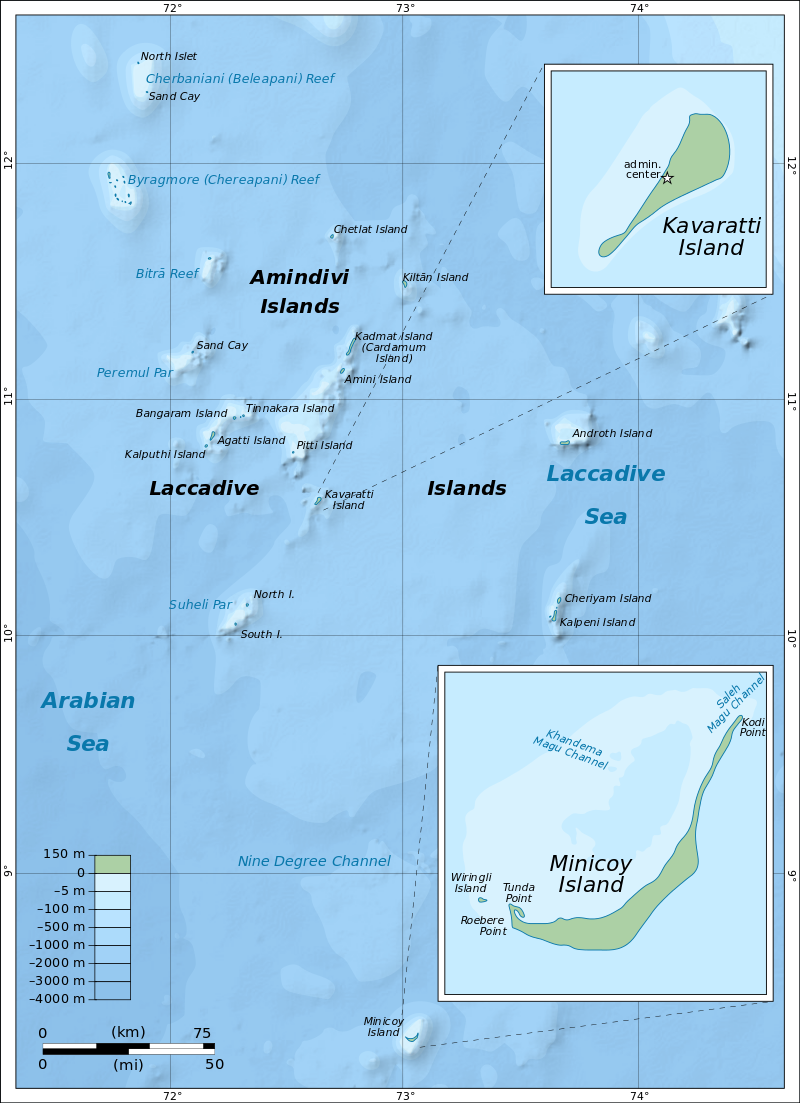
The Laccadive subgroup had been known earlier as the Cannanore Islands after the coastal town of Cannanore or Kannur are one of the three island subgroups in the archipelago. The name originated in the fact that while the northern group of Amindivi had in 1784 stopped being a vassal state of the Cannanore or the Arakkal kingdom in exchange to fealty to Tippu Sultan’s kingdom of Mysore, the southern group remained loyal to Cannanore. The Laccadive subgroup includes the island of Agatti, with the Agatti airport, the only airport in Lakshadweep, as well as Bangaram Atoll which has a tourist resort in Bangaram, its largest island. The islands of Agatti, Androth, Kavaratti and Kalpeni are inhabited and Islam is the main religion of the islanders. The Laccadive Islands subgroup is the central subgroup of the Lakswadweep consists mostly of atolls with islands, as well as part of one submerged bank. The Amindivi and the Laccadive subgroups have a submarine connection between them through Pitti Bank, a largely sunken atoll. The Laccadive subgroup is separated from the Amindivi Islands subgroup roughly by the 11th parallel north and from the atoll of Minicoy far to the south by the 9 Degree or Mamala Channel.
In the same manner as the Amindivi Islands further north, the islands of the Laccadive subgroup were settled from ancient times by people of nearby Kerala to which were added later people of Arab descent. Vasco da Gama visited these islands around 1498 and in the mid 16th century, all the inhabited islands of the Lakshadweep put themselves under the rule of the Arakkal kingdom in order to obtain protection from the Portuguese. In 1697, the notorious pirate Captain Kidd and his crew brought their ship, the Adventure Galley, to the Laccadive Islands, chopped up local boats for firewood and raped local women. When the locals retaliated by killing the ship’s cooper, the pirates attacked the village and beat up the people who lived there. Almost 100 years later, in 1784, the Amindivi group of islands rejected the protection of Cannanore and became a vassal state of the Kingdom of Mysore while the southern group remained loyal to the rule of Cannanore. Following the defeat of Tippu Sultan and the 1792 treaty of Srirangapatam, the southern subgroup was permitted by the East India Company to remain under the rule of the Cannanore Kingdom in exchange for a yearly tribute of INR 15,000. Since the tributary payments were often in arrears, the islands were put under direct rule of the British Government, first between 1855 and 1860, and then finally annexed in 1877 by virtue of the doctrine of lapse and became attached to the Malabar district.
One of the most habited islands of Lakshadweep; Amindivi is a group of islands lying in North Lakshadweep and is famous for its coir products, but due to government regulations, foreign tourists are not allowed to visit this island.
Agatti Island is situated on a coral atoll called Agatti atoll with another island, Kalpatti located at the southern end on the same reef. Agatti is one of the Lakshadweep islands open to tourism with visitors only allowed on the Island under certain restrictions, including an Entry Permit from the Lakshadweep Administration for entering or visiting the island. Entry Permits are issued based on the visitor having a confirmed place to stay as there are only two hotels or resorts in Agatti, Agatti Island Beach Resort and Sea Shells Beach Resort. A road runs through the island, which can be best enjoyed by hiring a bicycle available at many places. Stretching over an area of 8 km, the island is sparsely populated with around 8000 inhabitants. The Agatti airport, the only one in the archipeglo, is located in the southwestern part of the island. The locals mostly speak English and Malayalam, and Islam is the main religion with the primary occupation of the people being fishing.
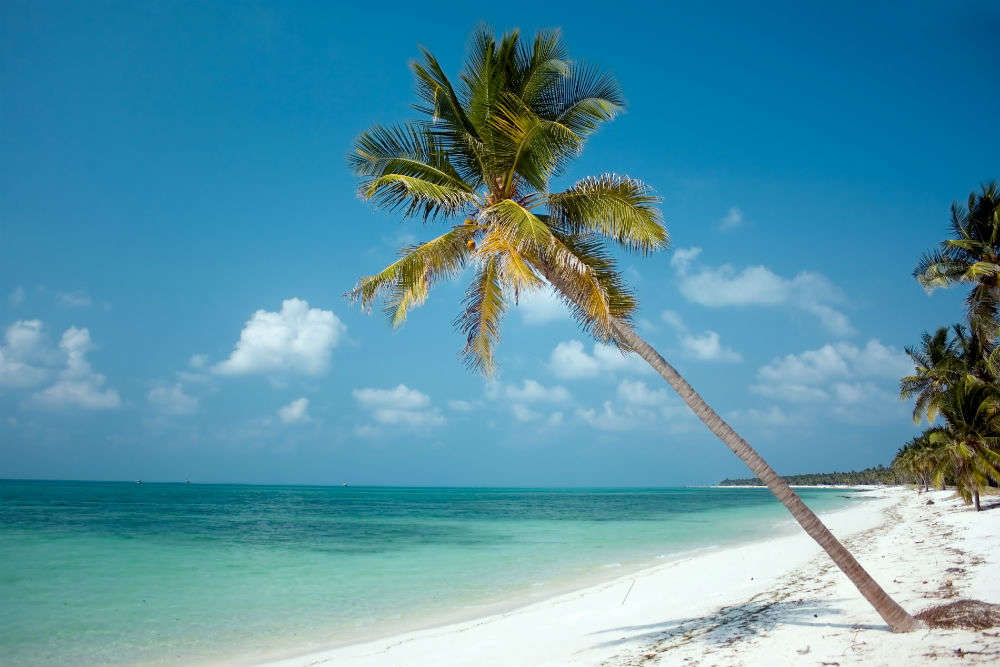
The island has splendid beaches with the tropical climate apt for sunbathing. One can also go on long strolls on the beach which are fringed with tall coconut trees. Adventure enthusiasts can indulge in water sports such as snorkelling, scuba diving, swimming, kayaking, and water skiing and one can even give deep sea fishing a go. Scuba diving and glass bottom boat rides are very popular and are a must-try while on the island. The best time to visit Agatti Island between October and March as the weather stays pleasant throughout the months and the sea stays calm making it safe to explore the island. During summers, between April and May, the temperature goes as high as 35 degrees celcius and the island receives intermittent to heavy rainfall during the monsoons. Alcoholic beverages are prohibited on the islands and only Indian nationals are allowed to visit and stay on Agatti Island with foreigners permitted to stay on Bangaram, Minicoy and Thinnikara Islands.
Bangaram is an atoll which is roughly rectangular shape northeast of Agatti island connected to the reef of Agatti through a shallow submarine ridge. Bangaram Island is the largest island in the atoll with a long brackish pond in the center of the island fringed by screwpine and coconut palms. South Bangaram Cay is a small sand cay and Thinnakara is another large island in the atoll. Parali 1, Parali 2 and Parali 3 are three small islets at the eastern fringe of the reef, but Parali 1 was washed away in 2017. The Bangaram Island Beach Resort was opened to tourists in 1974, but lack of commercial flights made access difficult. Tourism took off after the Agatti airport on the nearby Agatti island was commissioned and regular commercial flights from Kochi were established. Current alcohol regulations in Lakshadweep allow consumption of alcoholic drinks only on Bangaram Atoll. Thinnakara offers numerous adventure activities, including scuba diving, snorkelling, deep sea fishing beside white sand beaches, a calm lagoon and a sparkling, clear coral reef. The Atoll has numerous species of tropical birds found on the island. Bangaram Island forms a part of the terrestrial ecoregion of the Lakshadweep archipelago with many species of marine, terrestrial and aerial living beings including fishes, crabs, lobsters, gastropods, bivalves, turtles, seaweed and birds . It is also a region of ecological importance due to the presence of the coral reef around the island. The best time to visit Bangaram Island is between October and March as the weather is pleasant and the sea is calm most of the times. Tourists need a special permit to enter the island. If one cannot get space at the only resort at Bangaram Island, the best way to explore this island is by arranging a stay at one the hotels on Agatti island and visiting Bangaram as a day trip.
Pakshipitti where pakshi means bird in Malayalam, Telugu and Tamil, is an uninhabited coral islet, devoid of vegetation, about 24 km north of Kavaratti. The island is low and arid and lacks adequate anchorage points and is difficult to access. There is another island with the same name part of the Kalpeni Atoll. There is a dark rock on the eastern side and several stone cairns. Pakshipitti is an important nesting place for birds such as the sooty tern, the greater crested tern and the brown noddy. The birds nest side by side, but not intermixed, on the dry coral rubble. Since it has no protecting reef surrounding it, the islet is periodically rinsed by wave action and there is no accumulation of guano on it.
Paksipitti Bank is located at the southern end of Pakshipitti Bank and is a largely submerged atoll on the same bank as Amini Island. It may be considered a largely submerged and sunken atoll with just the two islands Amini and Paksipitti remaining at its opposite ends.
Also known as Androth, Andrott Island is a small inhabited island known as Divanduru in the past, a name that is found in some old French maps. Unlike other islands, Andretti islands are orientated in the east-west direction. Today, it is a protected territory and not a tourist destination. Andrott Island is the nearest to the mainland among all the islands in the group as well as the longest and the biggest. Most of the inhabitants are Muslims with a Hindu minority. The saint Ubaidullah who is believed to have preached Islam in Lakshadweep Islands, died here and his remains are entombed in the Jumah mosque. The island also houses several Buddhist archaeological remains.
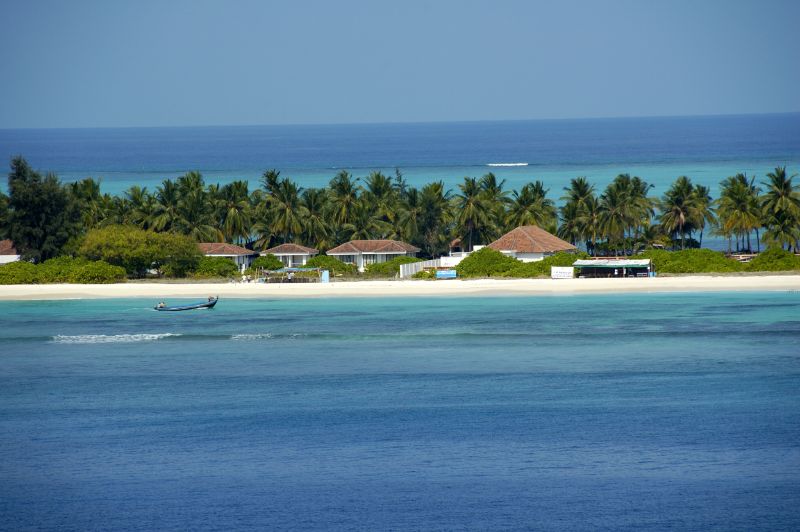
Kavaratti is the capital of Lakshadweep and also the name of the atoll upon which the town stands. Well known for its pristine white sand beaches and calm lagoons, it is a popular tourist destination with the calm lagoons on the island ideal for water sports and swimming. The waters around the coral atoll are rich in diverse marine life and the Kavaratti Aquarium has a rich collection of corals and a vast collection of tropical fish specimens. The other major industries on the island are fisheries and agriculture with coconut the dominant crop. The island is home to 12 atolls, five submerged banks, and three coral reefs. On the island, one can also visit the Urja mosque, the only sacred place on the island of a sculptor of the 17th century.
Also known as Koefaini, Kalpeni is an inhabited atoll 71 km south of Andrott and 201 km north-northeast of Minicoy, with the broad Nine Degree Channel between them. The islands are a group of three islands and is one of the most picturesque areas of Lakshadweep. It forms a single coral atoll along with the uninhabited islands of Cheriyam, Tilakkam, Kodithala and Pitti islet with the eastern and southern shorelines of the island having accumulations of coral debris, the result of a violent storm that hit the area in 1847. Kalpeni is the main island, with Kodithala immediately to the north and Cheriyam the northernmost island, the largest of Kalpeni’s satellite islands. The Tilakkam group are a group of islands off the west of Kalpeni and Koomel is a small islet off the west tip of Kalpeni. Kalpeni was the first island in the Union Territory where women were allowed to go to school and get an education. There is a beach at the northern tip of the island called Tip Beach where one snorkel, sea bathw and kayak. Because of the coral reefs present in the sea near the beach, the water is shallow and calm, making it an excellent spot for beach activities. There is a 37-metre-high lighthouse in Kalpeni from which top one can see a bird’s eye view of the island, the lagoon with the smaller islands, the reef and the surrounding ocean.
Suheli Par is a coral atoll in an oval shape surrounded by a zone of rich marine fauna. There are three islands on the reef encircling the lagoon. Valiyakara is located at the northern end of the lagoon and has retained most of its original vegetation. It has also has some largely stunted, unkempt coconut trees and is visited occasionally by workers who collect the coconuts. Hermit crabs are found in abundance and there is a lighthouse on this island. Cheriyakara is located on the southeastern side of the lagoon and slightly smaller than Valiyakara. It has a large coconut plantation. Between mid-October and mid-April, fishermen of Agatti and Kavaratti stay in temporary settlements on this island when they catch tuna in the surrounding waters of the atoll and process it on the island. Indira-Shastri Dweep is a long sandbank located between the two islands and was used as a breeding ground by terns. The grey heron and the black-capped kingfisher have been observed in this atoll and owing to the rich marine life there was a proposal to declare Suheli Par a marine national park. In 2006 a ship from Seychelles ran aground on this atoll, but there was no oil spill reported.
In the next part, our last part for this series, we’ll explore the Minicoy Atoll.
I Want To Be Where the Normal People Are – Rachel Bloom
Rachel Bloom has felt abnormal and out of place her whole life. In this exploration of what she thinks makes her “different,” she’s come to realize that a lot of people also feel this way; even people who she otherwise thought were “normal.”
In a collection of laugh-out-loud funny essays, all told in the unique voice (sometimes singing voice) that made her a star; Rachel writes about everything from her love of Disney, OCD and depression, weirdness, and female friendships to the story of how she didn’t poop in the toilet until she was four years old; Rachel’s pieces are hilarious, smart, and infinitely relatable (except for the pooping thing).
The Aminidivi group of islands, consisting of Androth, Amini, Kadmat, Kiltan, Chetlath, and Bitra came under the rule of Tipu Sultan in 1787 and passed to British control after the Third Anglo-Mysore War and were attached to South Canara. The rest of the islands came under the suzerainty of the Arakkal family of Cannanore in return for a payment of annual tribute which the British took over for nonpayment of arrears and were attached to the Malabar district of the Madras Presidency during the British Raj. On 1 November 1956, during the reorganization of Indian states, the Lakshadweep islands were separated from Malabar district and organised into a separate union territory for administrative purposes with the new territory called Laccadive, Minicoy, and Amindivi Islands before adopting the name Lakshadweep Islands on 1 November 1973.
The Aminidivi subgroup of islands consisting of Amini, Keltan, Chetlat, Kadamat, Bitra, and Perumal Par and the Laccadive subgroup of islands which comprises mainly of Androth, Kalpeni, Kavaratti, Pitti, and Suheli Par, have a submarine connection between them through Pitti Bank. Together with Minicoy Island, a lonely atoll located at the southern end of the 200-km-broad Nine Degree Channel, they form the Coral Islands of India in the Arabian Sea. All these islands have been built up by corals and have fringing coral reefs very close to their shores. Two banks further north, Angria Bank and Adas Bank are not considered part of the group. The Aminidivi Islands, are one of the three island subgroups in Lakshadweep and is the northern group of the Lakshadweep, separated from the Laccadive Islands subgroup roughly by the 11th parallel north. The islands of Amini, Kiltan, Chetlat, Kadmat and Bitra are inhabited with Islam being the main religion of the islanders. The islands were inhabited from ancient times by people of nearby Kerala to which were added later people of Arab descent. In the mid 16th century all the inhabited islands of the Lakshadweep were conferred as the jagir or estate of the ruling family of the Cannanore or Arakkal Kingdom by the Chirakkal or Kolattiri Raja in order to grant them protection from the Portuguese. In the latter quarter of the 18th century, the islands of the Amindivi group revolted owing to the rigours of the enforcement of the monopoly of the coir rope trade and following the uprising, the northern islands put themselves under the rule of the Kingdom of Mysore in 1784, then ruled by Tippu Sultan. The southern group of the Cannanore Islands, however, remained loyal to the Arakkal Kingdom. In 1792, as a consequence of the Third Anglo-Mysore War and the defeat of Tippu Sultan, the Amindivi Islands came under the East India Company rule following the treaty of Srirangapatna.
Cora Divh, also called Coradeeve or Little Bassas de Pedro Bank, is a submerged bank or sunken atoll and is the third largest feature of Lakshadweep, after Bassas de Pedro and Sesostris Bank. It is also the northernmost feature. Cora Divh has no emergent cays or islands and is covered by sand, coral rubble and broken shells.
Sesostris Bank is a submerged bank or sunken atoll and is the second largest feature of Lakshadweep and one of the northernmost features, after Cora Divh and Bassas de Pedro and is named after the steam frigate INS Sesostris of the Indian Navy.
Bassas de Pedro, also known as Manjappar or Pedro Bank, is a submerged bank or sunken atoll which is the largest feature of Lakshadweep. It is also one of the northernmost features, second only to Cora Divh and is in the shape of an arch open to the east with widths ranging from 15 km in the north to 33 km in the south. Its southern end is 63 km east of North Cay of Cherbaniani Reef, the closest land feature. There are no emergent cays or islands and the bank is steep-to, smooth with minor undulations in topography, and composed of sand, shells, and decayed coral. The water on the bank is not discolored.
Cherbaniani Reef, also known as Beleapani Reef and Valiyapanniyam in Malayalam, is a coral atoll and is the northwesternmost feature of Lakshadweep with a roughly oval shape. The 14 km long coral reef that encloses the lagoon has three small uninhabited islands on it composed of accumulated coral sand, shingle, cuttle-bones and sea shells. There are many land hermit crabs under the boulders and among the detritus and the atoll used to be a breeding ground for pelagic birds, including the sooty tern and brown noddy, formerly found in great numbers.
North Islet has a small mosque built and maintained by local fishermen from Bitra, Chetlat, Kiltan and Agatti islands. The fishermen came here and camp for fishing during the period between both monsoons. Lakshadweep islanders from Chetlat and Bitra sometimes visit the islands to collect guano for the gardens of the inhabited islands, gathering eggs, dumping garbage and disturbing the nestlings of pelagic birds in the process. The beaches are strewn with marine litter.
Byramgore Reef, also known as Chereapani Reef is a coral atoll whose northern part is submerged. There are a few sandbanks on the reefs, but little land is above the surface at high tide. The atoll is visited by birds, including the lesser crested tern and greater crested tern.
Chetlat Island is a coral island whose local history says that islanders were cruelly treated by Portuguese seafarers in the past. Coir twisting was the traditional occupation of the islanders and average Chetlat coir used to be equal to first-class coir of the other islands in Lakshadweep. One of the populated islands of the archipelago, Chetlat is located 37 km to the northwest of Kiltan Island and the reef and lagoon are located to the west of the island with a small scale yearly growing sand spit on the northern point of the island. Chetlat is the sole inhabited island of the township of Chetlat Island and the inhabitants are engaged in very small scale farming and fishing which are mainly for the island consumption. There is a small jetty on the west coast and a helipad on southpoint.
Bitra, also known as Bitra Par, is a coral atoll where prior to the 20th century, islanders from Kiltan and Chetlat visited to collect the eggs of birds breeding there. Until 1945, when a woman from Chetlat made this island her home, there were no attempts to settle this island permanently. There is a small shrine dedicated to an old Arab saint by the name of Malik Mulla who was buried on the island which has become a pilgrimage site. The atoll of Bitra encompasses two islands, the main Bitra Island is located at the northern end of the coral reef and the small south cay is located on the southern part. Bitra is the smallest of the populated islands of Lakshadweep with the main island having a small jetty on the south shore and a helipad on the westpoint. The inhabitants on the island are engaged in very small scale farming and fishing which are mainly for the island consumption.
Kiltan or Kilthan Island is a coral island which was settled during the early periods of immigration to the Lakshadweep islands, part of an international trade route between the Persian Gulf and Ceylon. It is also home of the Sufi saint Shaikh Ahmed Naqshabanthi. Kiltan is one of the populated islands of Lakshadweep with the reef and lagoon located to the west of the island and is also crossed by the 73rd meridian east through its landmark known as Kulikkara which is a tomb of a Lady venerated by the natives.
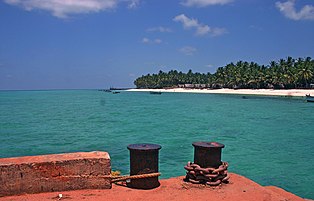
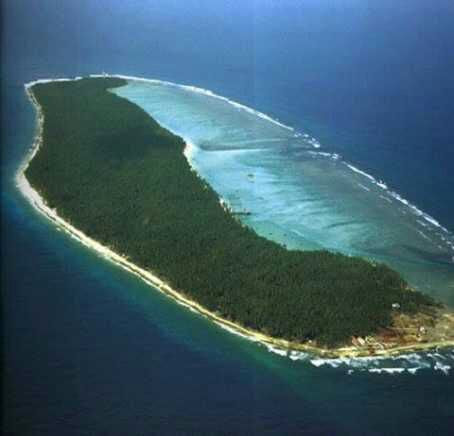
Kadmat Island, also known as Cardamom Island, is a coral island with seagrass and marine turtles which nest here. The island has been notified as a marine protected area for ensuring the conservation of the island’s animals, plants, organism and other resources. The only inhabited village on the island is Kadmat, which has fishing as the main economic activity with agriculture limited to 5% of the land area. Tourism is allowed even for non-Indians and the attractions are kayaking, snorkeling and leisure trips by a glass-bottomed boat for scuba diving. Kadmat Island is the central most island of the archipelago and is in the shape of a tear drop and is the longest island in the Amindivi group. There is an airport on nearby Agatti Island, in which flights operate from Cochin. From Agatti, it is a two and half hours boat ride to Kadmat. Ferry services also operate from Cochin on the coast of Kerala but involves a journey of 16 hours.
In 1960, a hoard of coins were unearthed and examined, revealing that the island has been inhabited since at least the year 200 and the island is known to have traded with the Romans, as in 1948 a Roman coin was found in a quarry on the island. Kadmat Island offers a host of activities to its guests which is why it is thronged by thousands of tourists every year. Some of the most popular activities and things to do on the island are scuba diving, kayaking, snorkelling and paragliding. One can also just sit and sun soak and admire the beautiful surroundings and use some of the many amazing spa and massage services available here.
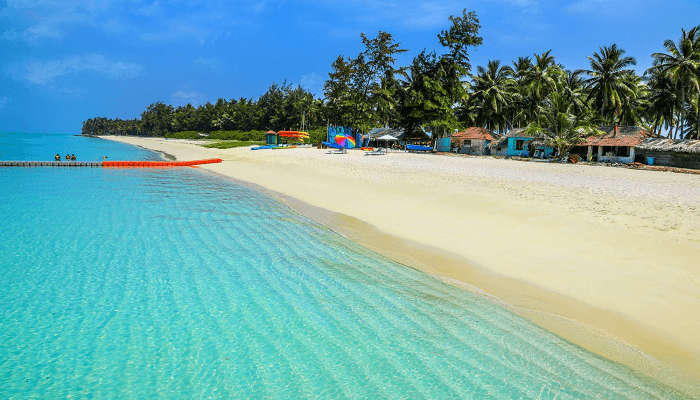
Spread over 100 metres and surrounded by beautiful blue lagoon and shimmery white sand, Kadmat Beach is not only one of the most gorgeous beaches in the region but also, one of the most visited. One can relax on a hammock, sunbathe on the shores, stroll along the seashare and watch some of its many mesmerising sunrises and sunsets. Kayaking is another popular activity here due to the pristine nature, mostly untouched and uncommercialised with crystal clear waters. There are glass bottom boats available which can be hired for the views.
The best time to visit Kadmat Island is during the winters and early summers, between the months of October and May when there are cool sea breezes blowing, and the climate is pleasant. It is better to avoid summers and monsoons due to the high heat and humidity.
Elikalpeni Bank is a submerged bank or sunken atoll and is the easternmost geographic feature of the archipelago.
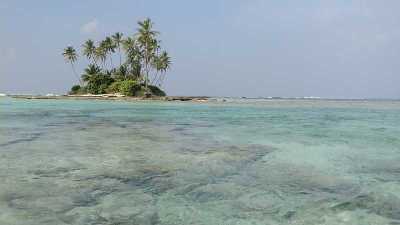
Perumal Par, also known as Peremul Par, is an uninhabited coral atoll very similar in appearance to the Cherbaniani Reef further north. It has a large lagoon devoid of islands in the encircling reef, except for 3 small sandy islets located at the eastern area. Terns of different species visit this atoll. There is some damage to the corals caused by Acanthaster planci crown-of-thorns starfish that was observed in the 1990s. Its surrounding waters are a good fishing area for baitfish and is often visited by fishermen from the inhabited islands nearby as well as tourists from the nearby Bangaram Island resort who often make excursions to this lonely atoll.
Amini Island was one of the first islands in the archipelago to be inhabited. The artisans on this island are known for making walking sticks out of coconut shells and tortoise shells as well as carved stone and coral motifs. The channel between Amini Island and Cardamom Island is safe and deep. The Amini Island Light is shown on the south point of the island. The island is oval with the long axis oriented northeast-southwest. It lies at the northeastern extremity of Pitti Bank, 42 km from the small, uninhabited Pitti Island which is not to be confused with the Pitti Islet of Kalpeni Atoll, which is located at the opposite southwestern extremity of the bank. Pitti Bank, also oriented along a northeast-southwest axis, is 49 km long and may be considered a largely submerged and sunken atoll with just the two islands Amini and Pitti remaining at its opposite ends. Kadmat island, although just 5 km northeast of Amini Island, is separated from it by a deep channel and thus forms a separate geographical unit.
In the next part, we will explore the Laccadive subgroup of the Lakshwadweep archipelago.