2017 Secondary 2 Week 7 Update

A very blah week for the children. GG’s common tests were on almost the whole week and she has been studying quite hard for it. She even woke up at 4:30 am one day to study since she can’t stay up at night. 

BB’s common test starts from tomorrow and unlike GG, he only has 5 exams while GG had almost 8. He will sit out the Mother Tongue paper since his school does not offer Hindi. Compared to GG, he has a more lackadaisical attitude towards his studies. He’s more of a “I’ll study at the last minute”type and this really pisses me off. I foresee more showdowns with him as the year continues and especially when he sits for his O levels!

Have a wonderful Sunday!

In My Hands Today…

Shadow of the Silk Road – Colin Thubron

701596Shadow of the Silk Road records a journey along the greatest land route on earth. Out of the heart of China into the mountains of Central Asia, across northern Afghanistan and the plains of Iran and into Kurdish Turkey, Colin Thubron covers some seven thousand miles in eight months. Making his way by local bus, truck, car, donkey cart and camel, he travels from the tomb of the Yellow Emperor, the mythic progenitor of the Chinese people, to the ancient port of Antioch—in perhaps the most difficult and ambitious journey he has undertaken in forty years of travel.

The Silk Road is a huge network of arteries splitting and converging across the breadth of Asia. To travel it is to trace the passage not only of trade and armies but also of ideas, religions and inventions. But alongside this rich and astonishing past, Shadow of the Silk Road is also about Asia today: a continent of upheaval.

One of the trademarks of Colin Thubron’s travel writing is the beauty of his prose; another is his gift for talking to people and getting them to talk to him. Shadow of the Silk Road encounters Islamic countries in many forms. It is about changes in China, transformed since the Cultural Revolution. It is about false nationalisms and the world’s discontented margins, where the true boundaries are not political borders but the frontiers of tribe, ethnicity, language and religion. It is a magnificent and important account of an ancient world in modern ferment.

Recipe: Sindhi Kadhi

sindhi-kadhi-2

Growing up in Mumbai, my closest neighbours were people who had fled Sindh in Pakistan after the partition and came to India as refugees. They were a joint family of four brothers and their families and the children in that family and me and my sister grew up together. Our front doors faced each other and growing up, the doors were only closed in the afternoons and at night. We were in and out of each other’s homes all the time and so food became one of the things we shared. Avial, sambhar, Idli, Dosai etc were favourites from our home to theirs and Samosas, Koki (a type of parathas), Sai Bhaji etc were our favourites from their home. I learnt to make many dishes from the aunties in that home and my mum learnt to make Sindhi Kadhi, which is a gravy dish from them too.

Over the Chinese New Year weekend, when I was wondering what to make for a sudden lunch invite to S’ uncle and aunt, I decided to make this version of Sindhi Kadhi. I didn’t exactly remember how my mum made it, so I turned online to source for a recipe. I used this recipe from Sanjeev Kapoor as my guide but played with it a bit. The main ingredient, as I remember used to be okra or ladies finger, but since I didn’t have that, I omitted it and added other vegetables.

sindhi-kadhi-1

Sindhi Kadhi

Ingredients:

  • 4 tsp gram flour or besan
  • 1 drumstick
  • 2 potatoes
  • 2 carrots
  • 7-8 beans
  • 1/2 tsp asafoetida
  • 1/2 tsp fenugreek seeds or methi
  • 1/2 tsp cumin seeds
  • 6-8 curry leaves
  • 3 tbsps oil
  • 2 tomatoes
  • 1/4 tsp turmeric
  • 1/2 tsp red chilli powder
  • 1 lemon sized ball of tamarind or 2 tbsp tamarind pulp
  • Salt to taste

Method:

  • In a large bowl, add the tamarind and pour hot water into it. Leave it for 20-30 mins and when cool to touch, squeeze the pulp and remove it. Strain the tamarind water and keep aside.
  • Chop all the vegetables into largish cubes and cut the drumstick into around 1.5-inch sticks.
  • Heat 2 tsp oil in a pan and stir fry the vegetables for a few minutes and aside.
  • In the same pan, heat the remaining oil and add the asafoetida, mustard seeds, fenugreek seeds, cumin seeds and curry leaves to the pan and sauté until fragrant.
  • Then add the gram flour and sauté until fragrant. Do not allow the gram flour to burn. When you smell a nice aroma from the gram flour, add around 1.5 cups of water and whisk well until the mixture is very smooth.
  • The mixture will thicken very quickly so you can add another cup of water to thin it. Add the sautéed vegetables.
  • In a hand food processor, crush the tomatoes or grate or chop them into very fine bits. Add this to the gravy which should be bubbling away by now. Add turmeric powder, red chilli powder and salt and mix well.
  • When the vegetables are almost cooked, add the tamarind juice or pulp and let them blend well. If the gravy is too thick, you can thin it with some water.
  • Check for seasoning and add what is missing and serve hot with rice.
  • I served this with my Caramelised Onion Pulao and a raita

sindhi-kadhi-1


In My Hands Today…

The Exchange of Princesses – Chantal Thomas

23196972Philippe d’Orléans, the regent of France, has a gangrenous heart–the result of a life of debauchery, alcohol, power, and flattery. One morning in 1721, he has a brilliant idea to further appease his thirst for power: he decides to marry eleven-year-old Louis the XV to the daughter of Philippe V of Spain, who is only four. This, Orléans hopes, will tie his kingdom to Spain’s. But it could also have a more duplicitous effect: were Louis XV to die without begetting an heir–the likeliness of which is greatly increased by having a child—Orléans himself would finally be king. In exchange, Orléans tosses his own daughter into the bargain, the 12-year-old Mlle de Montpensier, who will marry the Prince of Asturias, the inheritor of the Spanish throne.
The Spanish court enthusiastically agrees and arrangements are quickly made. The two nations trade their princesses in a grand ceremony in 1722, making bonds that should end the historical conflict between them. Of course, nothing turns out as expected. In a novel that reads like a fairy tale, Chantal Thomas chronicles a time in French history when children were not children, but pawns in an adult’s game.

Recipes: Caramelised Onion Pulao

caramelised-onion-pulao-3

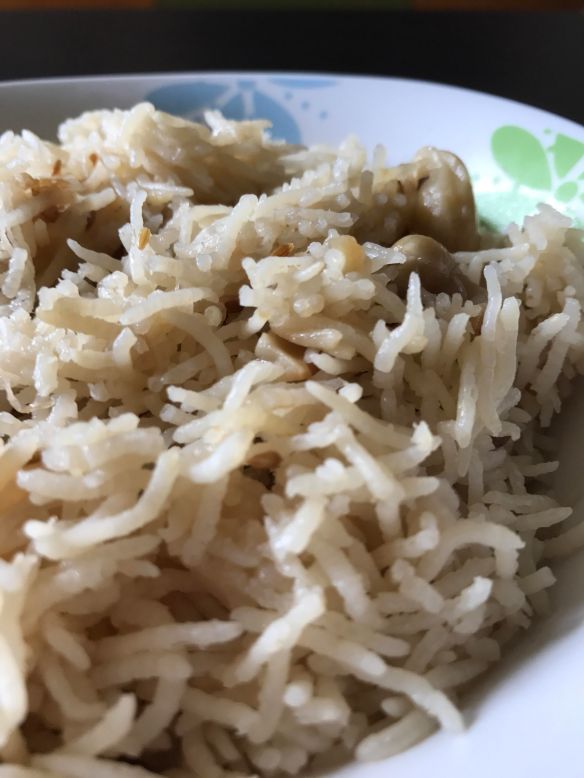
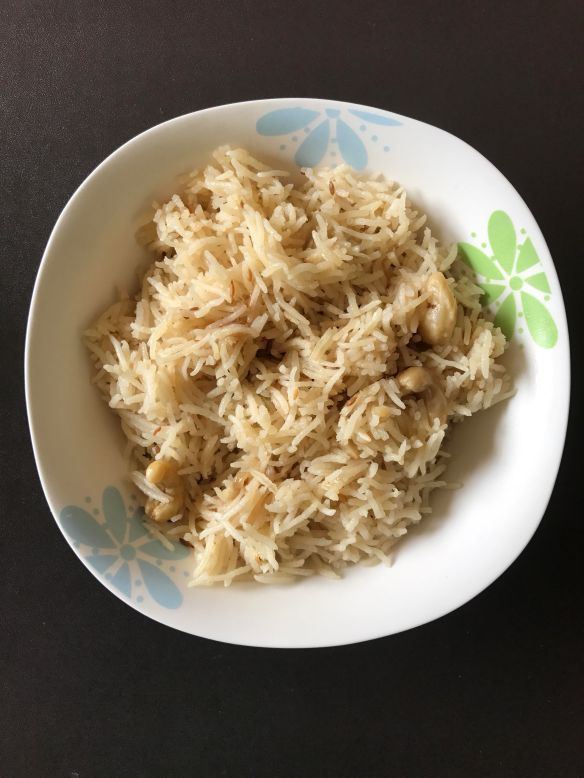
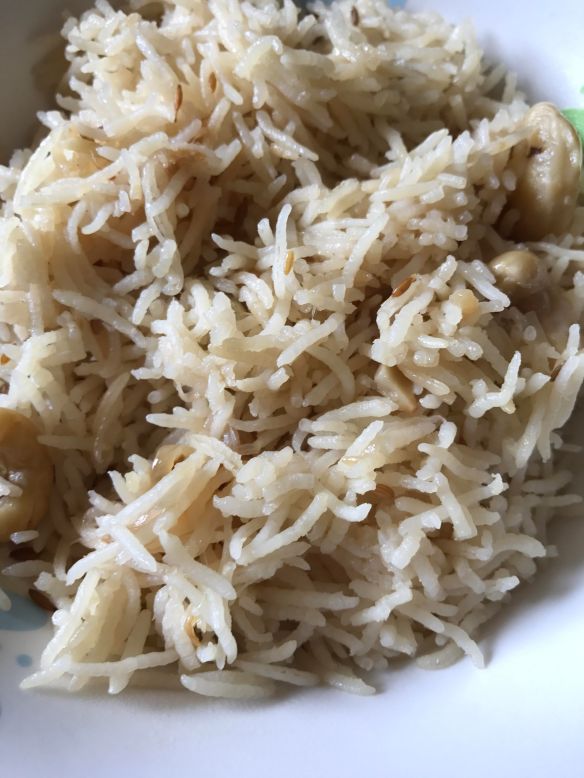
Over the Chinese New Year long weekend, suddenly S’ aunt and uncle said they would be coming to meet us. So we invited them to lunch instead. Since this was literally a last minute invite, I did not have any time to plan a meal and also since the shops were closed for the new year, I could not top up any groceries. So I made a meal with what I had at home. I made this Caramelised Onion Pulao which is inspired by a Sindhi rice dish I’ve eaten at my neighbour’s house in Mumbai called Bugha Chaanwara. I served this with a classic Sindhi Kadhi and some raita. A simple, but very satisfying meal.

caramelised-onion-pulao-1Caramelised Onion Pulao

Ingredients:

  • 2 cups basmati rice, soaked in water for 20 minutes and drained
  • 3 onions, finely sliced
  • 1 tsp cumin seeds
  • 4-5 cloves
  • 4-5 cardamom pods
  • Salt to taste
  • 2 tbsps ghee or oil
  • a handful of cashew nuts
  • 2 cups water

Method:

  • In a pan, heat the ghee or oil and when warm, add the onions and stir them to brown them.
  • Keep stirring and make sure they brown but do not burn. Stir them until they caramelise and become crisp.
  • Move the onions to the side of the pan and in the balance ghee or oil, add the cashewnuts and let them brown.
  • Next, add the cumin seeds and stir for a few seconds followed by the cardamom pods and cloves.
  • Now add the drained rice and salt to taste and stir well till the rice is completely mixed with the onions
  • Move this mixture to a rice cooker, add water and cook till done.
  • If you are cooking this on the stovetop, add water and check periodically till the rice is completely cooked.
  • The end result is a slightly brown and sweet rice which goes with any gravy.

caramelised-onion-pulao-2