

One of the eponymous dishes which are common across South India, Avial is one of my favourite dishes. I remember when my mum used to make this dish, I would eat it the whole day, so much that what was supposed to be enough for both meals, would finish by the time we had lunch!
Both GG & BB love it as much as I do, S is quite indifferent to it. When S started working with us, she also started to love it and if we go a couple of months without making it, she will remind me to make it soon.
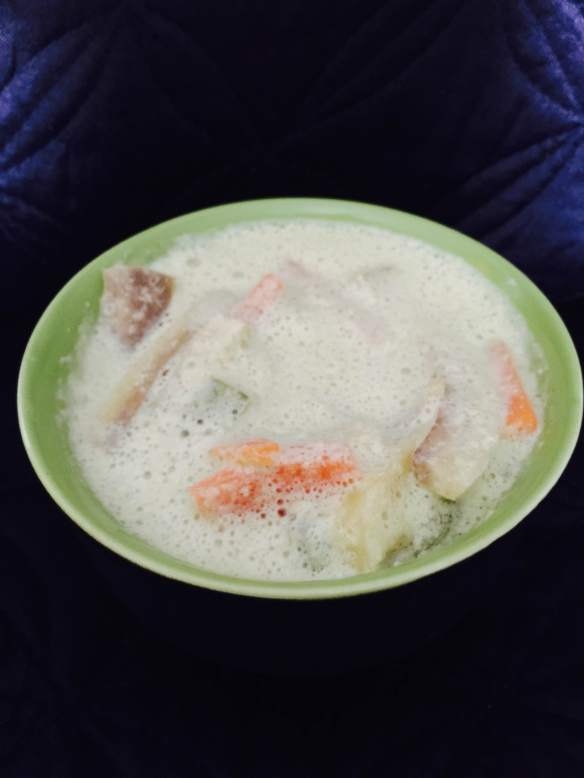
This dish is quite ancient and is said to be invented by Bhima, the second Pandava brother during their year in exile. Most vegetables used to make Avial are what we call local (Indian) vegetables. Some ‘English’ vegetables like potato, carrots, beans and peas are also used. Other vegetables like Yellow/Orange pumpkin, white pumpkin, drumstick, snake gourd, yam, raw banana are also used. You can use all of these or some, depending on what you have at home. The dish can also be made thick or thin – thick if you are not planning to eat it mixed with rice (like a gravy) or thin if this will be mixed with rice. In my home, if we make Avial, we don’t usually make anything else since it has all vegetables in it, we eat it with rice and some crisps.

Avial
Ingredients:
- 2 carrots, chopped lengthwise in 2 inch sticks
- 2 potatoes, chopped lengthwise in 2 inch sticks
- 2 raw bananas, chopped lengthwise in 2 inch sticks
- 1/4 piece of yellow pumpkin, chopped lengthwise in 2 inch sticks
- 7-8 beans, chopped 2 inch
- 2 drumsticks, chopped in 2 inch sticks
- 1 snake gourd, chopped lengthwise in 2 inch sticks
- 1 cup yoghurt, beaten
- 1/4 tsp turmeric powder
- salt to taste
- 3-4 curry leaves (optional)
- 1 tsp coconut oil (optional)
To be ground into a paste
- 2 tsps cumin seeds
- 6-8 green chillies
- 1 cup grated coconut
- 1/2 cup yoghurt
Method:
- In a deep bottomed pan, add all the chopped vegetables and cook them with very little water and the turmeric powder and 1 tsp salt. Cook till the vegetables are al-dente, they should be still firm to touch.
- While the vegetables are cooking, grind the coconut, chillies and cumin seeds, using the yoghurt as moisture. Grind the coconut till it is very fine.
- Once the vegetables are cooked, add the coconut mixture to the vegetables. Stir well and add salt to taste.
- From the remaining yoghurt, add as much yoghurt as you need to make it as thick as you need. If you need to make the avial thick, add very little yoghurt and more if you want to make the gravy watery.
- When the avial comes to a nice rolling boil, add the coconut oil and curry leaves (if using) and switch off the gas. Cover the dish with a plate or cover to keep the fragrance of the curry leaves and oil.
- Serve hot with rice and some crisps or papad.
Enjoy…..

 In 1938, Ruby, Helen and Grace, three girls from very different backgrounds, find themselves competing at the same audition for showgirl roles at San Francisco’s exclusive “Oriental” nightclub, the Forbidden City. Grace, an American-born Chinese girl has fled the Midwest and an abusive father. Helen is from a Chinese family who have deep roots in San Francisco’s Chinatown. And, as both her friends know, Ruby is Japanese passing as Chinese. At times their differences are pronounced, but the girls grow to depend on one another in order to fulfill their individual dreams. Then, everything changes in a heartbeat with the Japanese attack on Pearl Harbor. Suddenly the government is sending innocent Japanese to internment camps under suspicion, and Ruby is one of them. But which of her friends betrayed her?

 A body is discovered in a cave in the remote region of Cappadocia, Turkey. The woman died of gunshot wounds, and her corpse has lain undisturbed for twenty years. Inspector Cetin Ikmen is summoned from Istanbul to investigate and discovers a complex web of intrigue. Was she killed by her boyfriend, driven mad by love, or her husband, believing she would never bear the son he wanted so badly? When it is revealed the girl was pregnant when she died, the whispers and accusations increase. Ikmen, stifled among a rural community thriving on folklore and intrigue, begins to think he will never see clearly through the lies surrounding this case. One thing, however, is clear: the past is as potent as the present.
