We’re in the last quarter of 2020 and like me, I am sure you too are looking forward to 2021 with the hope that the new year will bring some relief to the world.
The children are still on their holidays, though GG has gotten her timetable for the next semester. Even though Singapore is slowly, but steadily moving towards opening up more, she will continue to be more or less on home-based learning. Her only grouse with the timetable is that she has a class on Saturdays also. She thought she had gotten over Saturday lessons after more than 12 years of Hindi school, but though those were about half day lessons and this is much shorter, it still means she will need to get her act together and be ready by lesson time on the day of the week when she would rather be doing something else.
BB has not heard back anything from school yet, so we don’t know if he will be going back to school or not and if yes, how long. I suspect he will be doing a more hybrid model of studying with some home-based learning and some in-person learning.
The US still continues to lead in positive cases with more than 7.5 million cases as of yesterday, including its President and first lady who were diagnosed late last week, followed closely by India with about 6.5 million cases and then Brazil with abut 4.9 million cases and Russia with slightly over 1 million cases. The four countries together constitute about 58% of the total world cases!
Anyway, here’s to an October which is much better than the September that just went by! Stay safe everybody!
In the summer of 2011, two bleary-eyed kids, teetering on the cusp of adulthood, decide to drop out of the daily grind and just travel. But once they hit the road, their plans go out the window.
Soon, they are barreling over potholes the size of lunar craters in Nepal, bungee jumping in Rishikesh, waking up to Buddhist chants in Sikkim and cycling down the world’s highest motorable pass in Ladakh.
On the way is a constant stream of oddballs, like the five-second-tea lady, the flute-playing hotel manager, flying Sonam, reggae junkies and many more this journey is all about rolling with the punches.
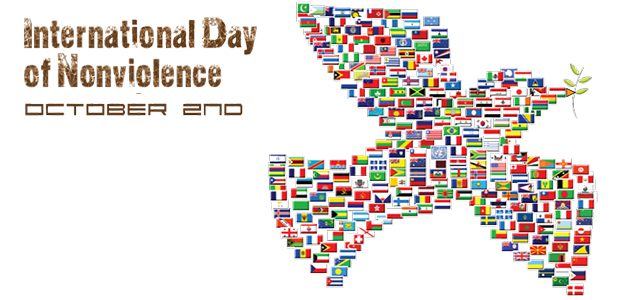
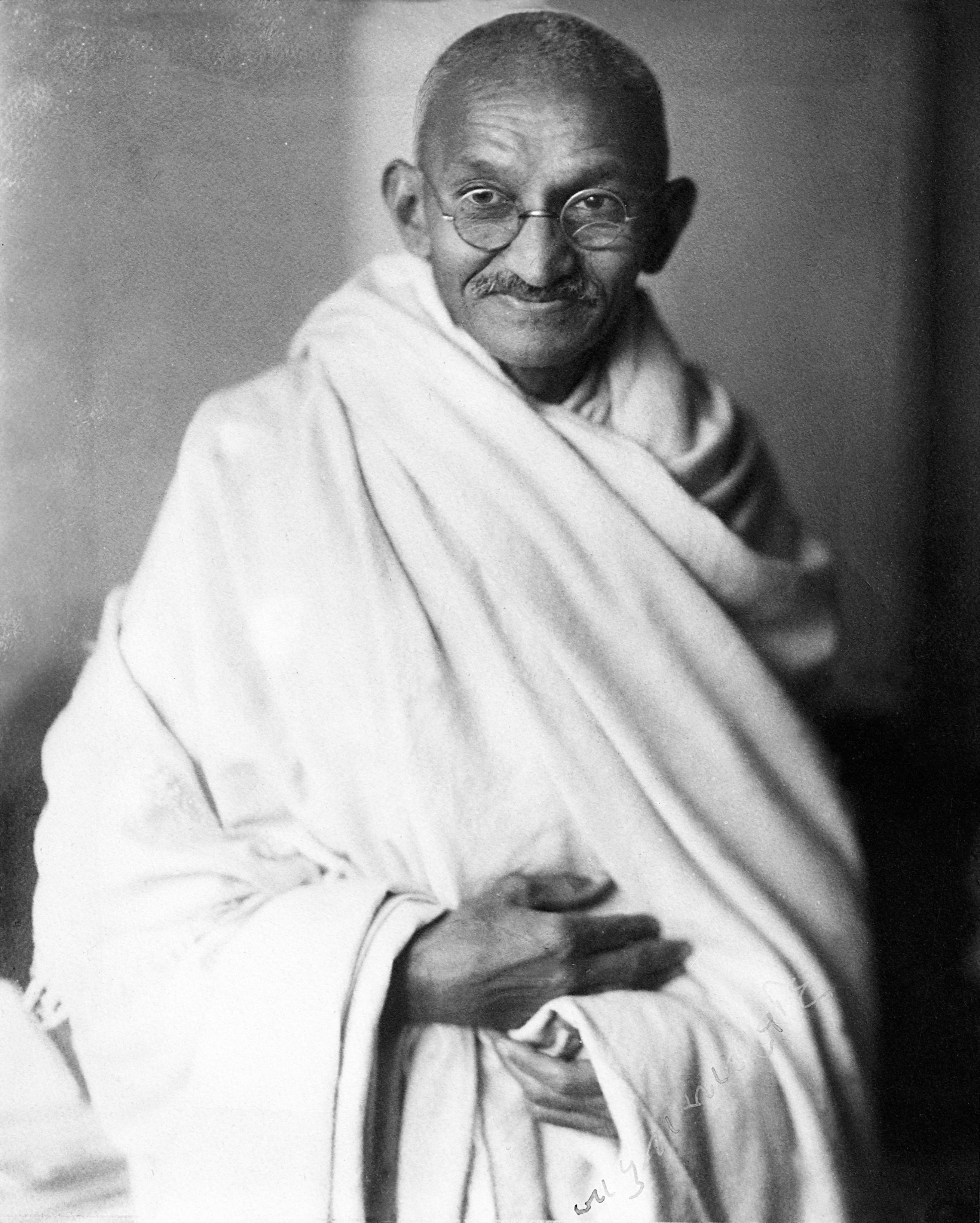
In honour of the man who probably showed the world what non violence can achieve, 02 October, the birth anniversary of Mohandas Karamchand Gandhi, who led the non violent uprising leading to India’s independence, has been declared the International Day of Non Violence by the United Nations on 15 June 2007.
According to the resolution which established the commemoration, the International Day is an occasion to “disseminate the message of non-violence, including through education and public awareness”. The resolution reaffirms “the universal relevance of the principle of non-violence” and the desire “to secure a culture of peace, tolerance, understanding and non-violence”.
The principle of non-violence, also known as non-violent resistance, rejects the use of physical violence in order to achieve social or political change. Often described as “the politics of ordinary people”, this form of social struggle has been adopted by mass populations all over the world in campaigns for social justice.
Professor Gene Sharp, a leading scholar on non-violent resistance, uses the following definition in his publication, The Politics of Nonviolent Action: “Nonviolent action is a technique by which people who reject passivity and submission, and who see struggle as essential, can wage their conflict without violence. Nonviolent action is not an attempt to avoid or ignore conflict. It is one response to the problem of how to act effectively in politics, especially how to wield powers effectively.”
While non-violence is frequently used as a synonym for pacifism, since the mid-twentieth century the term non-violence has been adopted by many movements for social change which do not focus on opposition to war.
One key tenet of the theory of non-violence is that the power of rulers depends on the consent of the population, and non-violence therefore seeks to undermine such power through withdrawal of the consent and cooperation of the populace.
There are three main categories of non-violence action: protest and persuasion, including marches and vigils; non-cooperation; and non-violent intervention, such as blockades and occupations.
Why is such a day important for us to commemorate? Days like these raise awareness because the term, “non-violence,” has been used so often in the last century that its meaning has taken on new forms. Often believed to be a synonym for pacifism, which it can be, it’s also been adopted by groups around the world to be a force for social change, rather than strictly opposition to war. Non-violence is a proven method for social change because the term “Non-violence” is a broad umbrella term under which there are several categories. Non-violent actions include protests, marches and vigils, which were successfully employed in the 1960s to bring about social changes in America. Non-cooperation and non-violent intervention, such as blockades and sit-ins, were also successfully used in America to demonstrate further inequalities. All of these efforts led to the peaceful spread of ideas. And lastly world over there are plenty of conflicts to solve as globalisation has given us a more productive global economy but it’s also led to more complex issues that need solving. To help keep these problems from escalating to violence, spreading the ideas and success stories of nonviolence will be crucial.
Mohandas Karamchand Gandhi, known in India as Mahatma Gandhi and the Father of the Nation was a was a lawyer, an anti-colonial nationalist, and political ethicist, who employed nonviolent resistance to lead the successful campaign for India’s independence from British rule, and in turn inspired movements for civil rights and freedom across the world. The honorific Mahatma which in Sanskrit means a great soul, first applied to him in 1914 in South Africa, is now used throughout the world.
Born and raised in a Hindu family in coastal Gujarat, western India, Gandhi trained in law at the Inner Temple, London, and was called to the bar at age 22 in June 1891. After two uncertain years in India, where he was unable to start a successful law practice, he moved to South Africa in 1893 to represent an Indian merchant in a lawsuit. He went on to stay for 21 years. It was in South Africa that Gandhi raised a family, and first employed nonviolent resistance in a campaign for civil rights. In 1915, aged 45, he returned to India. He set about organising peasants, farmers, and urban labourers to protest against excessive land-tax and discrimination. Assuming leadership of the Indian National Congress in 1921, Gandhi led nationwide campaigns for easing poverty, expanding women’s rights, building religious and ethnic amity, ending untouchability, and above all for achieving Swaraj or self-rule. The same year Gandhi adopted the Indian loincloth, or short dhoti and, in the winter, a shawl, both woven with yarn hand-spun on a traditional Indian spinning wheel, or charkha, as a mark of identification with India’s rural poor. Thereafter, he lived modestly in a self-sufficient residential community, ate simple vegetarian food, and undertook long fasts as a means of self-purification and political protest. Bringing anti-colonial nationalism to the common Indians, Gandhi led them in challenging the British-imposed salt tax with the 400 km Dandi Salt March in 1930, and later in calling for the British to Quit India in 1942. He was imprisoned for many years, upon many occasions, in both South Africa and India.
After independence as many displaced Hindus, Muslims, and Sikhs made their way to their new lands, religious violence broke out, especially in the Punjab and Bengal. Eschewing the official celebration of independence in Delhi, Gandhi visited the affected areas, attempting to provide solace. In the months following, he undertook several fasts unto death to stop religious violence. The last of these, undertaken on 12 January 1948 when he was 78, also had the indirect goal of pressuring India to pay out some cash assets owed to Pakistan. Some Indians thought Gandhi was too accommodating. Among them was Nathuram Godse, a Hindu nationalist, who assassinated Gandhi on 30 January 1948 by firing three bullets into his chest.
In fact, in India, his birth anniversary which falls on 02 October is one of the three mandated national holidays in India. In a country with a multi religious population, public holidays which are usually holidays for festivals are mandated mostly by the state government and at work, a lot is left to individual companies to decide on holidays based on their workforce. Gandhi Jayanti, as his birth anniversary is called, is one of mandated holiday, irrespective of what other holiday you get, along with Independence Day on 15 August and Republic Day on 26 January.
I, for one, believe violence is over-rated. While I don’t want to get into any arguments, I personally believe that the money spent on shoring up their military, sometimes up to almost 10-15% of their GDP (depending on which report you want to use) could be used for the betterment of their citizens by providing more aid to the more vulnerable portions of their society, providing those without access to food, education and healthcare to what they lack and so much more. But this is an argument or a blog post for another day.
Champagne, 1940: Inès has just married Michel, the owner of storied champagne house Maison Chauveau, when the Germans invade. As the danger mounts, Michel turns his back on his marriage to begin hiding munitions for the Résistance. Inès fears they’ll be exposed, but for Céline, half-Jewish wife of Chauveau’s chef de cave, the risk is even greater—rumors abound of Jews being shipped east to an unspeakable fate.
When Céline recklessly follows her heart in one desperate bid for happiness, and Inès makes a dangerous mistake with a Nazi collaborator, they risk the lives of those they love—and the champagne house that ties them together.
New York, 2019: Liv Kent has just lost everything when her eccentric French grandmother shows up unannounced, insisting on a trip to France. But the older woman has an ulterior motive—and a tragic, decades-old story to share. When past and present finally collide, Liv finds herself on a road to salvation that leads right to the caves of the Maison Chauveau.
Neil Island Belonging to Ritchie’s Archipelago, Neil Island is separated by Ross Island and Havelock Island by the ocean. The island is located approximately 36 km northeast of Port Blair and exudes a calm laid back charm. Visitors staying in Havelock Island can make a day trip to Neil Island which has an amazing biodiversity, white sandy beaches, unspoiled and pretty coral reefs and tropical woodlands. The small island which is only 5 km in its widest part takes only 2 odd hours to cover by walk. The best parts of this island are its three sandy beaches, namely Bharatpur Beach, Sitapur Beach and the Lakshmanpur Beach. The forest cover has reduced considerably due to the cultivation of rice but a section in the north-west of the island is being preserved actively. Due to its limited area, Neill Island can be covered with a simple walk.
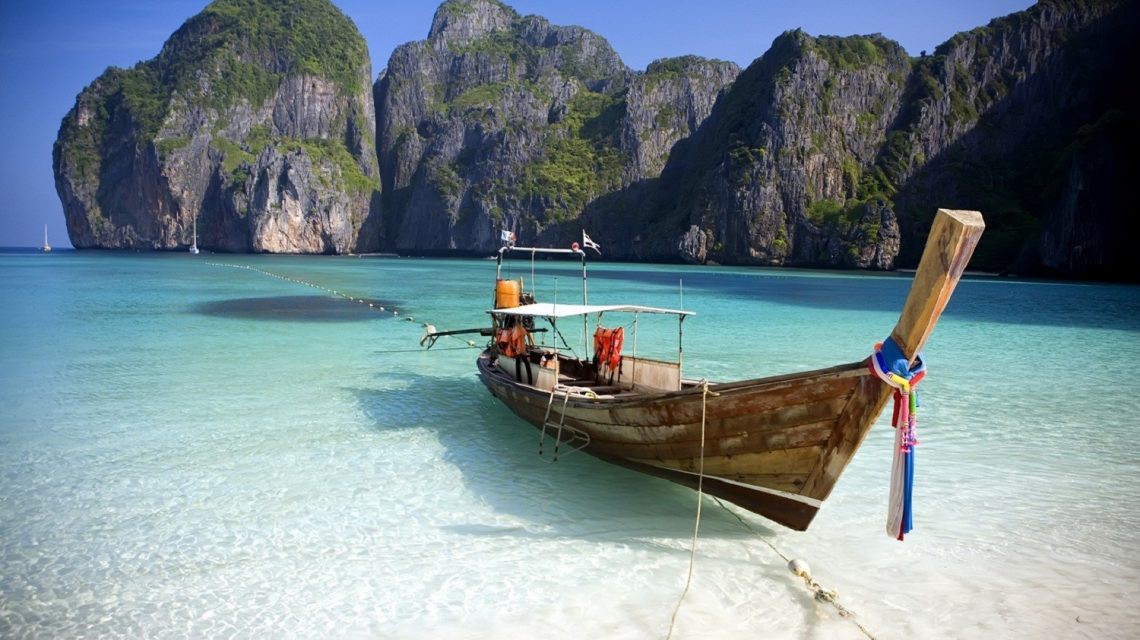
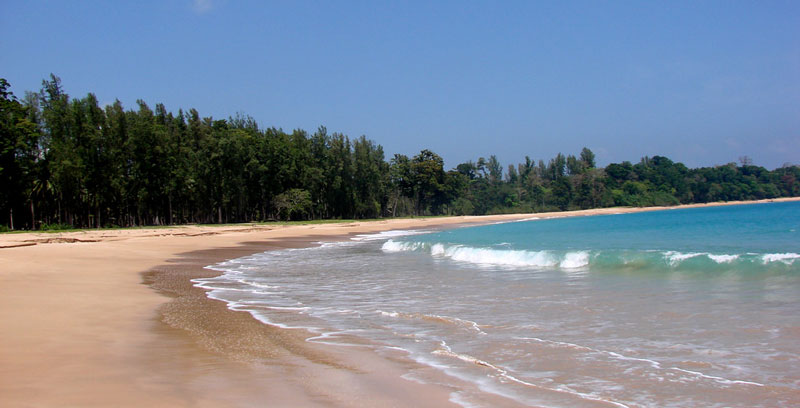
Bharatpur Beach: Popularly known as the Coral Kingdom of the Andaman, the Bharatpur Beach, which is located just half a km from the Neil Island jetty is a gorgeous shoreline, white sand beach, fringed with palm trees with turquoise crystal clear waters on Neil Island. The beach is a low tide beach, perfect for swimming and sunbathing. Bharatpur Beach is renowned for its exotic coral reef and vibrant aquatic life. Try to take a glass bottom boat ride to explore the underwater world at the beach. Do not miss out on the breathtaking sunrises and sunsets from this beach. In spite of its proximity to Port Blair, it is seldom crowded and provides for a tranquil atmosphere for holidaying. The shore has shallow water with coral reefs that make the beach a famous spot for water sports like snorkelling, glass bottom rides, and scuba diving other than beach exploration and sunbathing.
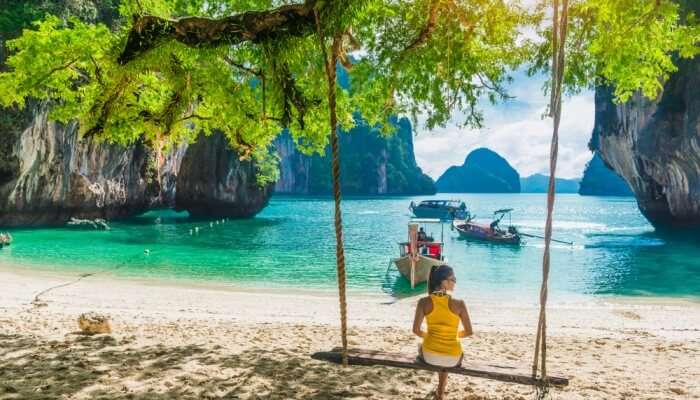
Laxmanpur Beach: Located on Neil Island, and at a distance of two km from the island’s jetty, Laxmanpur Beach is is a stunning white shell sand beach with the white sandy beach being perfect for hanging out and enjoying the natural beauty around you. Put up a hammock, grab a book and let the day just pass you by. The shallow waters near the shore, home to corals, is where you can go swimming, even if you are a non swimmer.
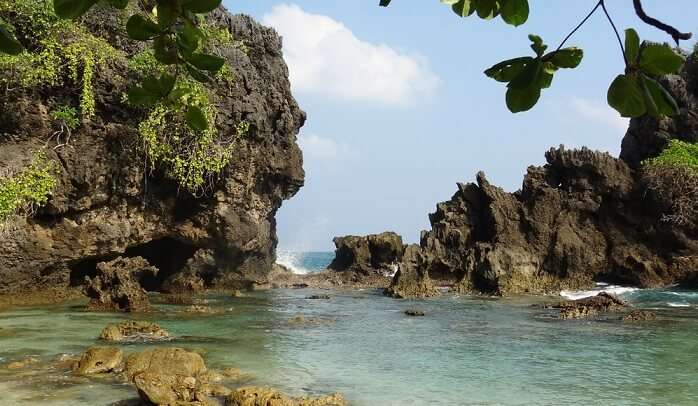
Howrah Bridge on Neil Island: The Howrah Bridge or the Natural Bridge is a bridge-like formation located in the famous ‘vegetable bowl’ or the coral laden side of Neil Island on the Laxmanpur Beach. The bridge is just a naturally stacked up huge coral rocks which together form a bridge-like structure. The island was severely affected in the Tsunami disaster of 2004 which washed off uncountable dead corals on the shore. As the island is largely inhabited by Bengali immigrants, the bridge was first coined as the Rabindra Sethu but later changed its name to Howrah Bridge. The bridge can be accessed only during low tides, hence, you will be taken to this coral island only pre-sunset hours. There are guides available who take a fixed amount to make you tour the entire shore where you are introduced to sea creatures such as sea Cucumber, starfish, crabs, etc. The bridge overlooks the grand Indian Ocean, plus the dead coral stretch where you stand in ankle deep water and can see the school of colorful fish and sea animals living on the dead corals which are partially submerged in shallow ocean water.
South Andaman Islands Rutland Island: At the far tip of India, south of Port Blair, lies the picturesque Rutland Island, a heaven for Thalassophiles, commonly called sea lovers. The island makes up the South Andaman district and comprises six villages, namely the Rutland Village, R.M. Point Village, Bamboo Nallah, Kichad Nallah, Bada Jhari and Dani Nallah. Out of all these, the Dani Nallah is the most popular for the memorable marine life and turtle breeding experience it offers, that’s truly one you’ll never forget! Rutland Island is barely 110 sq. kms and is home to around 350 inhabitants belonging to the Jangil Tribe. But what the island may lack in size or population, it makes up for with its impeccable views of beaches and rich marine life that are worth a visit! You can go fishing at Chidiya Tapu and get a glimpse of the coral reefs at the Cinque Islands. An enthralling open-sea diving experience awaits at the beaches where you can also take a dip or enjoy some snorkelling. Travel to Jolly Buoy for a glass-bottom boat ride and walk along the Red Skin Island beaches, with the waves lapping at your feet. Visiting Rutland Island on a day trip from Port Blair or Havelock Island is one of the best options.
South Andaman Island: Known to be the southernmost island of the Andaman group of Islands, South Andaman Island is also the most populated and most commercially viable island in the cluster. It is the third largest island in the cluster and is situated between Middle Island and Baratang from which it is separated by a narrow strip of land. Boasting of small villages and coconut fields, you can also try your hand at adventure activities here that include scuba diving, snorkelling and parasailing.
Little AndamanIsland: A beautiful island with crystal clear waters and clear sandy beaches, Little Andaman is the fourth largest island in the archipelago. It lies to the southern end of the archipelago over an area of 730 sq kms. The island is home to an extensive rainforest and rare species of marine turtle. If you explore enough, you could also come across some breathtaking waterfalls. Also known as Gaubolambe in the native language, Onge which is spoken by the Onge aboriginal tribe, the island is also called Ebu Belong. The local population is mostly comprised of a good number of Bengalis, Tamilians, and native aboriginal tribes known as the Onge tribe who have been inhabiting the jungles since 1957. So far the population of over 18,000 inhabitants occupies 18 villages on the island along with the main village, Kwat-tu-kwage on the Hut Bay. Apart from the ethnic diversity, Little Andaman is also unique in its biodiversity which is fairly spread between thickets, dense rainforests and long stretches of chromatic beaches and vivid coral reefs that are overly rich in marine life which includes a variety of rare species of marine turtles and a lot more. The Little Andaman Island is also home to the Little Andaman Lighthouse which is occasionally referred to as the Richardson’s Lighthouse.
Butler Bay Beach: A forgotten piece of heaven on Little Andaman, the Butler Bay Beach lies tucked about 100 kms from Port Blair city. A perfect place to get away from the hustle and bustle of city life, this beach is less frequented by tourists. This vast expanse of yellow sand and crystal clear waters was once the most popular beach destination in the Andaman and Nicobar Islands. However, after the grave tsunami in 2004, the beach has become more desolate and isolated. If you are an adventurous spirit, you can try surfing to up your adrenaline levels. However, note that the waves get pretty high, so do not venture too far out in the sea unless you are an expert. Visitos can also try trekking in the lush green jungles nearby which has absolutely stunning views. The lighthouse near the beach is perfect for spending an afternoon overlooking the sea.
Cinque Island: Located 26 km from Port Blair, Cinque Island is an inhabited isolated part of the Andaman Archipelago. It is nestled between Passage and Duncan Island towards the north side. The island is further divided into North and South Cinque Islands. The islands are collectively a part of Wandoor Marine National Park, or more commonly known as Mahatma Gandhi Marine National Park. A white sandy beach surrounded by lush green tropical rain forest, a visit to Cinque Island is a calming experience. With a rich and exotic marine life including coral reefs, vibrant and colourful fishes, sea anemones, turtles, saltwater crocodiles, starfishes, seaweed, water snakes, the rare sea cow among more, the island also offers professional scuba divers to test their diving skills and amateurs to learn diving from PADI instructed divers. The island is also great for other activities like sea walking and snorkelling. The view under the pristine water is stunning. The best time to Scuba dive is between December to February as the visibility is fantastic.
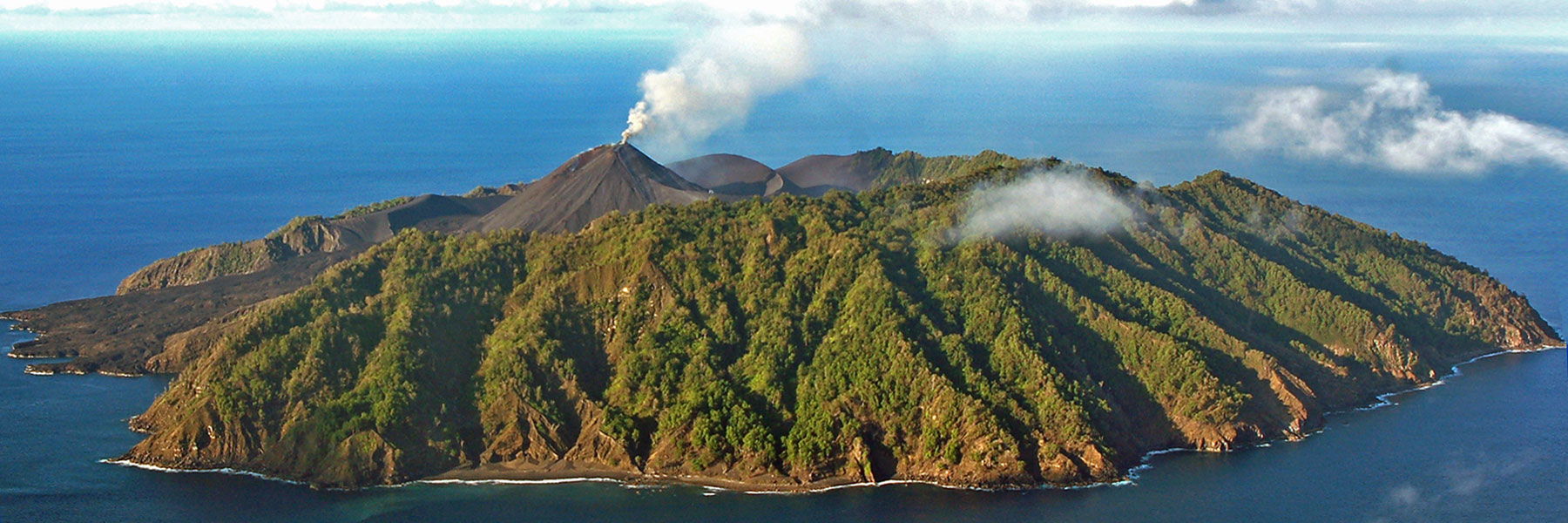
Barren Island: Located about 135 kilometres to the northeast of Port Blair, Barren Island is situated at the intersection of the seismically active Indian and Burmese plates, is 1.8 million years old and is home to the only active volcano in the Indian subcontinent. As the name suggests, the island is largely uninhabited, thanks to the volcano eruptions that take place here at frequent intervals. Although sightseeing around the island is not that common, you can obtain permissions from the local forest department to do so. There are a number of ferries and boats that can take you around to visit the island. However, due to the unpredictability of the volcanic eruptions, visitors are not permitted to land on the shores and are offered with a view from the sea, which is quite breathtaking. The crater of the Barren Island volcano is about half a kilometre away from the shore. The black bedrock of the island lends the sand on the beach a deep purple-black hue that contrasts beautifully with the vibrant blue of the ocean and underwater vibrant marine life. What is interesting is that even though the existence of this volcano is not a hidden fact, and has been known since centuries; owing to little-publicised research with restricted and limited access, the island continues to remain an unexplored mystery.
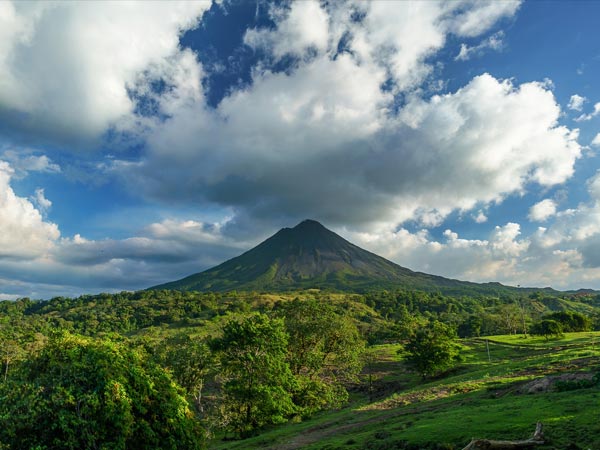
Narcondam Island: Located on the western side of the archipelgo, Narcondam Island is a tiny volcanic island which is still inhabited and sprawls over a small 6.8 sq kms, with the island’s highest point being 710 m and it is formed of an igneous rock known as andesite. It is mostly known for its dormant volcano that exists on the land. Due to the existence of the volcano on the island, it was left deserted and desolate for the longest period of time, but lately it has begun to see commercial tourism due to to its untouched and unexploited dense forests, crystal clear waters, uncommercialized beaches and the overall picturesque beauty. The island is also inhabited by several birds and boasts of a rich wildlife.
Katchal Island: One of the many beautiful yet secluded islands of the Nicobar archipelago, Katchal Island is a stunning beauty of the pristine Nicobar Islands that is still not as popular as the other islands. Among the many such isolated islands of the archipelago, one of the remotest ones is Katchal Island. Brimming with a historical origin story, a tale of a tragic past and an almost-unexplored stretch of natural beauty, the virgin island of Katchal has only recently been declared open. Before that, permission had to be taken from Port Blair administration to enter Katchal. The hills of Katchal are made of calcareous sandstone and marble slates and are covered with lush tropical forests. The forests hide a plethora of endemic flora and fauna, including a spectacular opportunity of birdwatching. Sunrises and sunsets are breathtaking out here at Katchal. Katchal Island is 300 km away from Port Blair and the only mode of transport to get there from Port Blair is via helicopter as of yet. Katchal Island, previously known as Tihanyu, was an Aboriginal Tribal Reserve Area and foreign individuals needed special permission to visit the island and even Indian tourists, it is only a day-tour destination. No one is allowed to stay there except government employees who were posted there. Katchal is home to both indigenous and non-indigenous people. As per history, Katchal was part of the overseas kingdom of the Cholas of Tanjore, Tamil till the Danish explorers started coming over, and then finally the British Empire took over the island in 1869. Later with India’s independence, Katchal Island became a part of Andaman and Nicobar and was included in the country’s administration. Native Nicobari tribes reside here in Katchal, and so do migrated Tamil people. The tribal people from West Bay Katchal believe that the current population of the island came from the worms who survived the great flood of ancient times. Katchal was one of the islands in the Indian Ocean which were devastated by the 2004 Tsunami.
Campell Bay and Indira Point: Campbell Bay is a small and tranquil village located in the Great Nicobar Island which is also where the southernmost point of the Nicobar Islands and also of the Indian subcontinent, Indira Point is located. The point is mostly known for its magnificent light houses that are painted with red and white stripes which are the major attraction of Indira Point. Other than tourism, these lighthouses help in direction navigation for the ships and vessels coming to and fro from Malaysia and Malacca. Besides enjoying a gorgeous expanse of Arabian Sea in the vicinity, you can also admire the beautiful sunrise and sunset views. In addition to that, the place reverberates with peace and tranquility and you can find enough time and space here to spend quality time alone or in company. Moreover, this island is also popular for holding the vast tropical land of dense forest which was named as Campbell Bay National Park in 1992 and is proudly a part of the great Nicobar biosphere reserve. Spreading across 426 square kilometers, Campbell Bay National Park has made its name in the list of best National Parks of India for most tourists.
So this was some of the islands in the archipelgo that is the Andaman and Nicobar Islands. I have probably just scratched the surface, there is so much more to see here. In the next blog post, the last in the series, we will see some of nature’s beauty that is there in the islands. Keep reading…









 Memories and Such