Recipes: Vegetable Jalfrezi

This ubiquitous dish found in most restaurant menus has its origin in colonial British India. The word Jalfrezi comes from the Bengali word jhālpharezī, which can be broken down jhāl meaning spicy food in Bengali and parhezī means suitable for a diet in Persian. Jalfrezi is usually prepared by stir-frying ingredients, a technique introduced to the region by Chinese cuisine.

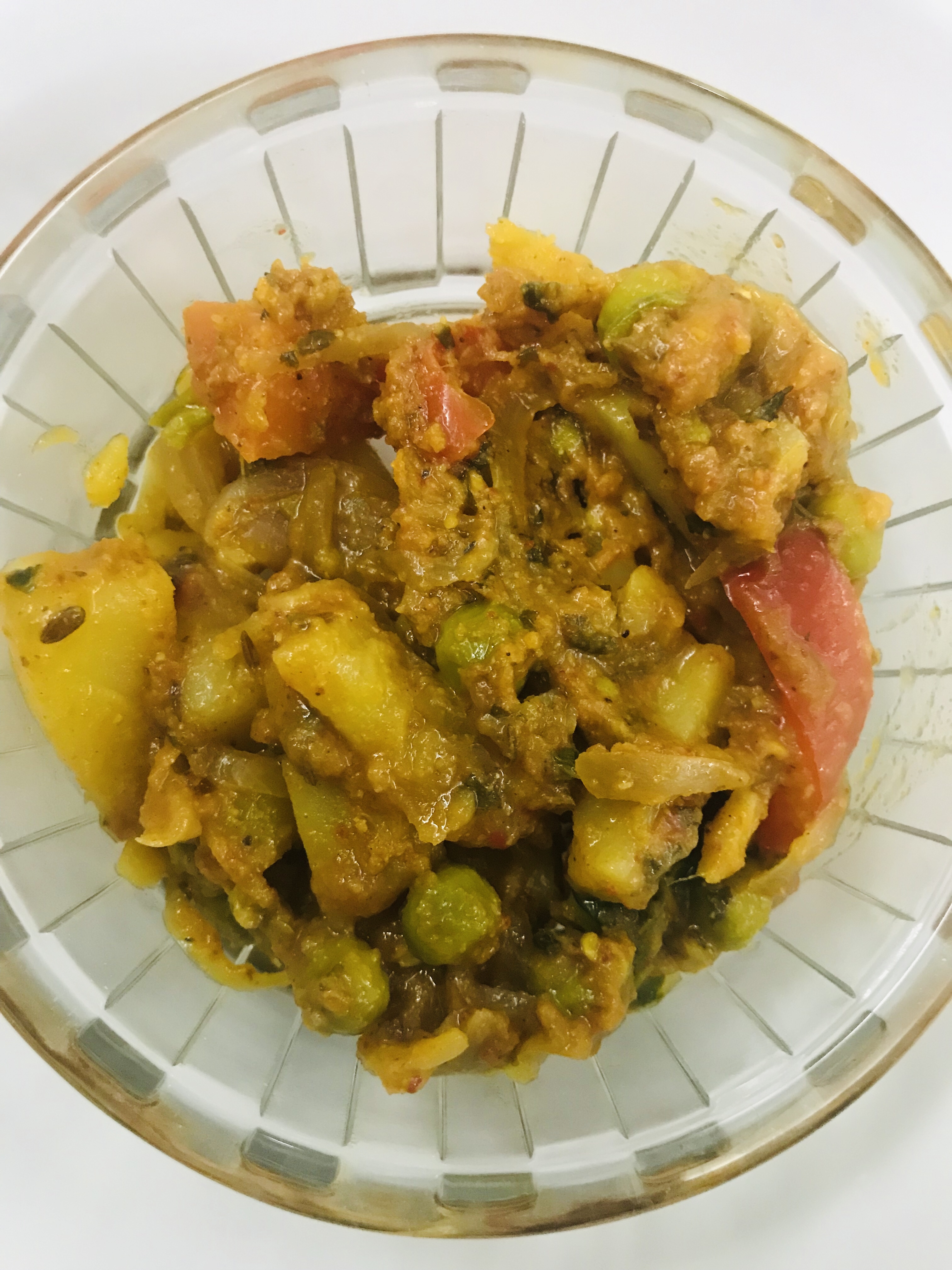
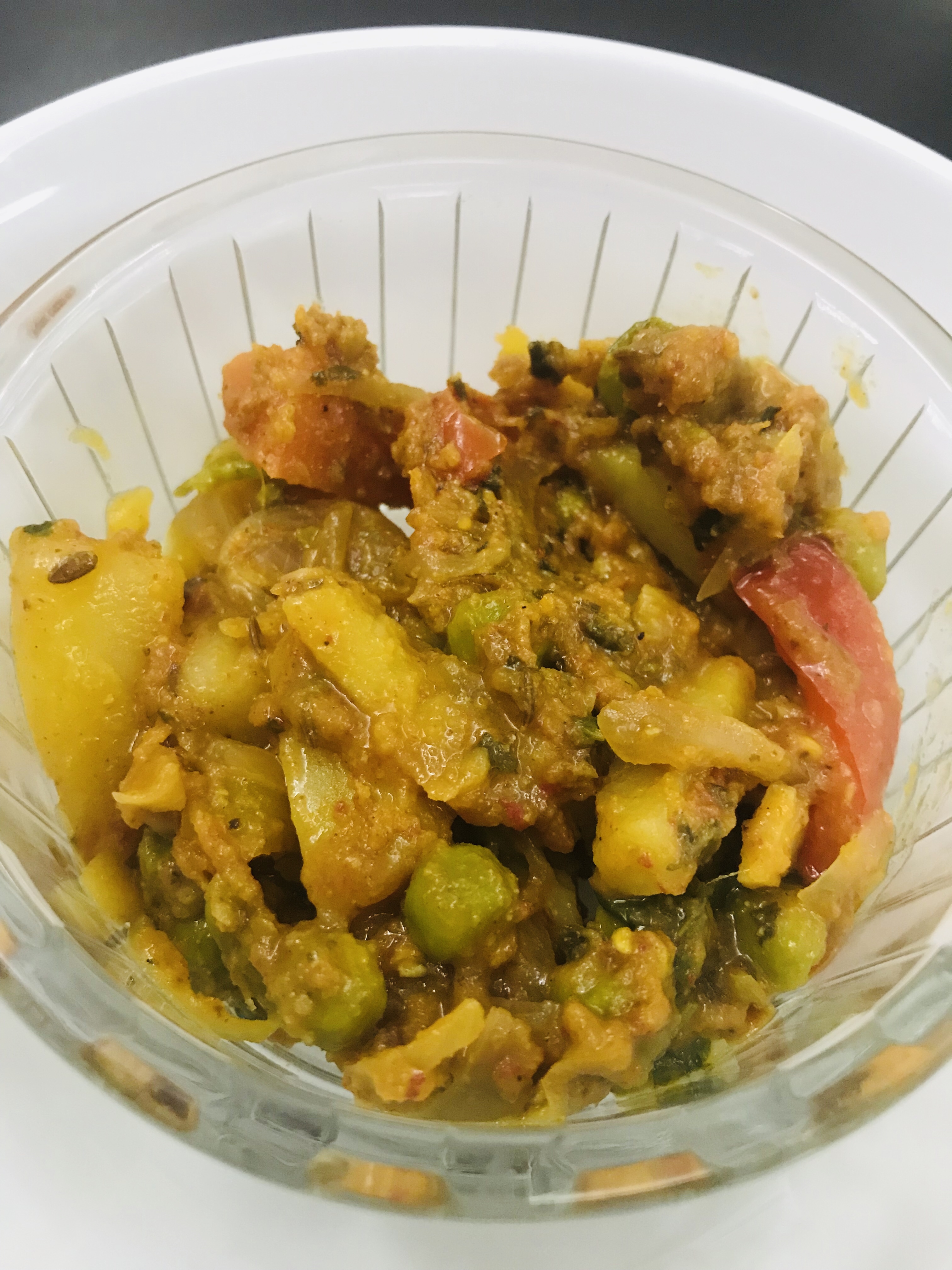
I’ve never made Jalfrezi before and tried it one evening for dinner. This dish is not in a gravy form and could be best described as semi-wet. Since this is not a gravy dish, I decided to have rotis or Indian flatbread to go with it. If you want to have it with rice, either make it slightly more watery or pair it with any dal.

Vegetable Jalfrezi

Ingredients:

  • 1/4 cup cauliflower florets
  • 1/4 cup carrots, chopped lengthwise into 1.5-inch sticks
  • 1/4 cup potatoes, chopped lengthwise into 1.5-inch sticks
  • 1/4 cup frozen peas
  • 1/2 cup paneer, chopped lengthwise into 1.5-inch sticks
  • 1 large green bell pepper sliced lengthwise into 1.5-inch sticks
  • 1 garlic
  • 1-inch piece of ginger
  • 2 medium sized tomatoes, chopped roughly
  • 2-3 green or red chillies
  • 3 medium-sized onions
  • 1/4 tsp turmeric powder
  • 1 tsp red chilli powder
  • 1 tsp cumin powder
  • 1 tsp coriander powder
  • 1 tsp kasuri methi
  • 1 tbsp butter
  • 1 tbsp oil
  • Salt to taste

Method:

  • Chop two onions roughly and keep aside. Cut the balance onion into two and slice the two halves into thin slices and keep aside.
  • In a blender, blend together the chopped onions, tomatoes, ginger, garlic and chillies into a fine and smooth paste and keep aside.
  • Heat the oil in a pan and lightly fry the paneer till they become slightly brown. Remove with a slotted spoon and drain on a kitchen tissue and keep aside.
  • In the same pan, add the butter and add the chopped vegetables and stir fry on high heat for around 5 minutes, stirring continuously till the vegetables are almost cooked, but still crunchy. Remove from the pan using a slotted spoon and keep aside.
  • Now add the sliced onions and stir fry till the onions become translucent. Then pour in the blended paste and stir well. Let it come to a rolling boil.
  • Add the spices – turmeric powder, red chilli powder, cumin powder and coriander powder plus salt and mix well. Let it boil until the oil separates. We don’t want the gravy to be thin, so let it boil down until you can just coat the vegetables.
  • Then add the stir-fried vegetables and the paneer and give it a quick stir to coat the vegetables with the gravy evenly. At this point, you need to have a semi-wet kind of gravy, more dry than wet actually.
  • Check for seasoning and add the kasuri methi after crushing it with your palms to release the oils.
  • Garnish with coriander leaves and serve hot with rotis or any kind of Indian flatbread.

We really loved this dish and this is a keeper for sure! I would also use beans, baby corn and even mushrooms in the future.
In My Hands Today…

Magruder’s Curiosity Cabinet – H.P. Wood

27015411

May 1904. Coney Island’s newest amusement park, Dreamland, has just opened. Its many spectacles are expected to attract crowds by the thousands, paying back investors many times over.

Kitty Hayward and her mother arrive by steamer from South Africa. When Kitty’s mother takes ill, the hotel doctor sends Kitty to Manhattan to fetch some special medicine. But when she returns, Kitty’s mother has vanished. The desk clerk tells Kitty she is at the wrong hotel. The doctor says he’s never seen her although, she notices, he is unable to look her in the eye.

Alone in a strange country, Kitty meets the denizens of Magruder’s Curiosity Cabinet. A relic of a darker, dirtier era, Magruder’s is home to a forlorn flea circus, a handful of disgruntled Unusuals, and a mad Uzbek scientist. Magruder’s Unusuals take Kitty under their wing and resolve to find out what happened to her mother.

But as a plague spreads, Coney Island is placed under quarantine. The gang at Magruder’s finds that a missing mother is the least of their problems, as the once-glamorous resort town is abandoned to the freaks, anarchists, and madmen.

Poem: Imagination

Source

We all dream and imagine, but I feel that young children do this so much better than older children and adults.

I daydream a lot and this is also part of being imaginative. We create worlds in our minds and as a reader and (perhaps) a writer, this is a critical requirement. When I read, I watch the book in my head and I have never been satisfied when I see a movie based on a book because I always feel that my imagination is far superior to the director’s vision. It’s my imagination versus the director and guess whose imagination wins each time?

Source

Imagination

As a child, we dream, we let our imagination take steam

But as we grow older, we lose that, choosing instead to be more prosaic

But if you are a reader, you will know

Your imagination continues to flower and flow

A good book is your passport

To lands far beyond, to ports where you can cavort

Your imagination then takes flight

Making every book your personal film, with sound and light

So don’t ever think you are too old for flights of fancy

Nourish your imagination, make sure it reaches every nook and cranny

Then it’s payback time you see by which

Life as you know it will get creative and rich

In My Hands Today…

The Lost Hours – Karen White

6125229

When Piper Mills was twelve, she helped her grandfather bury a box that belonged to her grandmother in the backyard. For twelve years, it remained untouched.

Now a near fatal riding accident has shattered Piper’s dreams of Olympic glory. After her grandfather’s death, she inherits the house and all its secrets, including a key to a room that doesn’t exist—or does it?

And after her grandmother is sent away to a nursing home, she remembers the box buried in the backyard. In it are torn pages from a scrapbook, a charm necklace—and a newspaper article from 1939 about the body of an infant found floating in the Savannah River.

The necklace’s charms tell the story of three friends during the 1930s— each charm added during the three months each friend had the necklace and recorded her life in the scrapbook. Piper always dismissed her grandmother as not having had a story to tell. And now, too late, Piper finds she might have been wrong.


2019 Week 8 Update

This week has been a very meh week for me. I didn’t do much, yet the week ended very fast!

I hope that I have come out of my February slump as I have taken to calling it and this week is much better in terms of what I am able to accomplish.

There is nothing really that stands out this week, so this update is going to end here. Hoping that this week is better in terms of what I am able to do and complete.

Have a wonderfully productive week!