Recipes: Kashmiri Potato Yakhni

“Gar Firdaus bar-rue zamin ast, hami asto, hamin asto, hamin ast.”
This quote, attributed to the Mughal Emperor Jahangir in the 17th century when he first visited Kashmir can be translated as, “If there is a heaven on Earth, it is here, it is here, it is here”. The Mughal Emperor was so impressed by the beauty in Kashmir that he would often say, if one has not visited this beautiful paradise, they are missing out on something worthwhile.

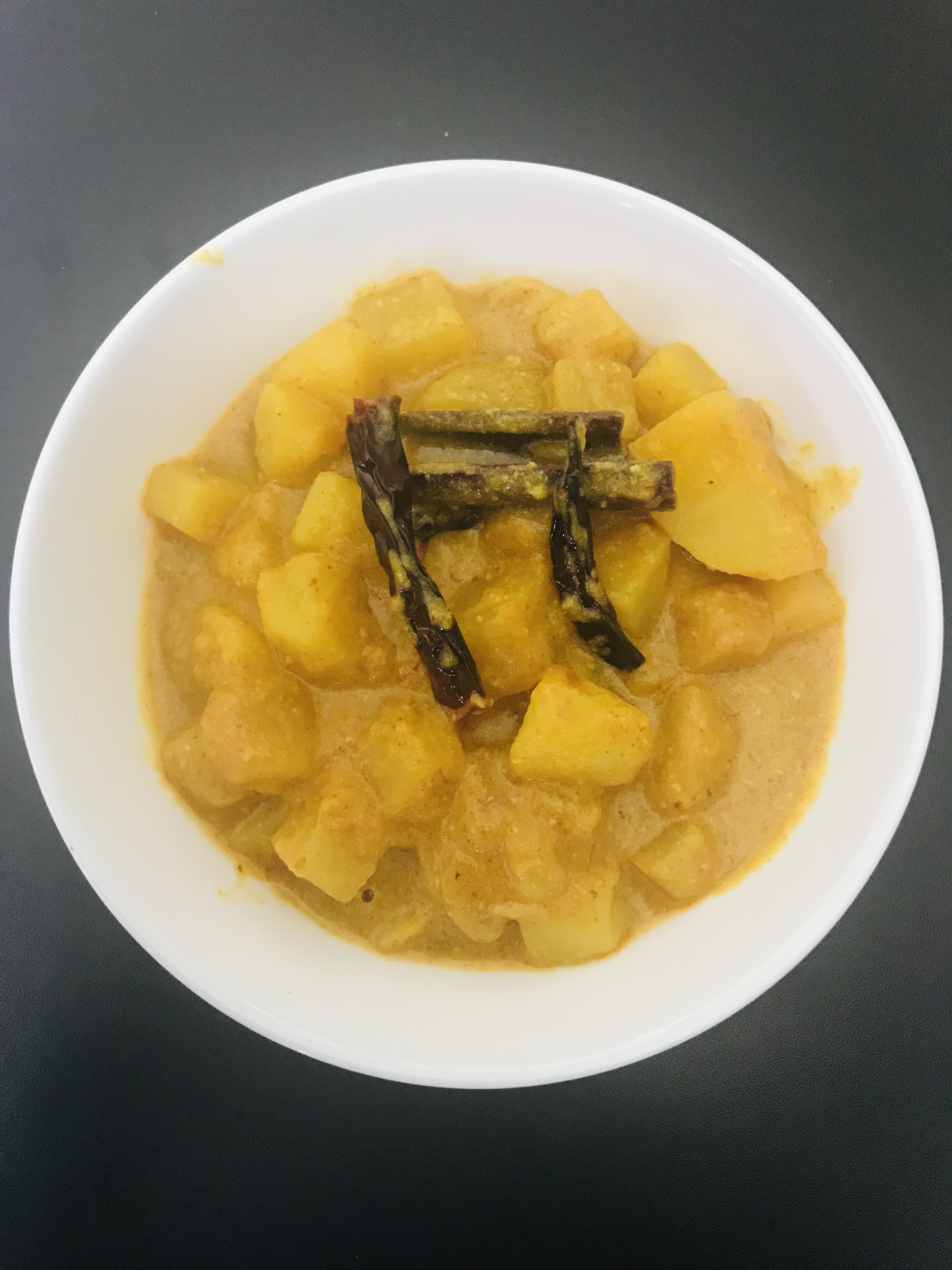
When I made my Kashmiri Pulao, I wanted it to be accompanied by a gravy dish from the same region. But as I discovered, since vegetables are scarce in the region, it is difficult to find vegetarian dishes here. So I adapted a mutton dish which I found online and created a potato yakhni. This may not be absolutely 100% authentic, but I was impressed with the taste.

Yakhni essentially means a gravy based dish and is a light curry or broth which has to include two main ingredients other than the meat – yoghurt and saffron. Yakhni came to be known in Kashmir during the Mughal emperor Akbar’s rule. Yoghurt-based meat curries were part of Persian cuisine, and the Emperor introduced this style of cooking to his new state when he annexed it in 1586. Yakhni dishes are also seen in Greek and Turkish cuisines, but what sets the Kashmiri Yakhni apart is the absence of tomatoes. Certain recipes also avoid onions and garlic since the Kashmiri pundits didn’t use those ingredients in their cooking.

So after this short lesson on the Kashmiri cuisine, let’s go on to the dish!

Potato Yakhni

Ingredients:

  • 1 kg potatoes, boiled, peeled and chopped into bite-sized pieces
  • 5 green cardamoms
  • 1-inch cinnamon stick
  • 1 bay leaf
  • 3 cloves
  • 1 tsp red chilli powder
  • 1 tsp turmeric
  • 2 tsp warm milk
  • 1 tsp dried ginger powder (saunth)
  • 2 tsp fennel powder
  • 2 dried red chillies
  • 1 cup yoghurt
  • 2 tbsp ghee
  • 2 pinches saffron
  • Salt to taste

Method:

  • Chop the potatoes into bite-sized pieces and keep aside.
  • Dissolve the saffron in the warm milk and stir a bit. Keep aside till needed.
  • Heat ghee in a deep bottomed pan. Add bay leaf, cinnamon, cardamom, clove, whole red chilli and cook on low flame till the spices begin to crackle.
  • Now add the chopped potatoes, turmeric powder, salt and saute for about five minutes on a medium flame.
  • Whisk the yoghurt well and add it to the potatoes. Make sure your flame is on low so that the yoghurt does not curdle.
  • Mix together the fennel and ginger powders and add it to the gravy.
  • Then add the red chilli powder and cook till the mixture thickens slightly.
  • Next, add the dissolved saffron along with the milk and stir for a couple of minutes. Check for seasoning and remove from the gas.
  • Serve hot with Kashmiri Pulao.

Notes:

  • If you want to make this with mutton, wash the mutton well and just replace the potatoes with the mutton.
  • To make fennel powder, simply grind 2 tbsp of fennel seeds into a fine powder. You can also find this readymade in Indian grocery stores. The same store will also have dried ginger powder available.

2018 Week 52 Update

The last week of 2018 and the last few days before school starts on 2 Jan!

The holidays just flew by without us really accomplishing what we wanted to do. As for 2018, I have mixed feelings about this year. I am ending 2018 the same way I started it – with hope. I will do another post once I have more time to myself about the year that went by.

The children will start school on Wednesday and though GG has still not gotten her timetable, she says she will have a long first day because of CCA. The fact that this is the SYF (Singapore Youth Festival) competition year means they don’t have time to waste. The competition will happen some time in April and once that is done, she has completed her CCA obligations. Because of her CCA Leadership role, she has also been awarded an award which she will get sometime in early January.

BB’s first week timetable is out and though it’s not as tight as I thought it will be, it’s not light either. His school has no studies on day 1 and they have been asked not to bring text books on that day. He also ends earlier than GG.

That’s it from me for this week and year. See you on the other side of the new year!

Happy 2019 and may the new year bring you what you have always hoped for.

In My Hands Today…

Child of Dandelions – Shenaaz Nanji

2791008

A breathtaking account of one girl’s determination to triumph over a devastating historical event. In Uganda in 1972, President Idi Amin, also known as the Last King of Scotland, announces that foreign Indians must be “weeded” out of Uganda in ninety days. Fifteen-year-old Sabine’s life is changed forever. The president’s message, broadcast on the radio every day, becomes Sabine’s “countdown monster,” and it follows her through days of terror. Sabine’s father is convinced that, as Ugandan citizens, their family will be unaffected, but her mother insists it’s too dangerous to stay. When her beloved uncle disappears and her best friend abandons her, Sabine begins to understand her mother’s fears. She becomes desperate to leave, but Bapa, her grandfather, refuses to accompany her. How can she leave him, and where will her family go to begin a new life?

TripAdvisor Top Museums Worldwide

If you have followed this blog and me long enough, you will know how much I like going to museums. I am basically a busybody at heart and museums allow me to indulge in this to my heart’s desire.

Museums are also the best place to spend on an experience rather than on material things, which is really more what creates happiness in an individual.

As a proponent of lifelong learning, I find museums to be the best place to learn – about cultures, about aesthetics which inspire and educate an individual.

As someone who loves history, anthropology and sociology, I love museums. I try to bring BB & GG along with me all the time in the hope this love for museums is transferred to them too and I am gratified that this is slowly becoming the truth.

I chanced upon this TripAdvisor list of the best museums to visit and this was the spark of today’s post. This one has the best museums in the world, but you can also check by certain cities and by regions if you want to.

1. Musee d’Orsay Paris, France

2. The National 9/11 Memorial & Museum, New York City, United States of America

3. The Metropolitan Museum of Art, New York City, United States of America

4. The British Museum, London, United Kingdom

5. Prado National Museum, Madrid, Spain

6. Acropolis Museum, Athens, Greece

7. Louvre Museum, Paris, France

8. The National WWII Museum, New Orleans, United States of America

9. National Museum of Anthropology, Mexico City, Mexico

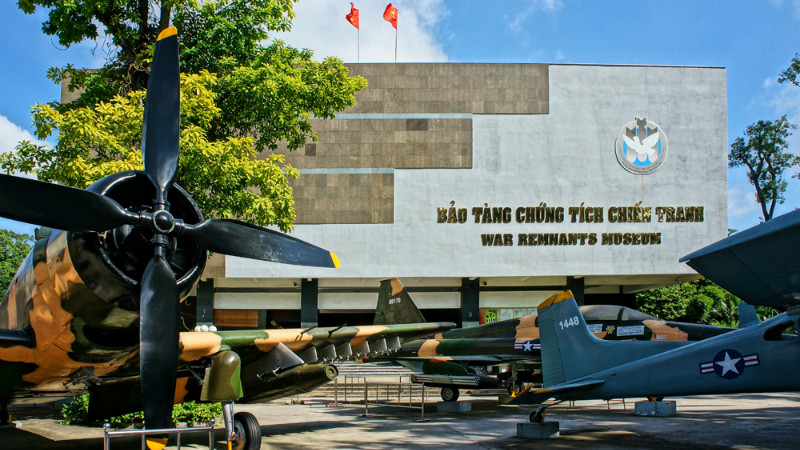
10. War Remnants Museum, Ho Chi Minh City, Vietnam

11. National Gallery, London, United Kingdom

12. Vasa Museum, Stockholm, Sweden

13. Uffizi Galleries, Florence, Italy

14. Rikjmuseum, Amsterdam, The Netherlands

15. The State Hermitage Museum, St. Petersburg, Russia

16. Van Gogh Museum, Amsterdam, The Netherlands

17. The Art Institute of Chicago, Chicago, United States of America

18. Egyptian Museum of Turin, Turin, Italy

19. Museum of New Zealand (Te Papa Tongarewa), Wellington, New Zealand

20. Museo Larco, Lima, Peru

21. Tuol Sleng Genocide Museum, Phnom Penh, Cambodia

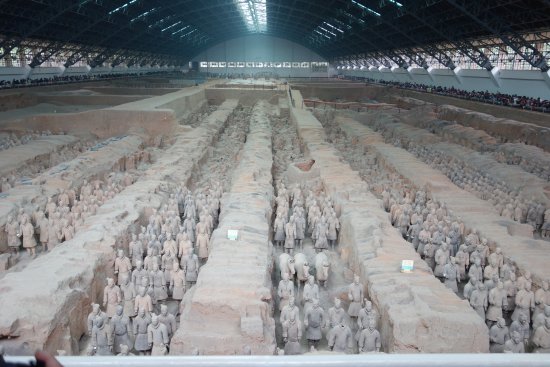
22. The Museum of Qin Terra-cotta Warriors and Horses, Xi’an, China

23. Gold Museum (Museo del Oro), Bogota, Colombia

24. Yad Vashem – The World Holocaust Remembrance Center, Jerusalem, Israel

25. Pinacoteca do Estado de Sao Paulo, Sao Paulo, Brazil

In My Hands Today…

The Assassin’s Song – M.G. Vassanji

1664732

In the aftermath of the brutal violence that gripped western India in 2002, Karsan Dargawalla, heir to Pirbaag – the shrine of a mysterious, medieval sufi – begins to tell the story of his family. His tale opens in the 1960s: young Karsan is next in line after his father to assume lordship of the shrine, but he longs to be “just ordinary.” Despite his father’s pleas, Karsan leaves home behind for Harvard, and, eventually, marriage and a career. Not until tragedy strikes, both in Karsan’s adopted home in Canada and in Pirbaag, is he drawn back across thirty years of separation and silence to discover what, if anything, is left for him in India.