2022 Week 30 Update

Another month bites the dust and we are closer to the end of 2022 than we are to the beginning of the year. The last seven months seem to have flown by and many would have started their planning for 2023.

Earlier this week, the World Health Organisation (WHO)  declared Monkeypox a global health emergency and has activated its highest alert level for the growing outbreak. This means that WHO now views the outbreak as a significant enough threat to global health that a coordinated international response is needed to prevent the virus from spreading further and potentially escalating into a pandemic. More than 18,000 cases of monkeypox have been reported across more than 70 countries so far this year, and the number of confirmed infections rose 77% from late June through early July, according to WHO data. As if COVID-19 was not enough, this is one more potential pandemic waiting to be unleashed upon us. Europe is currently the global epicentre of the outbreak, reporting more than 80% of confirmed infections worldwide in 2022. Because monkeypox is not a new virus, there are already vaccines and antivirals to prevent and treat the disease it causes, though they are in short supply.

In today’s quote, American actress and singer, Judy Garland who is best known for playing Dorothy in The Wizard of Oz tells us that we should always be a first-rate version of ourselves, instead of a second-rate version of somebody else. What this means is that we need to work on achieving a clear sense of our own identity to create clarity for us and those around us, for who we are and what we stand for. This will help create the principles and boundaries that help to take control of our destiny. Being a first-rate version of ourselves builds resilience and helps us to respond appropriately when we encounter situations that we are uncomfortable with. It provides us with an anchor when we feel lost or overwhelmed. We can then strive to be the best we can be in the knowledge that we have the basic template in place that works for us. We may be influenced and learn from others, but we don’t live their lives and their world is not our world and so we can’t live an authentic and positive life unless we live our version.

BB & GG are busy with school and internships. GG finishes her internship this week and then she will start her holidays. BB interviewed for an internship slot earlier this week and I am hoping he gets it because the role is something he is interested in. Otherwise, he will do a final year project with one of his lecturers. I am hoping he gets the internship as there will be more real-life learning there as compared to the project. And on that note, have a wonderful week and stay masked and stay safe.

In My Hands Today…

Tesla: Inventor of the Modern – Richard Munson

Nikola Tesla invented radio, robots, and remote control. His electric induction motors run our appliances and factories.

In the early 1900s, he designed plans for cell phones, the Internet, death-ray weapons, and interstellar communication. His ideas have lived on to shape the modern economy, yet he has been largely overlooked by history.

In Tesla, Richard Munson presents a comprehensive portrait of this farsighted and underappreciated mastermind. Drawing on letters, technological notebooks, and other primary sources, Munson pieces together the magnificently bizarre personal life and mental habits of the enigmatic inventor whose most famous inventions were the product of a mind fueled by both the humanities and sciences — Tesla conceived the induction motor while walking through a park and reciting Goethe’s Faust. Clear, authoritative, and highly readable, Tesla takes into account all the phases of Tesla’s remarkable life and career.

Tamil Brahmin or Iyer Wedding Rituals

A wedding is the union of two people, and every culture and religion has different rituals which signify this union. The rituals and ceremonies surrounding marriage in most cultures are associated primarily with fecundity and validate the importance of marriage for the continuation of a clan, people, or society. They also assert a familial or communal sanction of the mutual choice and an understanding of the difficulties and sacrifices involved in making what is considered, in most cases, to be a lifelong commitment to and responsibility for the welfare of spouse and children. Marriage ceremonies include symbolic rites, often sanctified by a religious order, which are thought to confer good fortune on the couple. Because economic considerations play an essential role in the success of child-rearing, the offering of gifts, both real and symbolic, to the married couple is a significant part of the marriage ritual.

In India, the variety of communities and religions ensure that weddings are a glitzy affair with Hindu weddings being highly elaborate affairs, involving several prescribed rituals and in most cases, the date of the ceremony is determined by careful astrological calculations. Indian weddings are known for their grandeur and vibrance. Tamil Brahmin weddings, especially hold a special place because of their meaningful rituals and ceremonies that bring two families together. The community I belong to also has traditions and ceremonies that are unique to us and here is a small attempt to demystify them.

Tambram or Tamil Brahmin is a phrase used to refer to the Brahmins who trace their origin to Tamil Nadu. This is separate from the Palakkad Brahmins who trace their origin to the Palakkad district in Kerala and who were the brahmins who fled Tamil Nadu during Muslim invasions and were given refuge by the then King of Palakkad. While the traditional tambram wedding does not have the typical North Indian ceremonies like Mehendi and Sangeet, today’s wedding traditions have incorporated them and the result is a beautiful fusion of wedding traditions.

Tamil Brahmin wedding rituals are based on the four Vedas – Rig, Yajur, Sama and Atharva. The spiritual symbolism of each ritual remains the most important and though the wedding may seem simple without much pomp, it is religious and very personal. A traditional Iyer wedding is an amalgamation of Vaidika ceremonies which are rituals as per the Vedic scriptures and various other rituals. While the core marriage rituals are Vedic, these are accompanied by a lot of other rituals that are loukika in nature, or not prescribed in the Vedas or the Puranas but are in practice due to popular acceptance over time. These loukika rituals may not be uniformly followed by all brahmin Iyers with customs and practices followed by individual families different.

Decades back, the wedding used to be a four or five-day affair and I remember my grandmothers telling me about their weddings when the whole village came together for a week to celebrate it. But today’s weddings are usually a day and a half, with many only having two half-day ceremonies and merging the previous evening’s ceremony with the reception to save time and money. The following ceremonies are followed by most of the brahmins, but some families may omit certain rituals and others have something slightly different.

Before the actual wedding date, there are pre-wedding rituals that are done after which the wedding takes place.

Nischyadaartham: In most Iyer weddings, the matching of the horoscopes of the bride and the groom is an important step. Once the marriage is fixed, the nischayadaartham or engagement ceremony is held on an auspicious day. Following a pooja invoking the blessings of Lord Ganesha to remove all obstacles, an exchange of coconut and thamboola or betel leaves and areca nuts is done in the presence of elderly members of both families. This ritual is also known as vaang nischaya or committing by word. The reading of the lagna patrika giving details about the date, day, time or the muhurtham and place of the wedding along with family details of the bride and the groom, is then signed by representatives of both the families, usually the fathers. This makes the engagement a written and signed contract and is a later addition to the nischyadaartham and has now become a part of this ceremony, over time.

Sumangali Prarthanai: Sumangali Prarthanai is a prayer done by the married women invoking the blessings of female ancestors, who would have passed away as sumangalis, aka who died before their husbands. Sumangalis, who are invited, are supposed to represent the ancestral sumangalis and are worshipped and fed as per the customs and practices prevalent in individual families. Along with the sumangalis, a kanya or a young girl who has still not attained meranche is also worshipped and partakes in the feast. Usually, the sumangali prarthanai in the bride’s family is done before the wedding so that the daughter, who will be getting married, can be a part of the ceremony and receive blessings. In the case of the groom, it is done immediately after the wedding so that the new daughter-in-law can participate as a sumangali in this ritual. This ritual is usually done before any auspicious event in the family and I had done this before BB’s thread ceremony. Also, it can only be done once a year by a family as a whole, so for multiple weddings or other such ceremonies, only the first one will be counted.

Pongi Podal: The bride and the groom are invited by their respective aunts, which will be the mother’s brothers’ wives or maamis and the father’s sisters or athais and treated to a traditional feast including Pongal and other favourite dishes. This feast is prepared by elders of the family to celebrate and bless the bride and the groom, who will then go on to form a family of their own.

Yatra Daanam: The groom and his family travel to the bride’s place of residence or the venue of the wedding after praying to Lord Ganesha and giving daana or alms to Brahmins to ward off evils. It is also considered auspicious to break a coconut before commencing the trip.

Other than these pre-wedding functions, other smaller functions also take place in the homes of the bride and groom which include praying to kula-devatas or family deities, erecting a panda kaal or a bamboo pole with plantain-covered decorations outside their homes after special prayers for the smooth conduct of the wedding and the applying of mehendi or henna for the bride and other ladies of both the families with the groom also applying some henna symbolically.

Now let’s go to the main ceremonies, which are included in the two-day event

Receiving the groom’s party: In country-side weddings in the olden times, the groom’s party used to be welcomed at the boundary of the bride’s village with the nadaswaram being played. I remember a wedding we went to when I was about six where the bride was my father’s maternal cousin and the bride was his paternal cousin. We initially stayed in a smaller town before going to the village where the wedding was to be held. Almost at the village, my grandfather wondered about the same thing, about whether there would a welcome committee at the entrance of the village since we were the groom’s party at that point. Today, the groom’s party is ceremonially received at the entrance of the wedding venue by the bride’s parents and relatives with coconuts, flowers and a thamboola with two decorated conical structures called paruppu thengai kutti which is made out of jaggery, lentils and coconut.

Vratham: This is a Vedic ritual that involves the groom taking permission from his father who is his first Guru to end his Brahmacharya Vratha or bachelor life and get married to lead the life of a Grihastha. Both the bride and the groom are made to perform certain samskaras or philosophies and a sacred string of protection called Kaapu or raksha is tied to the wrists of the bride and the groom after the chanting of Vedic mantras to protect them from all evil spirits.

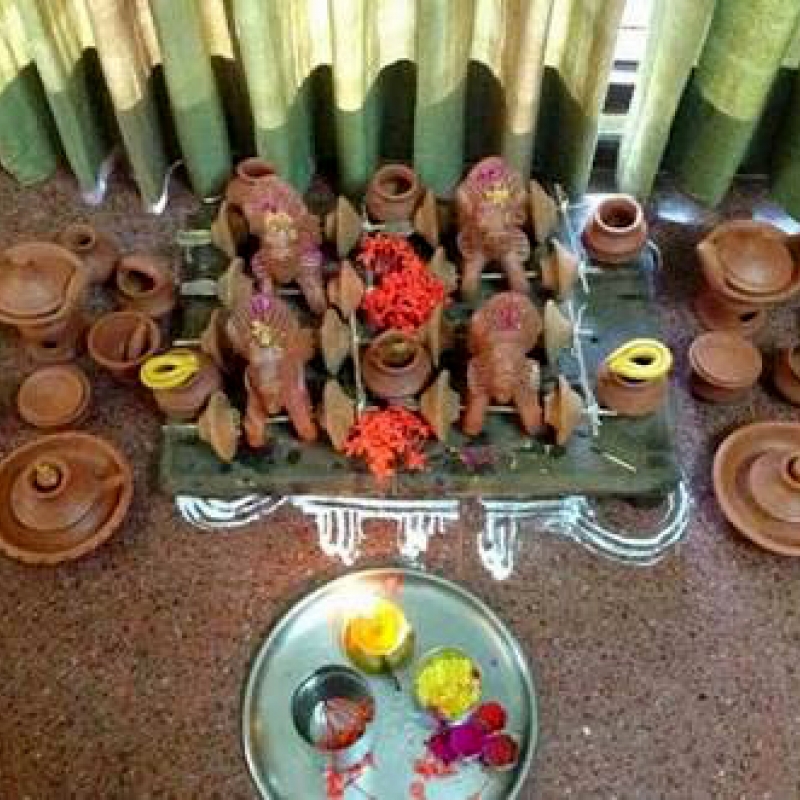
The Sprinkling of Paligai: This ritual originally involved planting a row of trees by the families of the bride and the groom. Over time, the actual planting of trees has given way to germinated seeds of nine kinds of pre-soaked grains being sowed in five clay pots each for the bride and the groom’s side. These seeds are sowed into these clay pots along with the sprinkling of milk mixed with water by married women from both families with prayers for a long and happy married life for the couple and blessings for their progeny.

Janavasam: This is when the groom is brought to the mandapam or the wedding hall in a grand procession accompanied by nadaswaram and sometimes the bursting of crackers. In the days gone by, this was a chance for the entire village to see the groom and his family and if anyone had any objections to the groom or his family, they had a chance to let the bride’s family know before the wedding. The rituals done during the nischyadaartham are repeated here and the bride’s brother presents clothes and jewellery to the groom and the groom’s sister does likewise to the bride. Both are then taken to a nearby temple to obtain blessings.

Kasi Yatrai: A very unique ritual amongst the brahmins, in this ritual, the groom carries a bamboo fan, an umbrella, a walking stick, and a grantha or a book of learning like the Bhagavad Gita, wears new slippers, and sets out to go to Kashi or Varanasi for further learning. He is stopped by the bride’s father who requests him to stop travelling for learning and offers to give his daughter in marriage to him so that he can return to be a Grihastha. The groom agrees and returns to the marriage hall for further rituals.

Maalai Matral and Oonjal: After the groom agrees to get married, the bride arrives and garlands are exchanged between the bride and the groom amid cheering by family members. The bride and groom exchange garlands under the guidance of their respective maternal uncles, an important figure in the hierarchy of a Hindu Family.  In the Indian tradition, a garland worn by an individual is generally not worn by another. By making an exception to the rule, the unification of two souls and oneness of the couple brought together by matrimony are highlighted. The bride and groom are carried by their uncles and brothers and each group tries to move away from the garland. Finally, the garlands are exchanged thrice and then the groom leads the bride by holding her hand to a decorated oonjal or swing. The swing symbolises the vicissitudes of life that the couple is expected to face and cope with, in perfect harmony. While they are seated on the swing, married ladies from both families symbolically wash the couple’s feet with milk by sprinkling some milk on their feet and wiping that with the edge of their sarees. At this point in the wedding, the bride and groom are the epitomes of Lord Vishu and his consort, Goddess Lakshmi. The women then wave coloured rice balls around them and throw these balls in all four directions to ward off evil and propitiate the planets and gods representing the directions. The bride and the groom are given a mixture of milk with pieces of bananas. Women of both families sing songs for this occasion. The Oonjal is followed by the vara poojai wherein the bride’s father welcomes the groom and washes his feet with water and the groom begins the marriage rituals with a prayer to Lord Ganesha. The Gothras of the bride and the groom are announced loudly by the priest along with their lineage up to three generations.

Kanya Daanam: The bride sits on the lap of her father, who holds a thamboola or betel leaves and areca nut in his palms. She then places her palms holding a coconut on her father’s palms. As the groom receives the bride’s hand from her father, the bride’s mother pours water over her daughter’s hand, which is made to fall on the ground like a dhaara or stream. This ceremony is called dhaarai vaarthu kodukkal in Tamil. The mantras chanted by the bride’s father symbolise the groom as a personification of Lord Vishnu and Gothra or the lineage of the bride is changed to that of the groom. This can be the equivalent of the western tradition of the father giving away his daughter in marriage. In some families, they also change the name of the bride to symbolise a new beginning. While for most people, it is just symbolic, in some families, the bride will henceforth only be called by her new name.

Maanglya Dhaaranam: The groom gives the ‘koorai podavai’ – a traditional nine-yard saree to the bride that she is supposed to wear to begin her life as the missus. The groom’s sister and other ladies of his family take the bride away to help her drape the ‘koorai podavai’ for the ‘maanglya dhaaranam’. The bride’s father then, once again, washes the feet of the groom and gives him a mixture of curd, honey and ghee. The maangalya or the mangalasutra are twin pieces of gold that is one each from the bride and the groom’s side and is placed on a yellow sacred string. Once the bride is ready in the nine-yard saree, she comes back and sits on the lap of her father and is showered with gifts and blessings. This happens before the couple tie the knot where the priest places a yoke denoting harmony and coordination on the head of the bride upon a sacred grass and the gold mangalyam or the wedding chain. Water is poured amidst the chanting of hymns, praying for her happiness and prosperity. The mangalsutra is tied around the bride’s neck in three knots, the first tied by the groom and the other two knots are tied by the groom’s sister. If the groom does not have a sister, a cousin does the honours. This signifies that the bride is welcomed by the groom’s family with the groom’s sister a representative for her family. This ceremony is performed amidst the chanting of mantras and a crescendo of nadaswaram, ketti melam, akshadhai showers of turmeric smeared rice and flower petals by the family members and friends to bless the couple. I was sobbing during this ritual as it finally hit me that I would be leaving my parents and moving out. I remember S trying to wipe my tears and do the rituals at the same time.

Paanigrahanam and Sapta Padhi: The groom holds the hand of the bride amidst chanting of hymns conveying that the Gods have ordained that they live as man and wife without parting and that the groom leads the life of a householder. The Sapta Padhi or seven steps is vital for the completion of the marriage. The groom takes the right foot of the bride and makes her take seven steps with prayers for her happiness, well-being and prosperity. The chants indicate that each step signifies the essentials of a harmonious life including, food, strength, wealth and prosperity, love and affection, progeny, opportune time and lasting friendship. The bride and the groom circle the Agni and on reaching the ammi kal or grinding stone the groom takes the toe of the bride’s right leg and places it on the stone. This signifies that the bride’s mind should be rock-like, unperturbed by the trials and tribulations of life. When they return to sit in front of the fire, the bride’s brother puts two handfuls of puffed rice in her hands, which is then offered to the Agni by the bride and groom with a small quantity of ghee. This entire ritual is repeated thrice.

Arundhati Nakshatra: Another interesting ritual is when the bride and groom are asked to take a look at the two-star constellation of Arundhati and Vasishtha, part of the bigger Saptarishi or Big Dipper constellation. In this special constellation, the two stars, Arundhati and Vasishtha move in tandem while revolving around each other, just like how a married couple should be. Now the funny thing is that brahmin weddings take place in the morning, and this ritual will come around the end of the wedding rituals, so around or before lunchtime. And one cannot see the stars at this time of the day, so all couples just look confusedly when the priest points to where the stars should be and nod their heads when asked if they saw them.

At the time of completion of chanting of mantras, the groom unties the darbha rope tied around the bride. This is followed by blessings showered upon the newly-married couple by all the elders of both families.

The first visit of the bride to the groom’s place and of the groom to the bride’s place is marked with female relatives giving them paalum pazhamum or a mixture of milk with bananas. A nalangu ritual may be held either at the wedding venue or the groom’s residence, wherein the bride and the groom are made to play some fun games that are more of an ice-breaker between the bride and the groom and also between the bride and her new family. This was relevant in the days when the bride used to be very young and was played so she gets used to the groom. It’s a fun ritual, but not relevant in today’s time, which is why I decided not to have it at my wedding.

For some families, this would be the end of the wedding function, while for others, there would be a reception in the evening where friends and colleagues would also be invited.

The bride then leaves for her marital home, where she will be welcomed with an aarti to ward off all evil and asked to kick a small cup of rice before she enters the home. This is to symbolise the prosperity she will bring with her.

I hope through this post, you got a small idea of how a Tamil brahmin or specifically an Iyer wedding takes place. This post will also help me explain to GG & BB their traditions as they grow older and may want to learn more. Writing this also brought back so many memories, and I relived my wedding which was amazing!

In My Hands Today…

Round Ireland with a Fridge – Tony Hawks

Have you ever made a drunken bet? Worse still, have you ever tried to win one?

In attempting to hitchhike round Ireland with a fridge, Tony Hawks did both, and his foolhardiness led him to one of the best experiences of his life.

Joined by his trusty traveling companion-cum-domestic appliance, he made his way from Dublin to Donegal, from Sligo through Mayo, Galway, Clare, Kerry, Cork, Wexford, Wicklow–and back again to Dublin. In their month of madness, Tony and his fridge met a real prince, a bogus king, and the fridge got christened. They surfed together, entered a bachelor festival, and one of them had sex without the other knowing. And unexpectedly, the fridge itself became a momentary focus for the people of Ireland.

Poem: Ode to a Saree

The saree is a timeless traditional Indian garment which is more or less worn across the country. Each region and state has their speciality and that’s what makes this garment unique. Multiple people will be wearing the same thing, but none of them will be the same. I love to wear sarees, but living outside India, I don’t have as many opportunities to wear them as much as I like. So here’s an ode to that six yards of grace and elegance.

Ode to the Saree

Six yards of pure joy and elegance
Graceful and flowing, full of brilliance
A symbol of a garment’s unwavering importance
Encapsulating the true Indian woman’s essence

Unstitched and long flowing, in multitudes of colours and fabrics
There is saree accounting for all tastes and pocket economics
The saree has stayed its course over centuries
Even today, every Indian woman has many of these beauties

There is a saree that represents every state and region that is a masterpiece
Craftsmen have spent years perfecting their skills and expertise
With embroidery, sequins, motifs, gold borders and intricate pallus
Many sarees have stories to tell, but only if you are not too obtuse

From the Kashida of Kashmir to the Muga of Assam
From Gujarat’s Patola to Tamil Nadu’s Kanjivaram
The saree is even today essential in every bride’s trousseau
The outfit guaranteed to bring out that very special glow

Modest and sexy, feminine and demure
It’s all in the drape you see, that special allure
Timeless in fashion, ancient, yet contemporary
No wonder the saree is a style statement always in trend