In Dhaka, Bangladesh, a garment factory burns to the ground, claiming the lives of hundreds of workers, mostly young women. Amid the rubble, a bystander captures a heart-stopping photograph—a teenage girl lying in the dirt, her body broken by a multi-story fall, and over her mouth a mask of fabric bearing the label of one of America’s largest retailers, Presto Omnishops Corporation.
Eight thousand miles away, at Presto’s headquarters in Virginia, Cameron Alexander, the company’s long-time general counsel, watches the media coverage of the fire in horror, wondering if the damage can be contained. When the photo goes viral, fanning the flames of a decades-old controversy about sweatshops, labour rights, and the ethics of globalization, he launches an investigation into the disaster that will reach farther than he could ever imagine – and threaten everything he has left in the world.
A year later, in Washington, D.C., Joshua Griswold, a disgraced former journalist from the Washington Post, receives an anonymous summons from a corporate whistleblower who offers him confidential information about Presto and the fire. For Griswold, the challenge of exposing Presto’s culpability is irresistible, as is the chance, however slight, at redemption. Deploying his old journalistic skills, he builds a historic case against Presto, setting the stage for a war in the courtroom and in the media that Griswold is determined to win—both to salvage his reputation and to provoke a revolution of conscience in Presto’s boardroom that could transform the fashion industry across the globe.
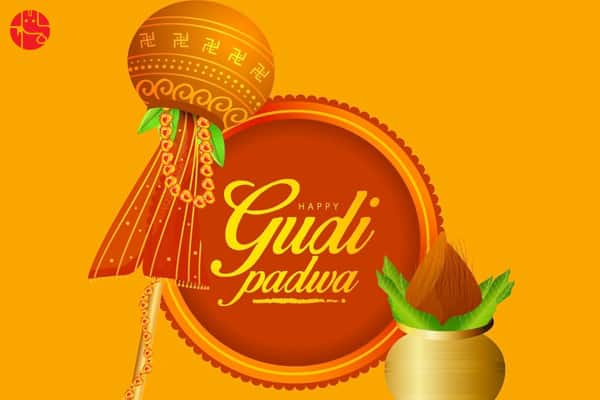
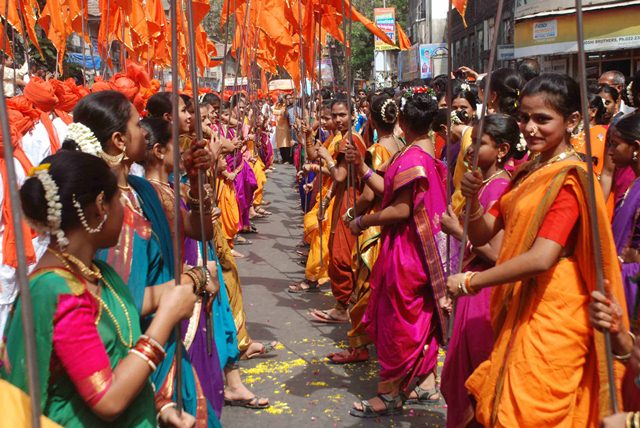
Spring is in the air and this means that various Indian communities will start celebrating their new year. The first is usually Gudi Padwa, a spring-time festival that marks the traditional new year for Marathi and Konkani Hindus. It is celebrated in and near Maharashtra and Goa on the first day of the Chaitra month to mark the beginning of the New year according to the lunisolar Hindu calendar. The word Padwa comes from the Sanskrit word Pratipada, which refers to the first day of a lunar fortnight. The festival is observed with colorful floor decorations or rangoli, a special Gudi flag which is garlanded with flowers, mango and neem leaves and topped with an upturned silver or copper vessel, street processions, dancing and festive foods.
Gudi Padwa marks end of one harvest season and beginning of a new one for farmers and so is also celebrated as a harvest festival in the region. On this day the position of the Sun is above the point of intersection of the equator, which according to the Hindu calendar marks the commencement of the Spring Season.
In India, this day which is the first day of the bright phase of the moon is called Gudi Padwa in Marathi, Ugadi in Telugu, and Yugadi in Kannada. The Sindhi community celebrates this day as Cheti Chand as the new year and observed as the emergence day of Lord Jhulelaal. Prayers are offered to Lord Jhulelaal and the festival is celebrated by making delicacies. However, this is not the universal new year for all Hindus. For some, such as those in and near Gujarat, the new year festivities coincide with the five day Diwali festival. For many others, the new year falls on Vaisakhi between 13 and 15 April, according to the solar cycle part of the Hindu lunisolar calendar, and this is by far the most popular not only among Hindus of the Indian subcontinent but also among Buddhists and Hindus in many parts of southeast Asia.
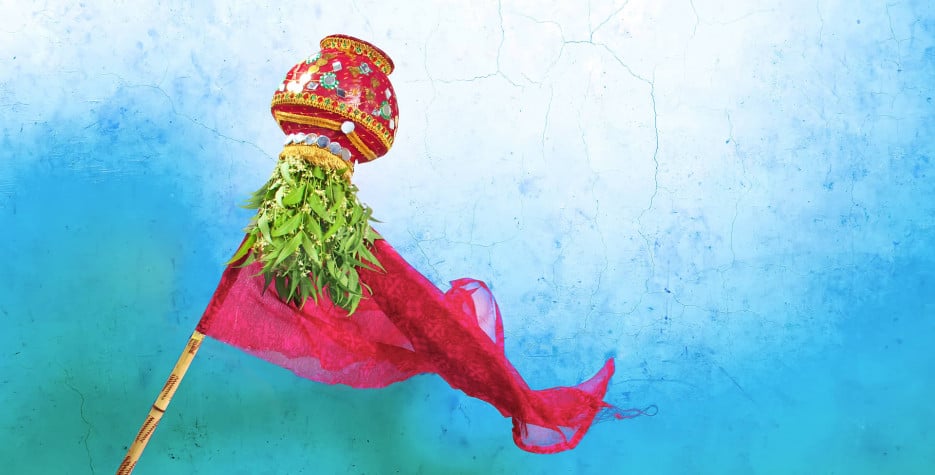
It’s really fascinating on the day of Gudi Padwa to see many Gudis arrangements in the windows and doors of Maharashtrian and Konkani households. The Gudi is a bright colorful silk scarf-like cloth tied to the top of a long bamboo pole. On the top of the pole, one or more boughs of neem leaves and mango leaves are attached along with a garland of flowers. This arrangement is capped with a silver, bronze or copper pot called handi or kalash in Marathi signifying victory or achievement. The whole arrangement is hoisted outside each household, typically to the right and is visible to everybody. Villages or neighborhoods also come together and host a community Gudi Kavad, which they carry together to the local Shiva temple. Some temples are located on the top of hills, and groups work together to help reach the kavad to the top.
There are many historical legends and beliefs associated with this festival. One of these comes from the Brahma Purana which states that Lord Brahma recreated the world after a raging deluge in which all time had stopped and all the people of the world, destroyed. On Gudi Padva, time restarted and from this day on, the era of truth and justice, known as Satyug began. Therefore, Lord Brahma is worshipped on this day and the Gudi symbolises the Brahmadhvaj.
Another popular legend about the origin of this festival revolves around the return of Lord Rama to Ayodhya along with his wife Sita and his brother Laxman from exile. The ‘Brahmadhvaj’ is hoisted in memory of the coronation of Lord Rama. The Gudi is hoisted at the entrance of the household in commemoration of the Gudi that was hoisted in Ayodhya as a victory flag. It is also believed that Lord Rama was victorious over King Bali on this day, marking this occasion.
For the people of Mahrashtra, there is an added significance to this festival. It is believed that Chhattrapati Shivaji Maharaj, celebrated leader of the Maratha clan, led the troops to victory and attained freedom for the kingdom from the dominion of the Mughals in that area. The Gudi then is a symbol of victory and prosperity.
It also symbolizes the victory of King Shalivahana and was hoisted by his people when he returned to Paithan (near current day Aurangabad).
The Gudi is believed to ward off evil, invite prosperity and good luck into the house. Many businessmen inaugurate their ventures on this day as it is considered an auspicious day.
On this day, courtyards in village houses will be swept clean and plastered with fresh cow-dung. Even in urban areas, even if they don’t do it everyday, on this day people take the time out to do some spring cleaning and women work on intricate rangoli designs on their doorsteps, the vibrant colours mirroring the burst of colour associated with spring. Everyone dresses up in new clothes and it is a time for family gatherings. Traditionally, families prepare a special dish that mixes various flavors, particularly the bitter leaves of the neem tree and sweet jaggery. Additional ingredients include sour tamarind and astringent dhane seeds. Most communities prepare something similar which is a reminder of life’s sweet and bitter experiences, as well as a belief that the neem-based mixture has health benefits.
Here’s wishing all those celebrating Gudi Padwa, Ugadi, Cheti Chand and Yugadi a very happy new year and to enjoy your celebrations and the yummy food that follows!
The best way to beat the system is from the inside.
Meet Jennifer – a smart, sexy woman who has broken through the glass ceiling to become a big-time trader in the world of high finance. When her boss is caught playing fast and loose with the regulations, Jennifer agrees to take the rap. After all, her fiance is a lawyer with the connections to get her off.
Instead, she ends up in a women’s prison; a world a whole lot meaner than Wall Street and where her designer clothes and fancy education count for nothing. She has to learn fast if she wants to survive and she does, once she is accepted by the prison’s top ‘crew’; a group of smart, strong, scary women led by tough lifer Movita and crazy Cher. These are women that Jennifer would never, ever, have befriended on the outside, but on the inside she soon discovers that working together is the only way out..
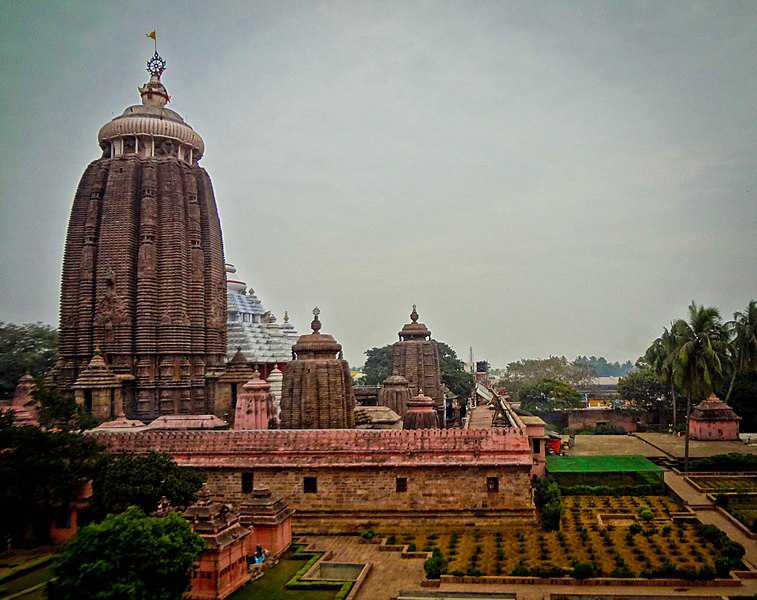
Puri When you think of Odisha, the first thing that comes to mind is the Jaganath Temple at Puri and the annual Rathyatra. This ancient city is among the original Char Dhams that hold significance in the Hindu religion. The Char Dhams or four abodes are a set of four pilgrimage sites and Hindus believes that visiting these sites helps achieve Moksha or salvation. The four places are Badrinath, Dwaraka, Puri and Rameswaram, one on each nodal points in India. Hindus believe that one should visit these places a t least once in one’s lifetime. The highlight of Puri is the Chariot festival or the Rath Yatra which takes place during the months of June-July and should not be missed. Known as the resting place of Lord Shiva, this ancient city dates back to 3rd century BC.
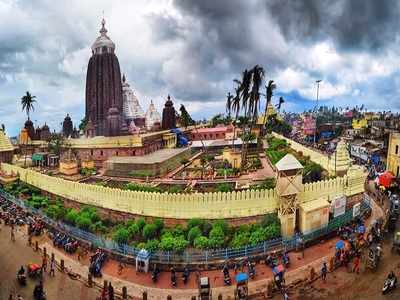
Sri Jagannath Temple The Jagannath Temple was built in the 11th century by King Indradyumna. The present temple was rebuilt from the 10th century onwards, on the site of an earlier temple, and begun by King Anantavarman Chodaganga Deva, first of the Eastern Ganga dynasty. The earthly abode of Lord Jagannath, a form of Lord Vishnu, this temple is part of the Char Dham sites and is a very holy pilgrimage site for Hindus. The complex with it’s rich Oriyan architechture consists of the main shrine plys many minor temples. The four gates are beautifully designed with intricate carvings. This temple is famous for its annual Ratha yatra, or chariot festival, in which the three principal deities are pulled on huge and elaborately decorated temple cars. These gave their name to the English term ‘Juggernaut’. Unlike the stone and metal icons found in most Hindu temples, the image of Jagannath is made of wood and is ceremoniously replaced every twelve or nineteen years by an exact replica. The Mahaprasad in the temple is scrumptious and is something that should not be missed. In one of the largest kitchens of India, the lip-smacking food is cooked in earthen pots for thousands every day and offered to devotees.
The Jagannath Rath Yatra is a festival much loved in the state and is dedicated to Lord Jagannath i.e. Lord Krishna, his sister Goddess Subhadra and his elder brother Lord Balabhadra. Commonly known as Gundicha Yatra, Dasavatara, Chariot Festival or Navadina Yatra, it is celebrated every year in the month of June or July. During the Rath Yatra, between 400-500 thousand devotees flock to Puri to get a glimse of the Lord as it is believed that those who manage to get a glimpse of the idols will have a prosperous year ahead. The Yatra begins when three richly decorated chariots resembling temple structures are pulled through the streets of Badadanda in Puri. Devotees from all over the world help pull the Lords’ chariots along with the priests. This is considered to be a pious deed, and people even risk their lives in the huge crowd for the chance to serve the Lord. This is the only day when devotees who are not allowed in the temple premises, such as non-Hindus and foreigners, can get their glimpse of the deities. The huge processions accompanying the chariots play devotional songs. The Ratha carts themselves are some approximately 45 feet (14 m) high and are pulled by the thousands who congregate at Puri for this annual event. There are three main chariots carrying three deities that are a part of the celebration. All the three chariots are made of wood and decorated by local artists. Lord Jagannath’s chariot is the biggest of the three having 16 massive wheels and a height of 44 feet. While Lord Balabhadra’s chariot has 14 wheels and a height of 43 feet followed by Goddess Subhadra’s chariot having 12 wheels and a height of 42 feet. Lord Balaram’s chariot is pulled first, then Goddess Subhadra’s followed by Lord Jagannath’s.
This festival has also been mentioned in the Puranas of Hinduism including Padma, Brahma, and Skanda Purana. The Rath Yatra is organized every year due to the belief that every year Lord Krishna visits his birth place Mathura for a few days. In order to fulfil the wishes of the Lord, every year this yatra is conducted with its starting point being Jagannath Temple. The procession’s last destination is the Gundicha Temple, where the wishes of Kanha are fulfilled. Once the raths reach the Gundicha Temple, the deities reside at the temple for a period of nine days where pilgrims are allowed darshan before taking it back to Puri in the same way. The return journey is called the Bahuda Yatra. On the way back, the procession halts at the Mausi Maa Temple (their aunt’s abode) where the deities are served with Poda Pitha (a kind of a sweet pancake). It is a said to be a poor man’s food which was a favourite of Lord Jagannath. The Jagannath Rath Yatra is one of the grandest and oldest festivals celebrated in India every year. The Jagannath Rath Yatra for 202o is scheduled for 23rd June.
Situated near the Jagannath Temple, the Lakshmi Temple is a very important temple owing to the beliefs around the history of this structure. It is believed that the marriage of Lord Shiva and Goddess Parvati happened on the sixth day of the fortnight of Jyeshta and they were invited to this temple by Goddess Lakshmi.
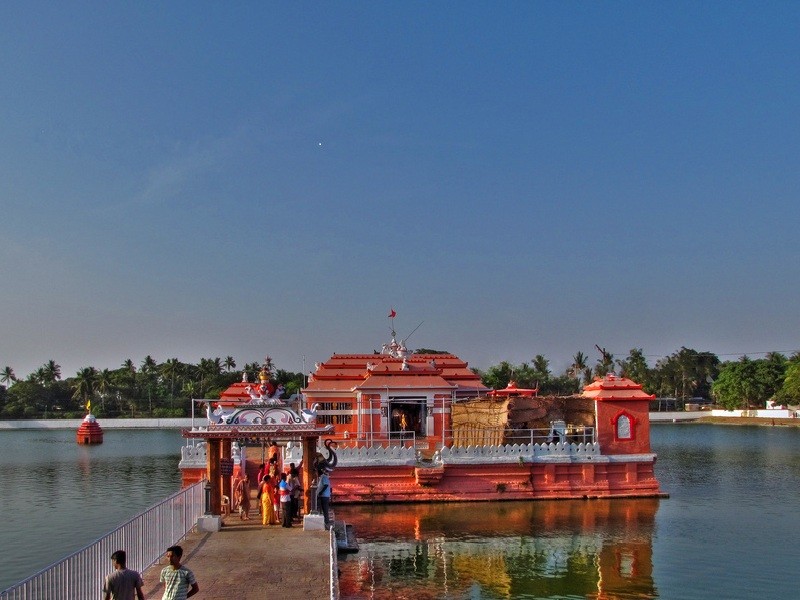
The Narendra Tank is one of the largest tanks in Odisha and is believed to have been built during the 15th century. This tank is considered holy and has a lot of small and big temples surrounding it. There is an island in the middle of the lake with a small temple called Chandana Mandapa.
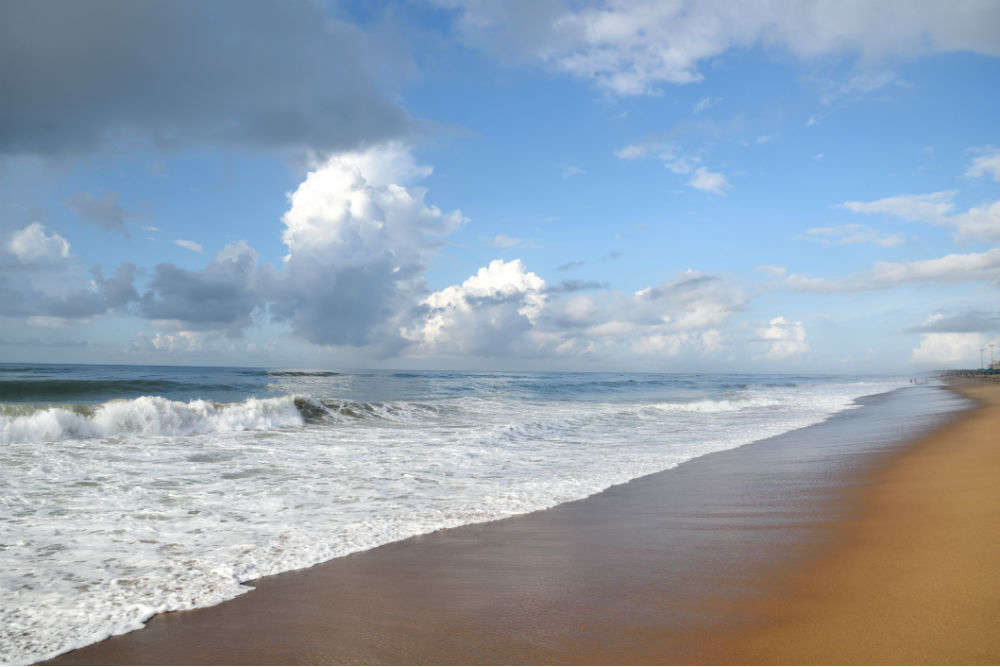
Puri Beach is one of the finest coastlines in East India, bordering the Bay of Bengal and is located at a distance of 35 km from the Konark Sun Temple. It is often flocked by devotees visiting the beach for a purification dip who come to Puri to pay their homage to Lord Jagannath. The beach is also renowned for the sand sculptures made by internationally known sand artist Sudarshan Patnaik. The sculptures are usually inspired by the art covering the temple walls or other mythological character or episodes. Adorned with fine golden sand and gushing waves, Puri Beach is quite renowned for its peaceful and calm surroundings. The stretch on the Chakratirtha side is much more tranquil and pleasant for a long stroll.
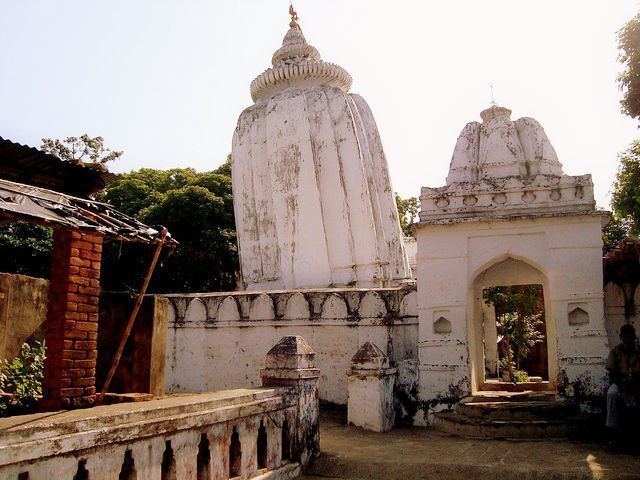
Baripada At a distance of 256 km from Bhubabeshwar and located closer to Kolkata than the state capital, Baripada is one of the cultural centres of Odisha, situated in the Mayurbhanj district. Its Rath Yatra is considered the biggest and oldest after Puri and thus Baripada is also known as Dwitiya Srikhetra or Second Puri. It is host to the world famous Car Festival (Rathyatra) which allows only women to pull the Rath of Maa Subhadra and gathers huge crowds. In this place, you can see some of the oldest temples in the state. The town also has its own dance form which is quite famous, known as the Chhau dance. Every year in mid April, there is a Chhau dance festival called Chaitra Parva festival for which people come from far and wide to witness. The Chhau dance is a dance form which is indigenous to the region and which has been inscribed in the UNESCO’s Representative List of the Intangible Cultural Heritage of Humanity list in 2010.
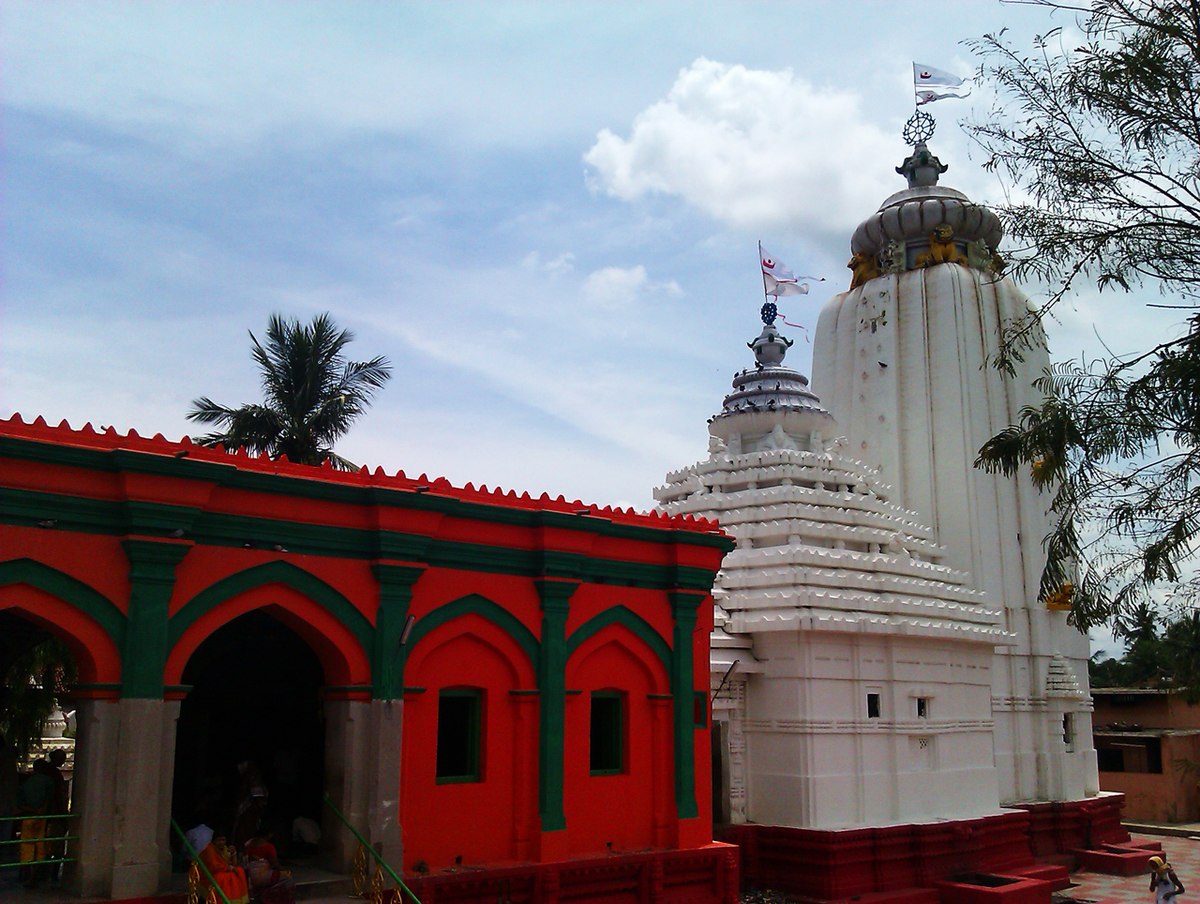
The Sri Jagannath Temple which is dedicated to the Lord of the Universe, or Lord Jagannath witnesses an inflow of a large number of pilgrims throughout the year. The temple is also known as the second Srikhetra of Orissa and boasts of being one of the oldest temples of Orissa. The Rathyatra that takes place here is also a grand affair and is the second largest after the Puri Rath Yatra. At the same time, the rituals and practices that are followed at the temple are unique and revolutionary. In the Baripada Rathyatra, women devotees are given more priority, and they are allowed to pull Maa Subhadra Ratha. This distinguishing feature separates the Sri Jagannath Temple from the remaining ones and attracts a large number of female worshippers from neighbouring areas as well. This temple which is also locally known as Bada Jagannath, is a beautiful 700-year-old structure believed to have been built by Raja Harihara Bhanja, who was also the founder of the capital city.
At the Jwala Mukhi Temple, there is a blue burning flame is kindled as Goddess Jwala, the goddess of light or fire. The dome of this temple is made of gold which was gifted by Akbar, the Mughal emperor. The temple is situated in lush green surroundings and is a good visit to not only soothe your senses but also your soul.
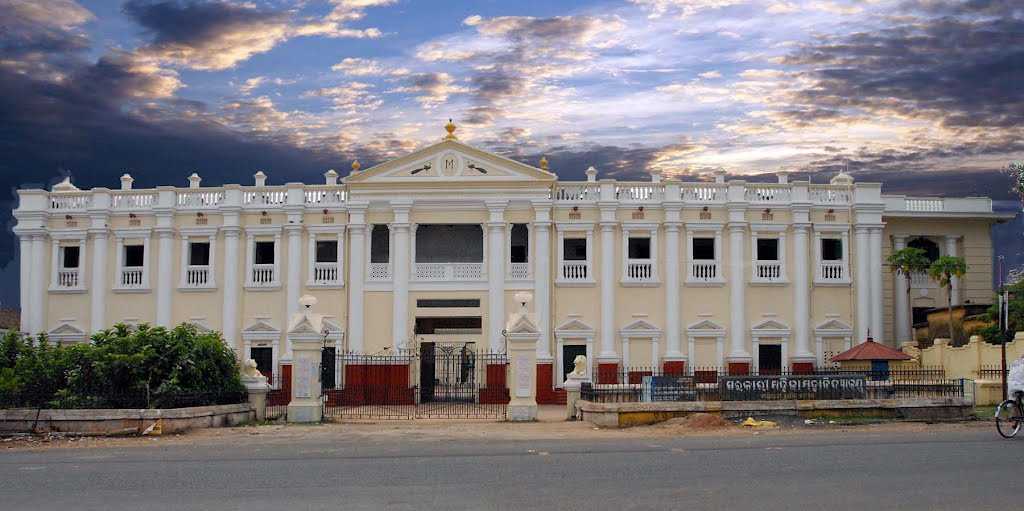
The Palace of Mayur Bhanj is a beautiful massive white building which depicts an amazing fusion of engineering and architecture and is one of the landmarks of the town. This beautiful palace belonged to the Maharajas of Mayurbhanj which was a princely state during British Raj but was sold to the Orissa government after the independence by the last ruler of Bhanj dynasty. The palace, however needs a lot of renovation and is now divided into two colleges.
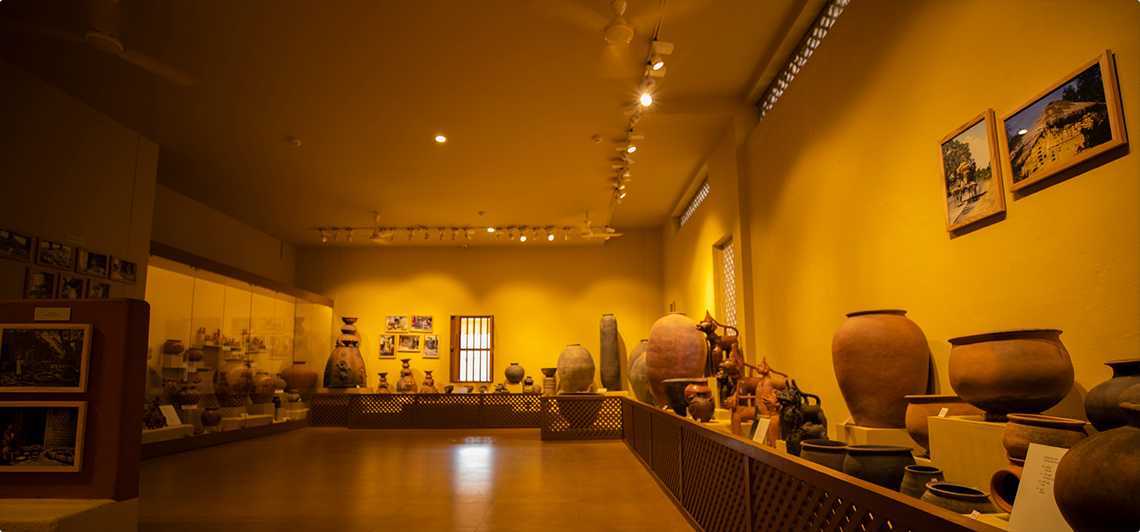
At the Baripada Museum get stunned by the some of the rarest artifacts here, like stone sculptures, historical documents, terracotta art pieces and other aesthetic commodities. The musem also has a library which has guide books about the history of the artifacts.
Sambalpur Known for its natural splendours, Sambalpur’s landscape is dotted with numerous waterfalls and plush green forests that beckon photography buffs, nature lovers, and adventure enthusiasts. Sambalpur is the gateway to the western part of Odisha and is the biggest city of this region. It abounds in rivers, hills, lush green forests and wildlife. The place also has a flourishing textile and handloom industry popular for its unique patterns and style, especially the Sambalpuri style of Saree. In addition to that, Sambalpur has a flourishing tribal life with an exquisite folk song and dance culture. Sambalpur got its name from Devi Samaleswari who is the main goddess of the region. One can also visit wildlife parks here to enjoy the beauty of nature that Sambalpur has in plenty. The area is known for the world famous Hirakud Dam which is the main attraction for the tourists here.
The Samaleswari temple is located on the banks of Mahanadi and is dedicated to Devi Samaleswari also known as Jagannath Adishakti, Mahalaxmi and Mahasawarswati. The name of the city is derived from this goddess, Samaleswari as she is the main goddess of the region. On the bank of the river Mahanadi the mother goddess Samaleswari is worshipped from ancient times as Jagatjanani, Adishakti, Mahalaxmi and Mahasaraswati. The temple is of Sandhara order. These types of temples have a square sanctum enclosed by a gallery of pillars meant for Pradakshina. The Idol of Shree Shree Samalai Devi consists of a large block of Granite rock with an inverted, trunk like projection at the bottom. A shallow cut on her ‘Baraha’ like face symbolises her mouth. Traditional Sambalpuri nose ornament of pure gold hangs down from her imaginary nose. Among the varieties of festivals observed before the goddess throughout the year, three festivals are observed prominently. The first two are navaratra puja during the months of March and April and during the months of September and October. Among these two navaratra pujas which are nine days of continuous worship of the goddess, the second one is observed with a great splendour and devotion. The third festival which is said to be the chief festival of the whole western Odisha region is ‘Nuakhai’. In this festival, the farmers offer the first produce from their lands to the goddess before using it for his personal use.
The Leaning Temple of Huma, dedicated to Lord Shiva was built in the 17th century and is the only leaning temple in the world. In this temple, only the top is leaning while the pinnacle is perpendicular to the ground. It is said that the reason for this could be either earthquake or the flood current in the river Mahanadi. There is a huge gathering specially during Shivratri festival during March.
The Ghanteswari Temple owes its name to the number of bells that hang in the temple premises. Rows of tiny bells that jingle at the slightest touch form the barricades on either side of the entrance to the temple. The steps leading to the temple are framed by bells all around. A gateway has thousands of bells hung in place by devotees. Within the inner sanctum, bells adorn every possible surface. Bunches of bells adorn the doorway to the inner sanctum sanctorum. The sheer number of bells is because devotees who have had their wishes and requests fulfilled by the Goddess, hang a bell in the premises. The bells in the temple helped navigate boats in unruly weather conditions when the shore was not clearly visible. It served the purpose of a lighthouse.
Constructed across the Mahanadi River the Hirakud Dam is the longest human-made dam in India. Stretching between the Burla and Hirakud hills, the dam is over 56km long was built in the year 1956. The dam irrigates 7,500,000 hectares of land and also generates hydroelectricity. One of the major attractions here is a drive-through road that you takes you 21km over the dam allowing one to admire nature’s bounty. Another striking feature of the dam is the wide expanse of the view that it offers from the Gandhi and Nehru Minarets that are located towards the Northern Facade of the dam. It is also a fantastic site for birdwatching as it is surrounded by abundant water and trees on all sides. Situated near the dam is a hill called Budharaja hill, which is well-known for the Budharaja Temple at its peak. Dedicated to Lord Shiva, this temple offers breathtaking views of the dam.
Cattle Island is a submerged hill in the Hirakud reservoir. The island was a developed village prior to the construction of the Hirakud Dam. Once the dam reached completion, the villagers living in the surrounding area were asked to evacuate. The villagers when relocating left a few domesticated cattle behind which were a part of the livestock they owned. The cattle over time bred and created a wild species of cattle for which humans are the alien species. Nearly all the cattle are white or cream coloured, lending an ethereal quality to the entire island. The cattle, being wild, are significantly larger and more ferocious than their domestic counterparts. They are believed to be blindly fast and protective of their land. Attempts made by man to capture these wild beasts have been in vain so far. Visit the island to see the remnants of a village recaptured and fiercely protected by nature.
Vikramkhol is a rock shelter or cave dating back to the Mesolithic period (between 3000 and 4000 BC). The caves have some form of inscriptions or art engraved into the walls of the cave. Located 81 km outside Sambalpur within a forested area, the caves are believed to be 37 m long and nearly 8 m high. These caves are not very easy to get to as paved roads have not been put down in an attempt to preserve the area.
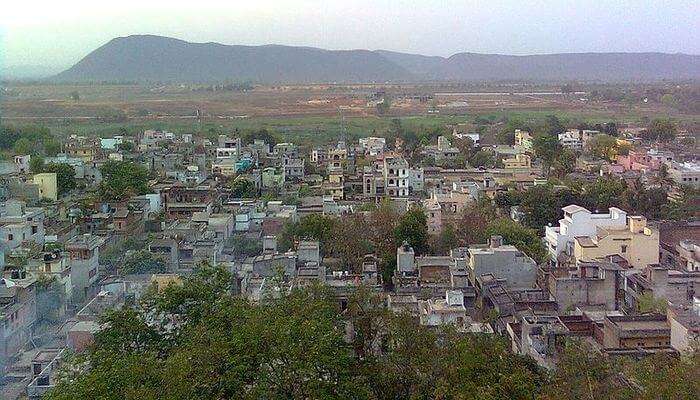
Rourkela Known as ‘Steel City of India’, Rourkela is one of the largest cities of Odisha as well as its commercial capital. The stands nestled amongst natural surroundings, endowed with hills and enriched by rivers. This city is a part of the tribal hub of the Sundargarh district. This city came into focus for having the Rourkela Steel Plant, which introduced CCTV to the continent of Asia for the first time in 1984. It also holds great religious significance due to its prominence in epics like the Ramayana and Mahabharata.
15km from NH215 near Lahunipara is this beautiful surprise of nature. Falling from steep mountain from a height of 244 meters, the Kandahar Falls it emerges like the edge of the sword and hence is named so. These falls are the highest in Odisha. It is not easy to locate Khandadhar, but once here, you can feel your long and mostly uncomfortable journey was worth it.
By the NH23 towards Rajamunda, on the banks of Brahmani about 45 km from Rourkela is the small village of Darjingis. This is a local favourite picnic spot because the river bed at this point is a beautiful golden hue which makes the river glisten like gold. Darjin has a lovely Inspection Bungalow with an amazing garden that faces the river. Another popular spot is Deoghar which is three km ahead of Darjing.
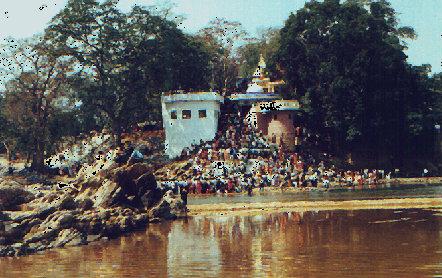
Earlier known as Parasara Munda, Vedavyas is regarded as a tirtha stal or holy place. It is situated at a place where the waters of rivers Koel, Shankha and Saraswati unite. Because of this, the place is also known as Tridhara Sangaam. Situated at a distance of about 9 km from the city of Rourkela, this place holds historic significance. The Gurukula and Vedic Ashram system of education is a well-known feature of this place. Legend says that the great saint, Maharishi Vyas had scripted the greatest Hindu epic, the Mahabharata, at this very spot. Here one can enjoy a tour of the Vyas Caves which can be toured using boats.
27km away from Rourkela and 25 km from Vedavyas, Ghogar is a gorge on the river Ib. There is also a naturally formed Shivalinga, made of black granite, this Shiva linga is extensively preached by the followers. The temple in this gorge has a history which can be traced back at least five centuries. The temple was constructed by the king of Sundargarh Raghunath Sekhar Deo. The uniqueness of the temple is that till date it is the priests appointed by the people of Bhuyan community that perform worship here.
Another week and with Europe now the epicentre of the Coronavirus Covid-19, deaths in Italy have overtaken those in China which is scary! Many countries have closed borders and so people are cloistered inside cities with the dying. I have heard because there is so much stress on the healthcare system in Italy, healthcare workers have to now choose whom to treat and whom to leave to die, which is quite frankly very scary to hear and see.
Mid morning yesterday, we received news that Singapore recorded it’s first fatalities to Covid-19. The two fatalities were people above the age of 60 and had been in Intensive Care for a while now. The news has saddened quite a few of us, but I guess this was something inevitable, given how it has been worldwide!
One of the busiest road crossing or maybe the most busy road border crossing between Singapore and the southern Malaysian state of Johor was deserted after a surprise announcement by the Malaysian Prime Minister to close all borders. Residents of Malaysia and Singapore were given roughly 26 hours to get out or come in before borders closed and this led to a mad scramble, especially for the 350,000 odd people who cross the causeway daily, to make arrangements to either work from home, take paid or unpaid leave or make arrangements to stay in Singapore. Luckily employers and the Singapore government came through and made arrangements for most of the workers to be housed in hotels and dormetories here. Here’s a picture of how the causeway looked on the first day of the border closure as opposed to what it usually looks like at the same time of the day.
Source Dolphins playing in the clear waters of the Venice canals
On to some good news from the virus. Because most people are at home and there are hardly to no vehicles on the roads, pollution levels across the world has dropped. Satellite observations have shown that the temporary measures have also driven significant decreases in harmful emissions which is good for the earth. In Venice, the often murky canals recently began to get clearer, with fish visible in the water below. Some people even reported seeing dolphins and birds which previously feared the canals. So there’s some good news
Source Greenhouse emissions over China taken by Nasa in January and February
So there you go, some silver lining in these dire and uncertian times. Stay safe people, practice social distancing, wash and santise your hands and other surfaces regularly and most importantly – Stay Healthy!












 Memories and Such