Our next state is the state of Selangor which is also known by its Arabic honorific Darul Ehsan, or the Abode of Sincerity. Located on the west coast of Peninsular Malaysia, Selangor is bordered by Perak to the north, Pahang to the east, Negeri Sembilan to the south, and the Strait of Malacca to the west. Selangor surrounds the federal territories of Kuala Lumpur and Putrajaya, both of which were previously part of it. The state has diverse tropical rainforests and an equatorial climate and the mountain ranges in the state belong to the Titiwangsa Mountains, part of the Tenasserim Hills that cover southern Myanmar, southern Thailand and Peninsular Malaysia, with Mount Semangkok as the highest point in the state.
The state capital is Shah Alam, and its royal capital is Klang, while Kajang is the largest city. Petaling Jaya and Subang Jaya received city status in 2006 and 2019, respectively. Selangor is one of four Malaysian states that contain more than one city with official city status; the others are Sarawak, Johor, and Penang. Selangor has the largest economy in Malaysia in terms of gross domestic product or GDP, with RM 239.968 billion, equivalent to roughly $55.5 billion in 2015, comprising 22.60% of the country’s GDP. Malaysia’s most developed state, Selangor has good infrastructure, such as highways and transport, and has the largest population. It also has a high standard of living and the lowest poverty rate in the country.
Selangor is located on the west of Peninsular Malaysia, overlooking the Straits of Malacca. The state is level on the west and hilly to the east. The hill and mountain, surrounding the western edge of the state effectively form a valley and a basin area for the Klang River. This valley is called Klang Valley and this is where most of the population is centred. It is located at the heart of Peninsular Malaysia on the west coast and surrounds the Federal Territory of Kuala Lumpur and Putrajaya. Malaysia’s capital, Kuala Lumpur is located in the heart of Selangor and was once part of Selangor territory before it was ceded to the federal government to form a Federal Territory.
The origin of the name Selangor is uncertain. A common suggestion is that the name refers to the Malay word langau, which is a large fly or blowfly that is found in the marshes along the Selangor River in the state’s northwest. According to local lore, a warrior who escaped from Malacca after the Portuguese conquest took a break from his journey north and rested under a tree here. However, he was disturbed by a persistent fly, whereupon he decided to explore the area. When he found the place to his liking and chose to settle there, he named the place “satu (se) langau” meaning “a large blowfly”. Another theory is that the name may have originated from a kind of tree found in Kuala Selangor and along the Selangor River named Mentangau. And yet another theory claims the state’s name is derived from the term Salang Ur where ur means town or village in Tamil, meaning the village of the Salang people. It has also been proposed that the name is derived from a combination of salang which means stabbing, and jemur, which means to dry in the sun, indicating that it was once a place where traitors were stabbed and then left to roast in the sun.
The most important settlement in the area in the ancient period may have been Klang. Ancient artifacts, including Bronze Age axes and bronze bells dating from the 2nd century, and iron tools called tulang mawas, or ape bones, have been found in or near Klang. The Mao Kun map, dating to the Ming dynasty and used by Admiral Zheng He during his expeditions between 1405 and 1433, refers to places in Selangor such as the Klang River estuary and perhaps a hilly area. The Malay Annals indicate that the Selangor area was under the control of the Sultanate of Malacca in the 15th century; however, Selangor at that time was not a unified domain—separate river states such as Klang and Jeram existed in the region.
After the fall of Malacca to the Portuguese in 1511, the area came under the control of the Johor Sultanate. In the 17th century, Johor was involved in a war against Jambi, and the Sultan of Johor engaged the help of Bugis mercenaries from Sulawesi to fight against Jambi. After Johor won in 1679, the Bugis decided to stay and started to gain power in the region. Many Bugis began to migrate and settled along the coast of Selangor. Some Minangkabaus may have also settled in Selangor by the 17th century, perhaps earlier. The Bugis and the Minangkabaus from Sumatra struggled for control of Johor and to establish a power base, the Bugis led by Raja Salehuddin founded the present hereditary Selangor Sultanate with its capital at Kuala Selangor in 1766. Selangor is unique as the only state on the Malay Peninsula that was founded by the Bugis.
In the 19th century, Selangor’s economy boomed due to the exploitation of its tin reserves. The Selangor Civil War was fought between 1867 and 1874, which was also partly a struggle for control of the revenues from tin which had attracted a large influx of Chinese migrant labourers, and Chinese clans allied with Selangor chiefs also joined the civil war. The conflicts between Malay and Chinese factions in Perak and Selangor, as well as concerns over piracy that affected coastal trade, led to increasing British involvement in the affairs of the Malay states.
In 1874, Sultan Abdul Samad of Selangor accepted a British Resident in a system that allowed the British to govern while the Sultan remained the apparent ruler. Klang was the capital of the British colonial administration for Selangor from 1875 until 1880 when it was moved to Kuala Lumpur. Under the stability imposed by the British, Selangor again prospered. In 1896, largely through the coordination of Resident Frank Swettenham, Selangor united with Negeri Sembilan, Perak and Pahang to form the Federated Malay States, with Kuala Lumpur as its capital.
The Federated Malay States evolved into the Federation of Malaya in 1948, which became independent in 1957. The federation became known as Malaysia in 1963 when its existing states federated with the other British colonies of Sarawak, North Borneo and Singapore. The city of Kuala Lumpur functioned as the national capital of Malaysia and as the state capital of Selangor. In 1974, Selangor relinquished Kuala Lumpur to the federal government. The Sultan of Selangor commemorated the city’s transfer by building an archway on the borders of the new Federal Territory and Selangor; known as the Kota Darul Ehsan that straddles a section of the Federal Highway between Bangsar and Petaling Jaya. The state capital was moved to Shah Alam after the cession. Putrajaya, a new city designed to be the new administrative capital of Malaysia, was built by the federal government in Selangor; Sultan Salahuddin was asked again to cede land to the federal government. Putrajaya became a federal territory in 2001.
Selangor is Malaysia’s most populous state; it has the nation’s biggest conurbation, the Klang Valley. Selangor’s geographical position in the centre of Peninsular Malaysia contributed to the state’s rapid development as Malaysia’s transportation and industrial hub, creating jobs and attracting migrants from other states and Other Asian countries.
The traditional culture of Selangor’s Malay majority is also influenced by those of Bugis, Minangkabau, Mandailing, Javanese, and Banjarese ancestry; most of whom are Muslims. Javanese ancestry is dominant in west coast districts while Minangkabau descent is dominant in Gombak and Hulu Selangor. The 3,000 Mah Meri people, part of the Orang Asli—the indigenous peoples of the Peninsula—can be found on Carey Island. The economy of Selangor is a progressive market economy whose core sectors are commerce and agriculture. It is the richest state in Malaysia in terms of gross domestic product (GDP) per capita (PPP).
Shah Alam
Selangor’s capital Shah Alam is situated within the Petaling District and a small portion of the neighbouring Klang District. Shah Alam replaced Kuala Lumpur as the capital city of the state in 1978 after Kuala Lumpur was incorporated into a Federal Territory in 1974. Shah Alam was the first planned city in Malaysia after independence in 1957.
Shah Alam was once known as Sungai Renggam and was noted for its rubber and oil palm estates. Later, the same area was identified as Batu Tiga before Malaysian independence and has been a centre of rubber and palm oil trade for centuries. The Sungai Renggam Plantation was earmarked for the development of a township by the Selangor government in 1963, and under the recommendations of Vlado Antolic, a town planning advisor from the United Nations, chose the present site strategically located between Kuala Lumpur and Port Klang.
Its current name was chosen by the then-state Sultan of Selangor, Sultan Salahuddin Abdul Aziz Shah, after his late father Sultan Alam Shah. Many other monuments, buildings and even a street are named after the late Sultan. Shah Alam was opened in 1963 to make it the new administrative centre of Selangor, replacing Kuala Lumpur which was made a Federal Territory on 1 February 1974. With the consent of the Sultan, Shah Alam was proclaimed the capital of Selangor on 7 December 1978 with an initial area of 41.68 sq km, and administrated by a municipal council. Shah Alam was enlarged several times between 1983 and 1997, with the last annexation on 1 January 1997. Shah Alam was granted city status on 10 October 2000.
The Taman Botani Negara Shah Alam or the National Botanic Garden is a glorious nature park, home to plenty of vegetation, gardens, lakes, a petting zoo, a seasonal temperature house, and a public pool. The garden hosts activities from lightweight to extreme adventurous sports like hiking, horse riding, rock climbing or fox flying among other things. One is free to walk or rent a bike to explore the gardens and stop at the watchtowers to bask in the scenic views or relax and take a break at the gazebo. The garden is closed on Mondays and other days, it is open between 9 am and 5 pm
The 43-hectare Shah Alam Lake Garden is a favourite retreat of residents, with its beautiful landscape and scenic pathways. Some sections of the lake are elevated so visitors can walk over and watch the aquatic life. One may even catch a glimpse of an occasional peacock, goose, or stork. Some other popular things to do at the park include taking a splash at the waterpark, Wet World, indulging in Malaysian cuisine at the floating seafood restaurant, or going kayaking. The lake garden is open from 11 am to 7 pm on Mondays, Tuesdays, Thursdays and Fridays and between 10 am to 7 pm on Saturdays and Sundays. It is closed on Wednesdays. Entry charges are between MYR 8 to 10 per person.
Overlooking the Garden of Islamic Arts is the magnificent Sultan Salahuddin Abdul Aziz Shah Mosque, the state mosque of Selangor. It is the second-largest mosque in Southeast Asia and the largest in Malaysia. Named after Selangor’s late Sultan who commissioned it in 1982, the mosque is also known as the Blue Mosque. Four 142-meter-high minarets standing tall at each of its corners are the world’s tallest group of minarets. The mosque can accommodate around 24,000 devotees at a time. Its distinguishing feature is its large blue and silver dome, which measures 51.2 m in diameter and reaches 106.7 m above ground level. The blue stained glass of the mosque fills the ornate building with glimmering blue light. The nine galleries display an artistic blend of Islamic arts such as fine decorative calligraphy, painting and sculptures. Short clothes are not allowed inside the mosque. Blue-coloured robes are available at the mosque to wear over your clothing. The mosque is open only to Muslims on Fridays. On Mondays to Thursdays, it is open from 9 am to noon and then again between 2 to 4 pm. On Saturdays, Sundays and Public Holidays, it is open from 9 am to noon, then between 2 to 4 pm and again between 5 to 6:30 pm.
The Blue Mosque overlooks the Selangor Arts Garden Complex, a landscaped park inspired by the Quranic Garden of Paradise. This 14-hectare spiritual sanctuary houses nine galleries, including three permanent galleries exhibiting a rich array of Islamic arts such as calligraphy, sculptures, paintings and architecture. It also houses a private educational institute for higher learning of fine arts. The site is occasionally used for traditional Islamic performances and is closed on Mondays and other days, it is open from 9:30 am to 5:30 pm.
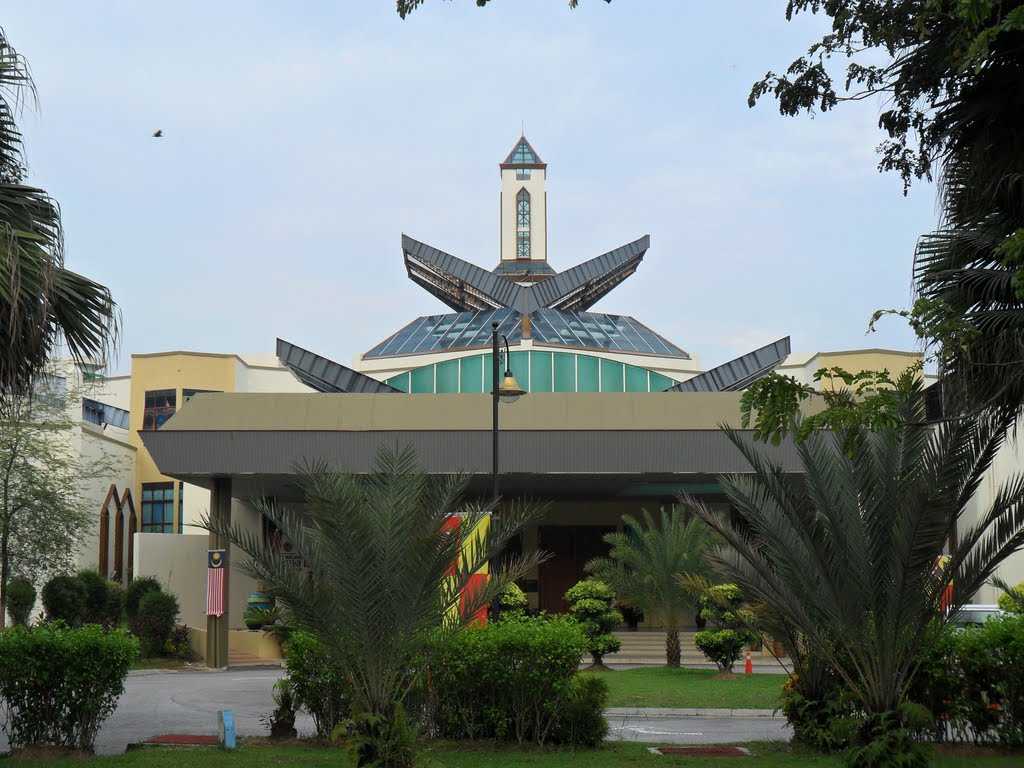
The Selangor State Museum or the Sultan Alam Shah Museum displays many treasures and artefacts related to the history of Selangor. Adjacent to the museum is the former Selangor State Library or Perpustakaan Raja Tun Uda. The Selangor Islamic Arts Complex or Kompleks Kesenian Islam Selangor or Riyadh Fannil Islam is situated nearby, housing many Islamic masterpieces and creativities. An Islamic Art College is located within the Complex. At the banks of the Lake Gardens, an art gallery and performance centre called Laman Budaya is located, where exhibitions and shows regularly take place.
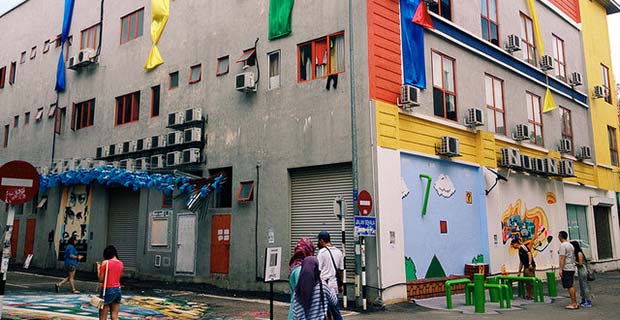
Laman Seni 7 is an undiscovered gem in Shah Alam. A section of wide and narrow alleyways in the city, it features some of Malaysia’s prominent street artist creations on the concrete and building walls. The art gallery on display in Laman Seni 7 spans two blocks and is fashioned like a U. Here, each mural tells a tale, accompanied by a plaque giving a brief insight about the art and the artist.
The Setia Alam Community Trail is a 10.3 km loop trail considered a moderately challenging hike but is fairly suitable for hikers of all types of fitness levels. The locals have set up signage, so it’s highly unlikely to get lost, but you can download the Komoot App to navigate. There are two routes: Route A which is less steep and has a nice view of the Peak Garden. Route B is less crowded and has a beautiful lake on its way. It will take between 4.5 to 5 hours to complete the loop.
Subang Jaya
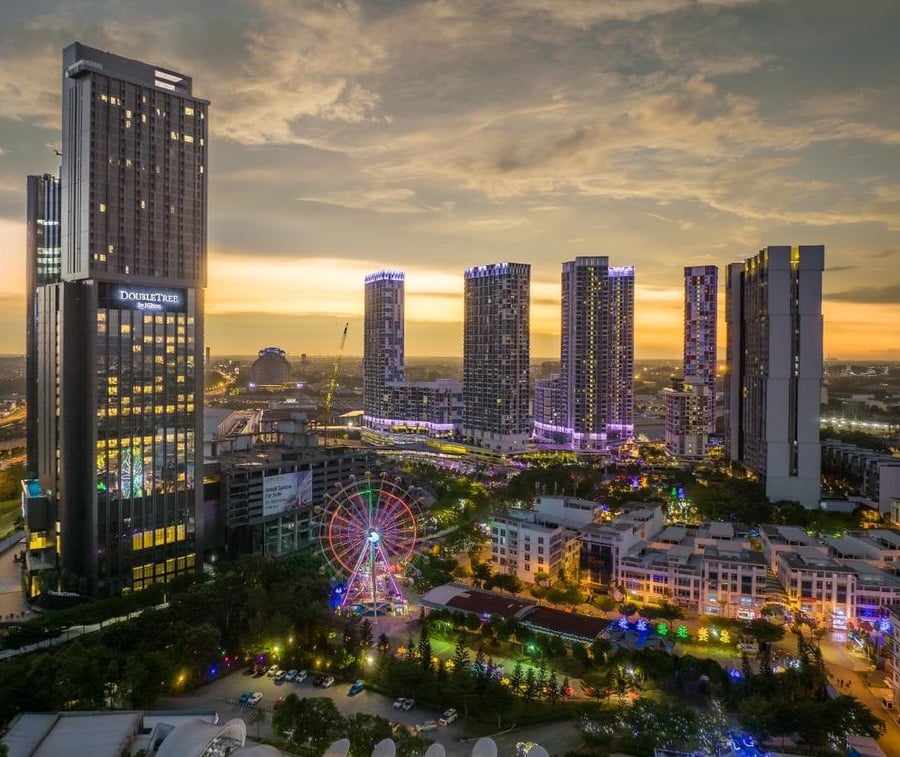
The third district in Petaling, Subang Jaya is the sixth largest city in Malaysia by population. Before 1974, what is today Subang Jaya was part of Klang District. Development on Subang Jaya began on 21 February 1976 by Sime UEP Properties Berhad, the property development arm of the Malaysian conglomerate Sime Darby. The site was formerly a rubber plantation called Seafield Estate. In 1997, Subang Jaya received the status of a municipality. In Dec 2019, it was officially announced that Subang Jaya’s municipality would be upgraded to a city council after a long 5-year wait since the application in 2014. Located 20 km from Kuala Lumpur, it is well-known for education and has many universities and colleges. It is most known for Sunway Lagoon Resort and Sunway Pyramid Mall. The city is very well connected by trains, buses and taxis and travelling is not an issue. Subang Jaya has a number-precinct system, so it is advised that tourists go through the system once to better understand the city while travelling and don’t face any issues while commuting.
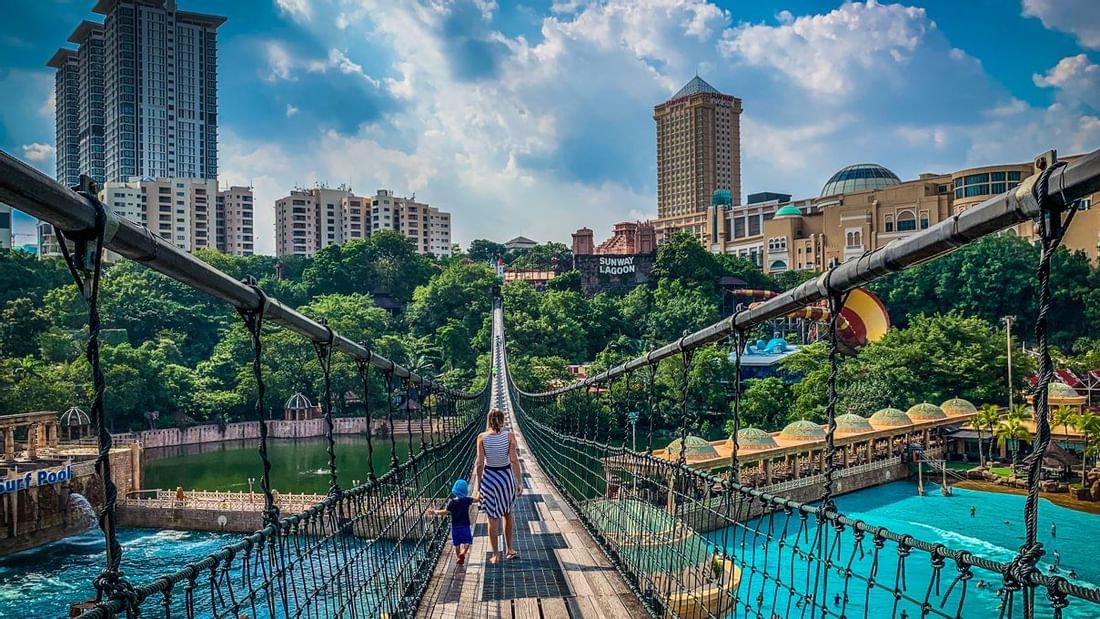
Sunway Lagoon is a famous theme park located in Sunway City. It is popular for the Water Park, Scream Park, Wildlife Park, Amusement Park and Asia’s first-ever Nickelodeon Theme Park located on its premises. The park began operations in 1992 and was officially opened on 29 April 1993. Since its opening, the theme park has added Malaysia’s first surf simulator, the FlowRider in 2010; Malaysia’s first 5D Waterplexx in 2012 and a very large water ride, Vuvuzela, in 2013. The 88-acre park is built 150 feet below ground level on a tin mining wasteland and currently has 90 attractions spread across six parks. It has also hosted many international lifestyle, music and sporting events. The park is open from 10 am to 6 pm daily and has an entry fee of RM 202 for an adult, RM 170 for a child or a senior citizen.
Darul Ehsan Mosque is the first mosque of Subang Jaya. Adorned with beautiful interiors, marble and carpet flooring, it was built in the 1980s and was inaugurated by Almarhum Sultan Salahuddin Abdul Aziz Shah of Selangor during the silver jubilee celebrations of his reign. It is open 24 hours during the week, between 9 am to 1 pm on Saturdays and between 5 am and 9:30 pm on Sundays. Situated in the UEP Industrial Park, the Church of St Thomas More is a Roman Catholic parish. The church is open for mass at 6:15 am on Mondays to Fridays and at 5 pm on Saturdays for Novena and at 6 pm for sunset mass. On Sunday it is open for mass at 6:45 am, 8:30 am and 11:30 am. Gurdwara Sahib Subang was established in 2018 and houses a prayer hall, a langar hall, a community kitchen as well a conference rooms. It is open between 5 am and 8 pm daily.